

Quick Answer: Who Are Fu, Lu and Shou?
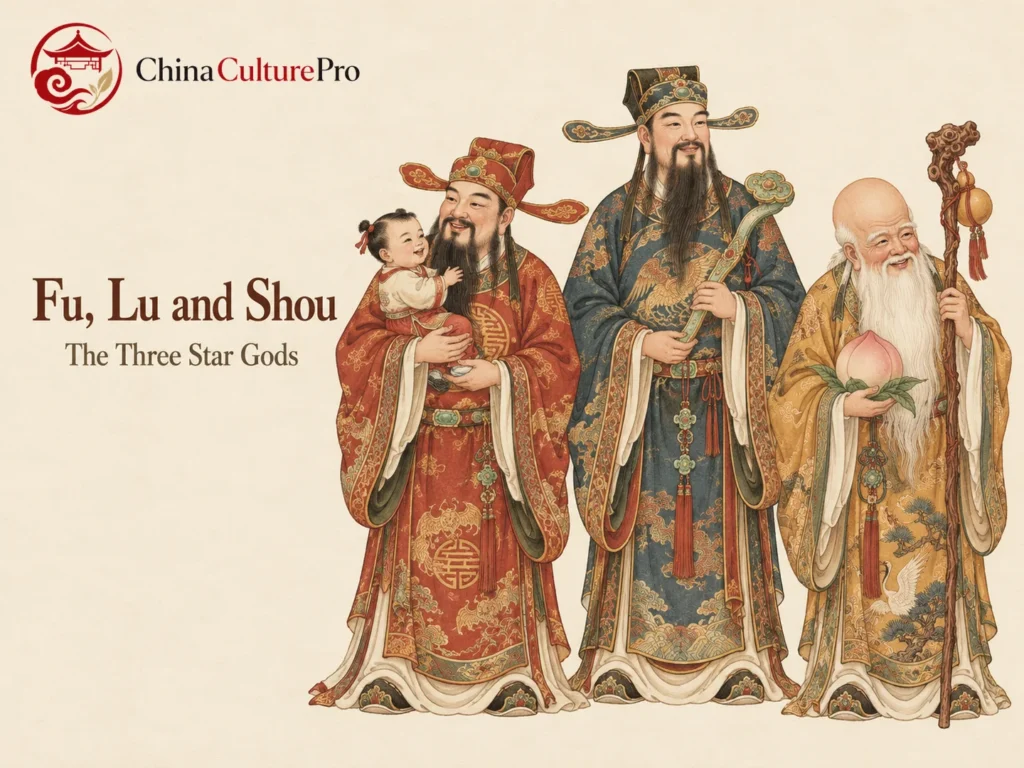
Sanxing(三星,Sānxīng), the Three Star Gods, are Fu(福,fú), Lu(禄,lù)and Shou(寿,shòu). Together they personify three wishes: good fortune, official advancement and long life. They appear in Chinese popular religious and auspicious imagery across many materials. [1][5]
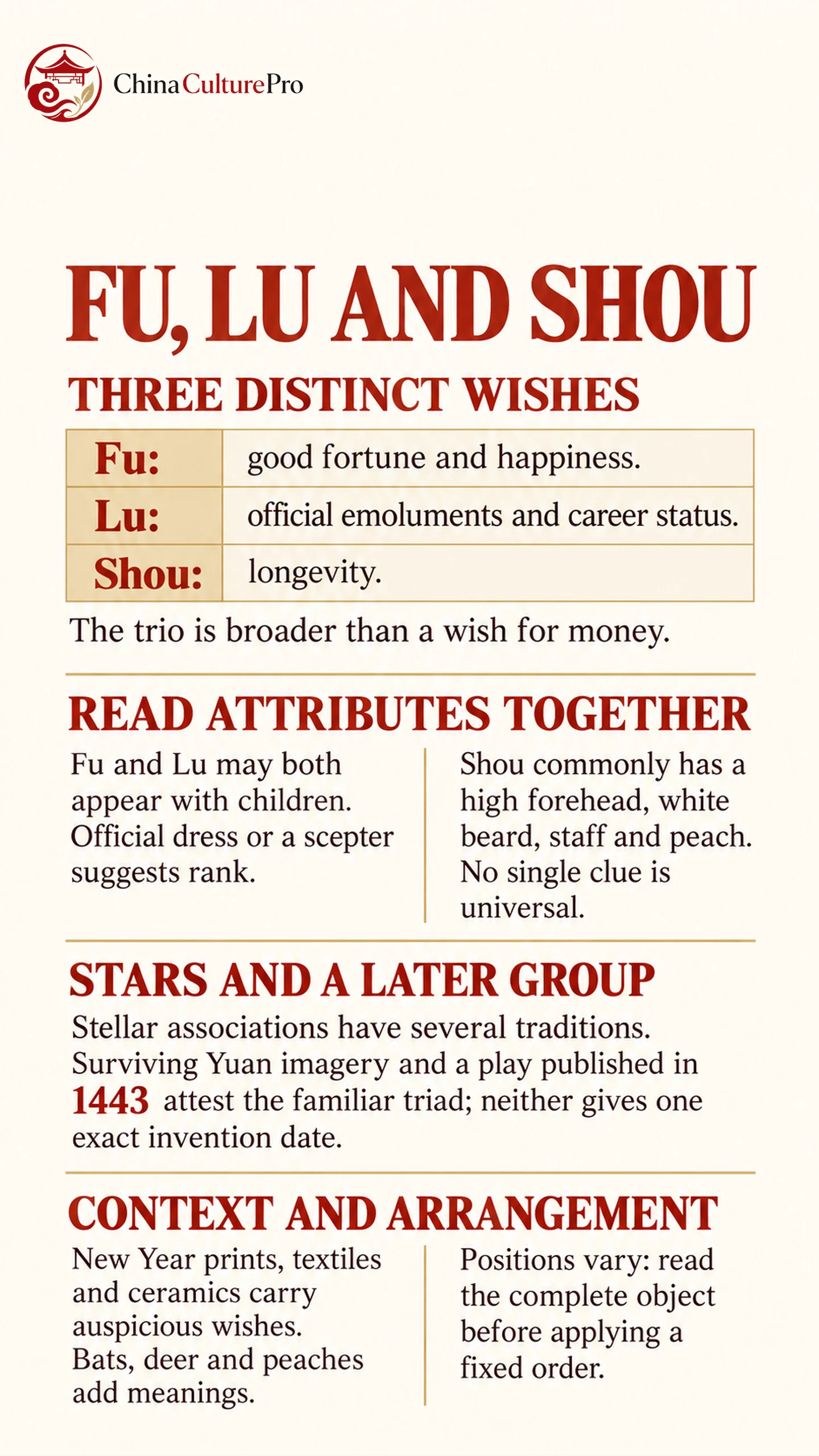
- Fu: Happiness and good fortune, including hopes for a flourishing family. [2]
- Lu: Emoluments, official preferment and the prosperity associated with career status. [5]
- Shou: Longevity, often embodied as a smiling elderly figure with an enlarged forehead. [2]
- Identification: Dress, held objects, inscriptions and companions work together; one attribute may vary. [2][3][6]
They form a symbolic and devotional group, not three securely documented historical brothers. Their images express wishes rather than promises of wealth, promotion or extended life.
An old man with a prominent forehead, an official holding a scepter and a figure accompanied by a child may suggest the Three Star Gods. Yet their positions and accessories change. Read the three wishes first, then use the details of the particular image to identify the figures.
What Fu, Lu and Shou Each Mean
Fuxing(福星,Fúxīng), the Star of Good Fortune, represents a broad field of happiness and blessing. Family continuity can be part of that meaning, but translating Fu only as money loses much of its scope. [2][3]
Luxing(禄星,Lùxīng), the Star of Emoluments, refers more specifically to the income and standing attached to official service. English labels such as “prosperity” or “wealth” are common, but rank, appointment and career success explain why this figure so often looks like an official. [1][5]
Shouxing(寿星,Shòuxīng), the Star of Longevity, embodies the wish for a long life. His elderly appearance makes that wish visible. The familiar trio therefore joins personal happiness, social advancement and length of life, each making a distinct contribution to the combined blessing. [3][5]
This helps distinguish the group from Caishen, the wealth-god traditions. Lu’s salary and status associations overlap with prosperity, but the triad’s complete message includes happiness and longevity.
How to Identify the Three Star Gods
Look for a combination of features. Shou is often the easiest to recognize; Fu and Lu can be harder to separate when both wear elaborate robes or accompany children. A ruyi(如意,rúyì), the curved ceremonial scepter, can provide another clue within a specific arrangement. [2][6]
A Wanli-period porcelain plate identifies Fu in green, Lu in red holding a ruyi, and Shou in yellow with a high forehead and long beard. These colors describe that plate, not mandatory costume colors for every work. [6]
| Figure | Common clues and their limits |
|---|---|
| Fu / Good Fortune | May accompany or hold a child; use the complete group rather than the child alone for identification. [2][3] |
| Lu / Emoluments | Official cap, formal robe or scepter suggest rank; some prints associate him with a baby. [2][3] |
| Shou / Longevity | Prominent forehead, white beard, staff and peach commonly identify the elderly longevity figure. [2] |
Stars, Divine Identities and the Formation of the Triad
The stellar background is older and more varied than one standardized set of portraits. Fu can be linked with Jupiter, while Lu is associated in one tradition with a star of the Wenchang group. Shou is connected with the southern Old Man star. These associations belong to Chinese stellar and religious traditions; the three figures are not simply one modern constellation. [4]
Links with Wenchang Dijun help explain the shared language of stars, appointment and official achievement. They do not make every learning deity identical with Lu. [4]
Evidence for the familiar group should be distinguished from the antiquity of star worship. Curatorial research identifies a Yuan-period painting as the earliest known image of the triad and a play published in 1443 as early literary evidence. These are surviving attestations, not proof of a single moment of invention. [1]
Classification also depends on context. The figures appear in Daoist-influenced imagery, yet their widespread use belongs to popular religion and auspicious culture. Daoist influence and popular devotional use can coexist in the same image. [1][3]
New Year Pictures, Birthday Gifts and Decorative Objects
New Year prints place the Three Stars among images expressing hopes for the household’s coming year. One nineteenth- or twentieth-century woodblock print combines three large figures with children, showing how the group could bring several family aspirations into a single composition. [2][3]
The imagery also appears on furnishings and celebratory objects. A late-seventeenth- or early-eighteenth-century embroidered altar hanging gives the Three Stars its upper register, with five boy attendants and offerings below. Its materials and arrangement show how the subject could occupy an elaborate ceremonial setting. [5]
A porcelain ewer made during the Kangxi period takes the shape of the written Fu character. Its two sides depict the fortune and longevity gods; Lu is absent. An object can invoke the wider auspicious theme without showing all three human figures. [1]
Longevity imagery naturally connects with birthday wishes. Peaches and the elderly Shou also intersect with narratives associated with Xi Wangmu. The peaches belong to narratives of immortality and auspicious wishes. [2]
Reading Auspicious Animals, Characters and Group Arrangements
A bat can stand for good fortune through a sound association with Fu, while a deer can suggest Lu. Cranes and peaches carry longevity associations. These motifs can reinforce a figure’s meaning or convey a wish without any human deity appearing. [2][7]
Characters add another layer. A paper offering with the three figures includes written wishes and forms of the Shou character. Reading the lettering alongside the figures reveals a broader field of blessings, rather than a portrait with only one possible meaning. [7]
Position is equally variable. The embroidered altar hanging places Shou in the center; the Wanli plate arranges its figures differently. Identify attributes and labels before applying a supposed fixed left-to-right rule. When comparing descriptions, also check whether “left” means the viewer’s left or the figure’s own left. [5][6]
The Eight Immortals are another familiar group in auspicious art, with their own names and attributes. Within religion in China, several such groups can share a celebratory setting without merging into one roster.
FAQs About Fu, Lu and Shou
Are Fu, Lu and Shou the Same as Caishen?
No. Lu includes prosperity through office and career, but the Three Stars collectively express good fortune, status and longevity. Their group identity should not be reduced to wealth alone. [1][5]
Which Star God Holds a Baby?
The association varies. Fu may hold a child, while some prints connect Lu with a baby. Look for accompanying dress, inscriptions and the identities of the other figures. [2][3]
Must the Three Star Gods Stand in One Fixed Order?
No universal order covers all objects. A Qing embroidered hanging places Shou centrally, illustrating why labels and attributes are more reliable than a fixed arrangement. [5]
Are the Three Star Gods Daoist Deities?
They appear in Daoist-influenced art and popular religion. The setting determines whether a particular image functions as devotion, decoration or both. [1][3]
Sources
[1] Los Angeles County Museum of Art. Lidded ewer in the form of fu, 30.2.88a-b: curatorial notes
[2] Ashmolean Museum. Chinese New Year Prints: the Star Gods, 2018
[3] University of Michigan Museum of Art. Fu Lu Shou, woodblock print, 2015/2.167
[4] Hong Kong Space Museum. Chinese Starlore: Wenchang and the fortune and longevity stars
[5] The Metropolitan Museum of Art. Hanging with the Three Stars, 1977.263
[6] National Palace Museum, Taipei. Plate with three gods and floral decoration in wucai painted enamels, Wanli period
[7] Horniman Museum and Gardens. Paper offering depicting Fu, Lu and Shou, 2008.148.21