
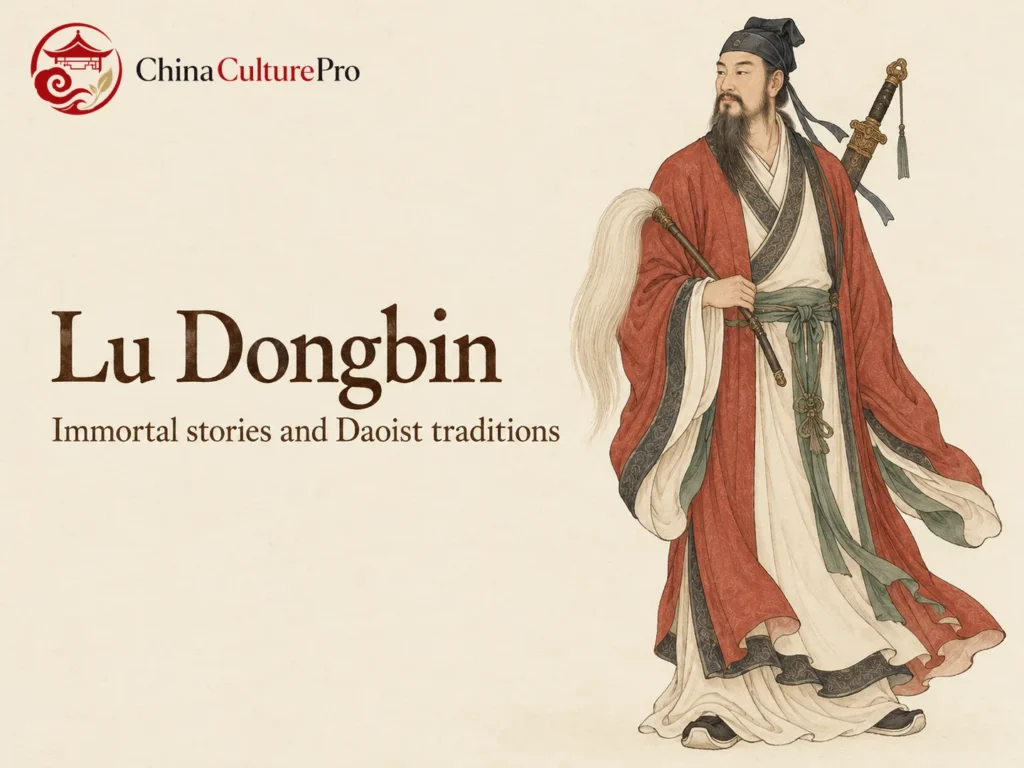

Quick Answer: Who Is Lu Dongbin?
Lü Dongbin(吕洞宾,Lǚ Dòngbīn), often written Lu Dongbin in English, is a major Daoist immortal and one of the Eight Immortals. He appears as a scholar, swordsman, spiritual teacher and recipient of temple devotion. Stories place him in the Tang period, but his detailed historical biography remains uncertain. [1][7]
- Images: A sword is a familiar attribute, although some portraits emphasize scholarly refinement. [3]
- Stories: The Yellow Millet Dream(黄粱梦,Huángliáng Mèng)presents worldly success as fleeting. [2]
- Religious role: Quanzhen(全真,Quánzhēn)Daoism honors him among its ancestral masters. [4][7]
- Devotion: Temples dedicated to him sustain traditions beyond the collective Eight Immortals. [6][7]
A dated painting, a temple tradition and a miraculous biography provide different kinds of evidence. They should not be combined into a fully verified account of one Tang man’s life.
A robed immortal with a sword may be Lü Dongbin, but he is more than an accessory in an eight-person group. His dream stories, scholar portraits and temple identities reveal several ways Chinese communities have imagined spiritual transformation and the limits of worldly ambition.
Names, Titles and the Limits of His Historical Biography
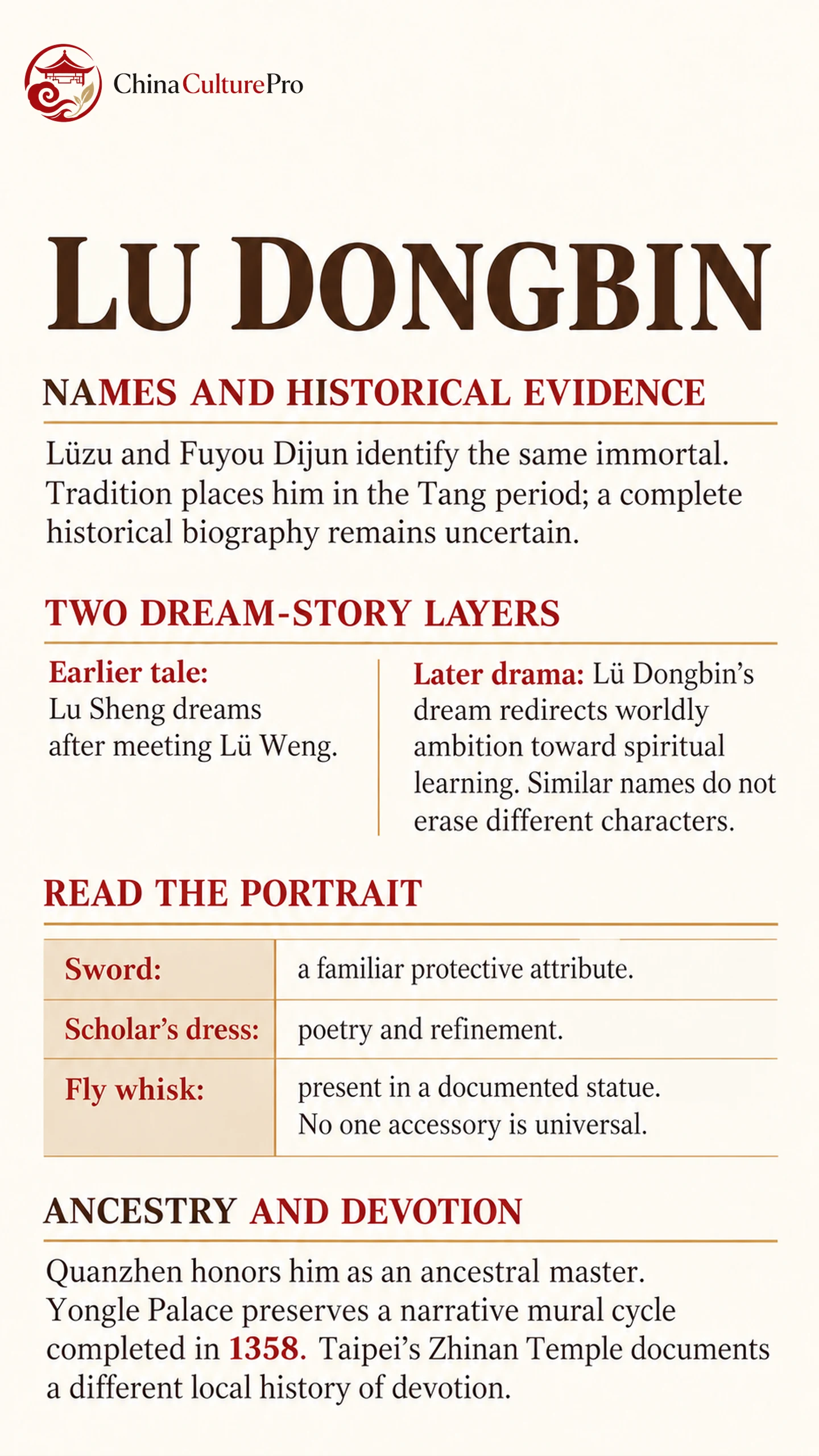
Lüzu(吕祖,Lǚzǔ), meaning Patriarch Lü, is a common reverential name. Fuyou Dijun(孚佑帝君,Fúyòu Dìjūn)and titles including Chunyang(纯阳,Chúnyáng)also refer to him. These names help connect a temple statue with the immortal encountered in a painting or story. [4][6]
Tradition places him in the Tang dynasty and supplies names, family origins, examination failures and encounters with immortals. Those details belong to biographies that accumulated around the cult. His historical existence is uncertain, while evidence indicates that devotion to him had developed by the late tenth century. [1]
The distinction is useful: uncertainty about an early individual does not erase the documented history of worship. Yuan and Ming paintings, temple murals and later sculptures establish how people represented and honored him, even when they cannot verify every event in a miraculous life. [1][3][5]
The Yellow Millet Dream and Other Immortal Stories
The Yellow Millet Dream turns a whole career into an experience shorter than the preparation of a meal. In versions centered on Lü Dongbin, worldly achievement gives way to disgrace and loss; awakening reveals that the grain is still cooking. The encounter redirects him toward spiritual learning, with Zhongli Quan(钟离权,Zhōnglí Quán)as his teacher in a familiar later telling. [2][4]
The narrative has more than one textual layer. The earlier Tang tale Zhenzhong Ji(枕中记,Zhěnzhōng Jì)features Lu Sheng(盧生,Lú Shēng), a dissatisfied traveler, and Lü Weng(吕翁,Lǚ Wēng), the Daoist elder who lends him a pillow. A Yuan dramatic version develops the theme around Lü Dongbin. Similar names and a shared dream motif should not erase the different characters. [2]
Other accounts describe tests of his resolve before attainment. These episodes present spiritual perseverance within the immortal’s biography. They should be read alongside, rather than substituted for, the different scholarly identity emphasized in some portraits. [3][4]
Recognizing Lü Dongbin in Paintings and Statues
Many portraits show the sword associated with defending the righteous. Yet a Ming painting emphasizes Lü’s identity as a cultivated scholar and poet. Recognizing the figure requires attention to dress, bearing, setting and any inscription, not simply the presence of a blade. [3]
A Qing-period wooden statue identified as Fuyou Dijun presents a seated, middle-aged Daoist in a long robe holding a fly whisk. Its worn surface and damaged whisk also remind us that a missing accessory need not mean an object was originally intended as a different deity. [4]
| Visual clue | Interpretive value |
|---|---|
| Sword | A familiar attribute associated with protection and righteous action, but not the only way the immortal is represented. [3] |
| Scholar’s dress and bearing | Can foreground poetry and cultivation rather than martial display. [3] |
| Daoist robe and fly whisk | Appear in a documented Fuyou Dijun statue; read them with the object’s identification. [4] |
Quanzhen Ancestry, Inner Alchemy and Popular Devotion
Quanzhen, often translated as Complete Perfection or Complete Realization, honors Lü Dongbin as an ancestral master alongside Zhongli Quan. Religious ancestry should not be confused with proving that he personally founded every later institution that invokes him. [7]
He is associated with neidan(内丹,nèidān), inner alchemy, and teachings attributed to him. Here the alchemical setting concerns cultivation. Attributed teachings are not automatically writings securely dated to his supposed lifetime. [1]
His popular roles extend beyond specialist cultivation. Legendary connections with crafts and occupations helped communities claim him as a patron; one account links him with barbers through a story of an imperial haircut. That story explains a devotional association without becoming evidence that the immortal actually served the emperor. [4]
Within the Eight Immortals, he shares a group identity with figures such as He Xiangu. Individual shrines and teachings give him additional roles that the group roster alone cannot explain. [7]
Yongle Palace and Taipei’s Zhinan Temple
Yongle Palace(永乐宫,Yǒnglè Gōng)in Shanxi preserves an important monumental expression of his cult. Its Chunyang Hall(纯阳殿,Chúnyáng Diàn)contains a cycle of fifty-two scenes depicting his miraculous manifestations and journeys. The murals were completed in 1358. Their date anchors the images, not the truth of every episode they depict. [5]
Taipei’s Zhinan Temple(指南宫,Zhǐnán Gōng)provides a different setting. Its local history connects the cult with an image brought from Yongle Palace and records construction at its present site in 1890. The temple developed traditions of spirit writing and a religious environment drawing together several teachings. [6]
Accounts of divine protection belong to the community’s devotional history. The documented movement of images, building history and continuing identification of the principal deity answer other questions. These examples show how religion in China develops through stories, images and regional communities.
FAQs About Lu Dongbin
Was Lü Dongbin a Real Historical Person?
Tradition places him in the Tang period, but his historical existence and detailed biography are uncertain. Evidence for his later cult and artistic representations is much firmer. [1]
What Does Lü Dongbin’s Sword Mean?
It commonly expresses protective power and righteous action. Some works emphasize a scholarly identity instead, so a sword is a useful clue rather than an obligatory feature of every portrait. [3]
Is the Yellow Millet Dream a Historical Event?
It is a religious and literary narrative with changing protagonists across versions. The story illustrates the impermanence of worldly achievement; it does not document an observed dream in a verified biography. [2]
Is Lü Dongbin Worshipped Only as One of the Eight Immortals?
No. He is also honored individually in temples and within Quanzhen ancestry. Local titles such as Lüzu or Fuyou Dijun connect those settings with the familiar immortal. [4][6][7]
Sources
[1] Art Institute of Chicago. The Taoist Immortal Lü Dongbin: Yuan painting and religious traditions
[2] Ministry of Education, Taiwan. Revised Mandarin Dictionary: Huangliang Meng, the Yellow Millet Dream
[3] Smithsonian National Museum of Asian Art. Standing figure of Lü Dongbin, Ming dynasty, F1916.580
[4] National Museum of Taiwan History. Wooden image of Fuyou Dijun, 2017.001.0530
[5] Shanxi Yongle Palace Mural Protection Research Institute. Chunyang Hall and its fifty-two Lü Dongbin narratives, 2019
[6] Ministry of the Interior, Taiwan. Taipei Zhinan Temple: history and religious traditions
[7] Academy of Chinese Studies. Eight Immortals: Lü Dongbin and Quanzhen ancestry