
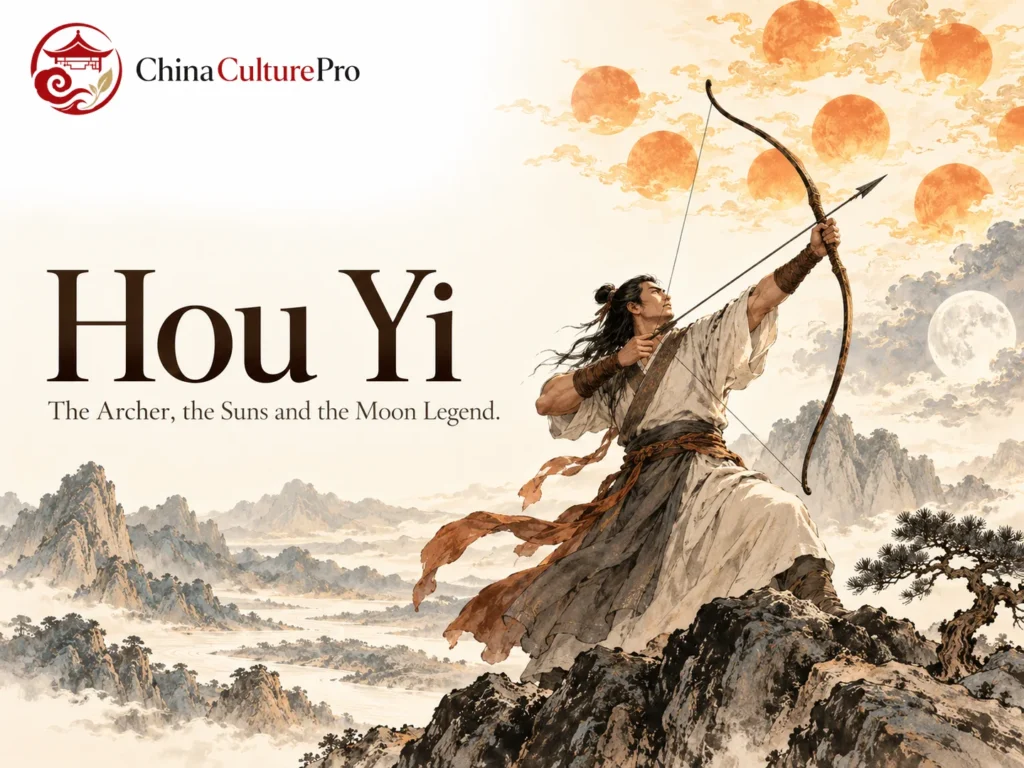

Quick Answer: Who Is Hou Yi?
Hou Yi(后羿,Hòu Yì)is the archer best known for shooting down nine of ten suns in Chinese mythology. Stories also connect him with a stolen elixir and his wife’s ascent to the moon.
- Solar rescue: His arrows end a catastrophe caused by too many suns appearing together.
- Moon story: An elixir of immortality creates separation rather than a happy ending.
- Different traditions: Ancient references to Yi, later retellings and accounts of a ruler called Hou Yi do not form one consistent biography.
His divine or mortal status, family connections and eventual fate depend on the version being told.
Nine suns fall, and the remaining sun lights a world that people can inhabit again. That is Hou Yi’s defining achievement. Yet his story does not end with perfect control: in the moon legend, the extraordinary archer cannot undo a personal loss. The tension between public rescue and private separation gives these connected tales their force.
The Archer and the Ten Suns
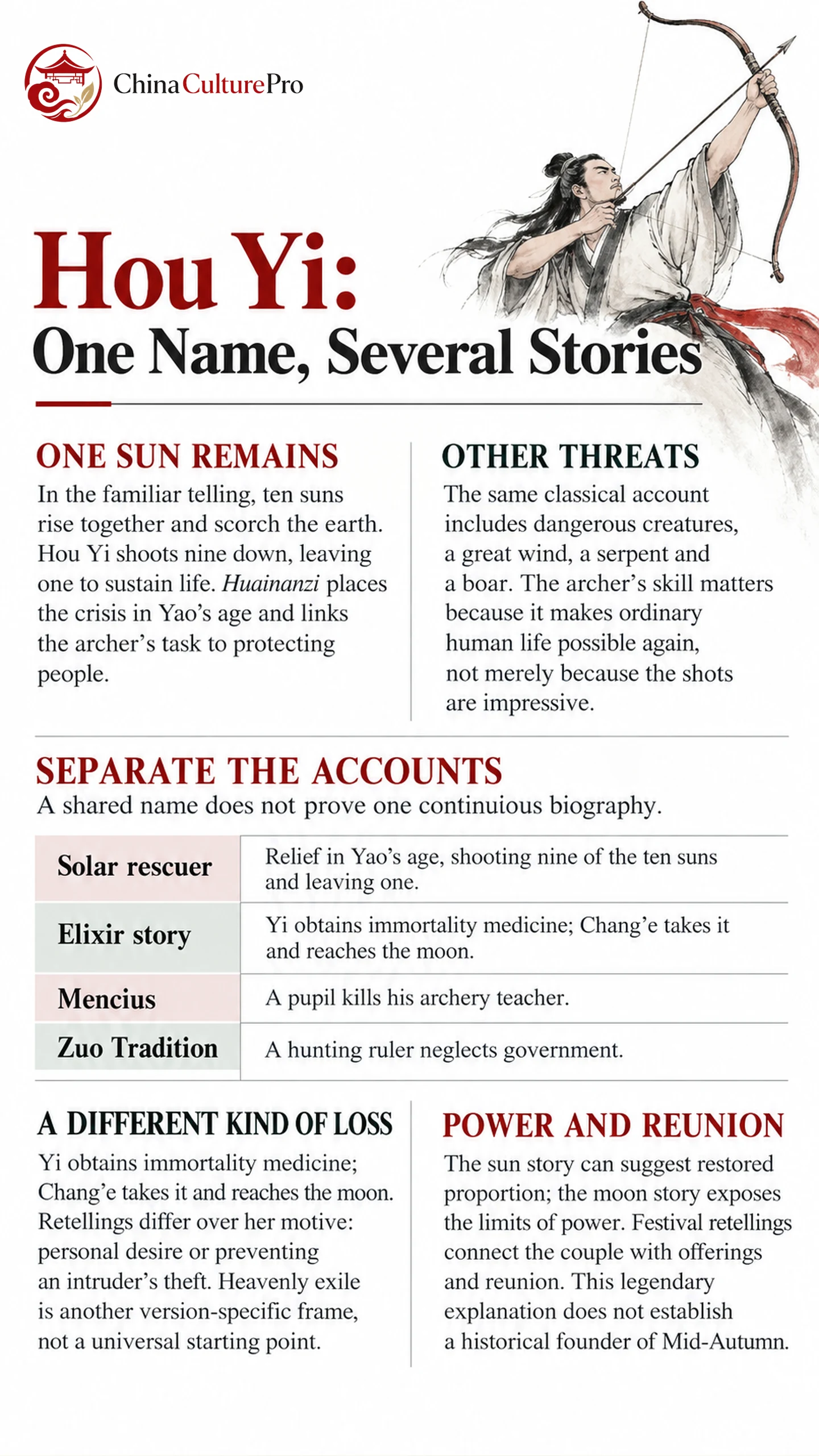
In a familiar retelling, ten suns normally appear in turn. When they rise together, their combined heat scorches the earth. Hou Yi takes up his bow and shoots nine down, leaving one to provide the light the world needs. The point is to end destructive excess, rather than extinguish sunlight altogether. [1]
An important classical witness places the crisis in the age of Yao(尧,Yáo), the legendary ruler. The Benjing chapter of Huainanzi(淮南子,Huáinánzǐ)describes ruined crops, dying vegetation and people left without food. Yao sends Yi to confront the threats. In this account, the archer’s action belongs to a larger effort to protect people from a world out of balance. [2]
There is a useful difference between that compact ancient passage and an expanded modern story. The passage says that Yi shoots at the ten suns; the familiar outcome of nine falling and one remaining is part of the wider transmitted telling. Accounts can also differ over the suns’ parentage, whether they are represented as birds, and who sends the archer. Those details should be attached to a version, rather than combined into a supposedly fixed genealogy. [1][2]
More Than a Sun-Shooting Hero
The same Huainanzi passage gives Yi a series of other tasks. He confronts named creatures, including a nine-headed threat, a great wind, a long serpent and a huge boar. They are not simply extra targets added to display his accuracy: together with the heat, they make the human world unsafe. The passage concludes with the people rejoicing. [2]
This broader setting helps explain his role as a culture hero. His skill is valuable because it removes dangers to ordinary life. A short children’s version may focus on the visually dramatic suns, while a fuller account preserves a sequence of rescues.
The archer can therefore be compared with other protectors in Chinese mythology, including Nüwa’s repair of heaven. Both stories imagine a threatened world made habitable, though their protagonists act through different means and belong to distinct narrative traditions.
Hou Yi, Chang’e and the Elixir
The moon story introduces Chang’e(嫦娥,Cháng’é)and the Queen Mother of the West(西王母,Xīwángmǔ). In Huainanzi’s Lanming chapter, Yi requests the medicine of immortality from the Queen Mother; Chang’e takes it and flees to the moon. The short passage concerns a precious thing lost without a way to replace it. It does not supply every scene found in a modern romance. [3]
Later and popular tellings give that separation different emotional meanings. One presents Chang’e as taking the elixir for herself. Another has her swallow it to prevent an intruder from seizing it. An educational retelling can begin with the couple as immortals banished to earth; another can begin with a heroic human archer. These choices change how readers understand the medicine, its use and the couple’s loss. [1][4]
The Chang’e moon-goddess traditions deserve attention in their own right. For Hou Yi’s story, the essential contrast is enough: he can bring down suns, but cannot simply recover his wife from the moon. Her motives should be stated according to the chosen version, rather than settled by calling her either selfish or heroic in every telling.
Why Different Figures Are Called Yi
The name creates another difficulty. In Mencius(孟子,Mèngzǐ), a pupil masters Yi’s archery and kills his teacher because only Yi remains superior to him. The passage uses archery and its transmission to frame a moral problem; it does not identify itself as the next episode after the solar rescue. [5]
The Zuo Tradition(左传,Zuǒzhuàn)preserves a different political account: a ruler associated with Youqiong takes over Xia government, neglects public affairs through hunting and is overthrown. This received account does not narrate the shooting of suns. It should not be treated as a verified historical record of the mythic archer’s life. [6]
| Strand | What distinguishes its account |
|---|---|
| Solar rescuer | Yi acts against overwhelming heat and other threats in the age of Yao. |
| Elixir story | A request for immortality leads to loss and a moonward departure. |
| Archery teacher | A pupil’s rivalry produces the teacher’s death in Mencius. |
| Xia political tradition | A hunting ruler neglects government and loses power in the Zuo Tradition. |
English readers will encounter “Yi,” “Archer Yi” and “Hou Yi.” The familiar name helps readers find the story; the source still determines which deeds and ending belong to the account.
The Story’s Meanings and Festival Connections
The solar story lends itself to a reading about restoring proportion: one sun sustains life where ten destroy it. The moon story instead gives extraordinary power a limit. These are interpretations of the plots, rather than predictions or a single religious doctrine.
The couple also belongs to the storytelling associated with Mid-Autumn. Cultural retellings link the separation with moon offerings and the wish for reunion. That is a legendary explanation within festival culture, rather than proof that one named archer founded the historical festival. [1][4]
When exploring Mid-Autumn Festival traditions, keep the practices and their explanatory stories in view together. Knowing a legend can enrich a custom without turning every detail of the legend into documented history.
FAQs About Hou Yi
Why did Hou Yi leave one sun?
In the familiar telling, one sun remains to give the world necessary light and warmth. The rescue removes destructive excess without leaving permanent darkness.
Was Hou Yi a god or a human?
Versions differ. Some make him a heavenly archer who becomes mortal; others present a heroic human. State the chosen tradition rather than assigning one universal status.
Who killed Hou Yi?
Mencius tells of a pupil killing the archer Yi. Political traditions give a ruler called Hou Yi another downfall. These endings should not automatically be merged.
Did Hou Yi start the Mid-Autumn Festival?
Stories connect him and Chang’e with moon offerings and reunion. They are cultural explanations, not evidence that he was the festival’s historical founder.
Sources
[1] British Library, International Dunhuang Programme. The archer and the moon goddess
[2] Huainanzi. Benjing chapter
[3] Huainanzi. Lanming passage on the elixir
[4] Singapore Chinese Cultural Centre. Exhibition text on festival stories
[5] Mencius. Li Lou II
[6] Zuo Tradition. Duke Xiang, year four