
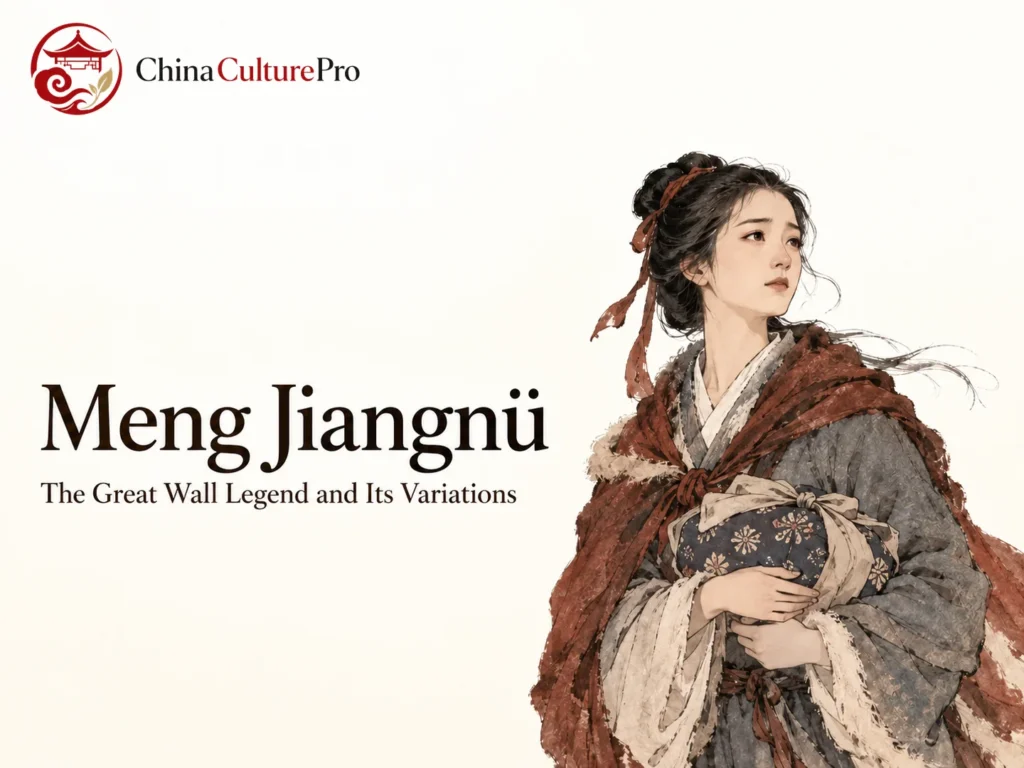

Quick Answer: Who Is Meng Jiangnü?
Meng Jiangnü(孟姜女,Mèng Jiāngnǚ)is the grieving wife whose tears bring down a wall in one of China’s best-known folk legends. The familiar version places her husband’s death amid the forced labor of the Qin Great Wall.
- The journey: She carries winter clothes to the husband taken away from their home.
- The discovery: She learns he has died, and her lament reveals what the wall conceals.
- The tradition: Earlier accounts of a warrior’s widow develop into different stories of construction, grief and resistance.
The legend is not proof that a woman literally demolished the Great Wall. Her husband’s name, her birth story and her final fate vary between tellings.
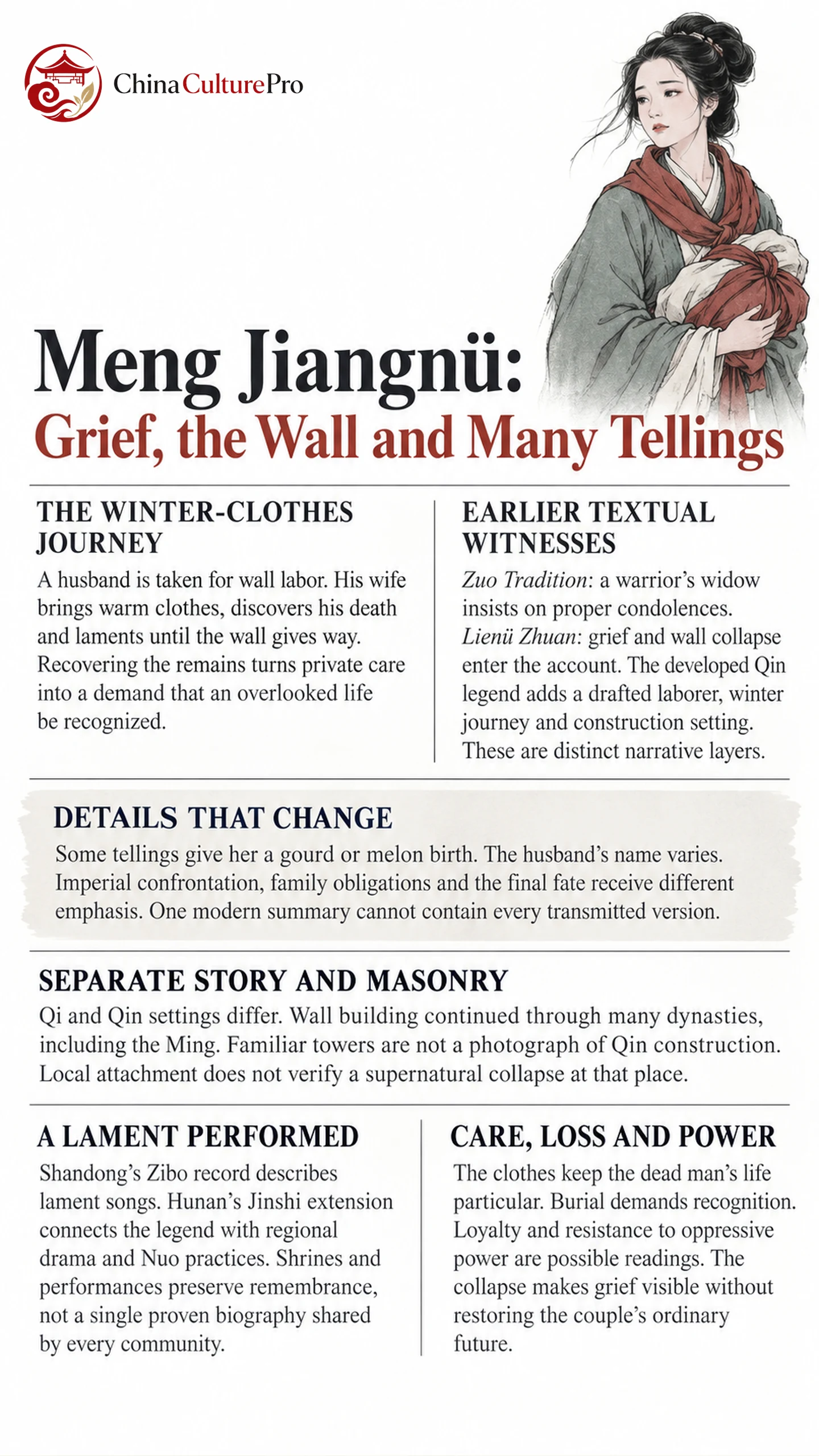
Winter clothes meant for a living husband become part of a journey toward mourning. That reversal gives Meng Jiangnü’s story much of its power. The famous collapse is extraordinary, but the task that brings her to the wall is intimate and practical: keeping someone she loves warm. The contrast makes this Chinese folk legend more than a tale of miraculous tears.
The Familiar Story: Winter Clothes and the Broken Wall
In a familiar telling, Meng Jiangnü marries a young man often called Fan Xiliang(范喜良,Fàn Xǐliáng). Their life together is cut short when he is seized for work on the wall. Time passes without his return. As cold weather approaches, she makes warm clothes and sets out to find him. [1]
The journey turns her private concern into a confrontation with the immense building project. When she finally reaches the workers, she learns that her husband has died and that his remains lie within or beneath the wall. In the tale, her grief brings down a section, exposing the dead and allowing her to recover him for burial. [1]
Some versions then bring her before the emperor. He wants to marry her; she obtains an honorable funeral for her husband before refusing a life with the ruler responsible for their separation. Versions that continue into this confrontation can end with her death; a summary that stops at the recovered remains gives the loss a different closing emphasis. [2]
The emotional movement is clear even when details change: a wife tries to care for a living person, discovers a concealed death and demands recognition for it. The wall’s failure makes that recognition physically visible.
From Qi Liang’s Widow to the Qin Wall Legend
An important early narrative concerns the wife of Qi Liang(杞梁,Qǐ Liáng), a warrior of the state of Qi. In the Zuo Tradition(左传,Zuǒzhuàn), she refuses condolences offered outside the home and insists on appropriate treatment of her husband’s death. Her voice challenges a ruler through ritual expectations. [3]
The received Lienü Zhuan(列女传,Liènǚ Zhuàn), or Biographies of Exemplary Women, adds a scene of overwhelming grief beside the dead husband and a collapsing wall. This witness should not automatically be read as the full later story of Qin laborers, winter clothes and a northern construction site. [4]
| Witness or strand | What distinguishes it |
|---|---|
| Zuo Tradition | The widow insists on proper condolences after a warrior’s death. |
| Lienü Zhuan | Grief and wall collapse appear in an exemplary-woman narrative. |
| Developed Qin-wall legend | A winter-clothes journey, a drafted laborer and imperial oppression organize the familiar plot. |
The change is more substantial than replacing one name with another. A story of the dignity owed to a warrior and his widow becomes a broader account of people suffering under a monumental project. Different periods and genres can draw different meanings from the same grieving figure.
Different Births, Names and Endings
Some popular tellings begin with a magical birth from a gourd or melon shared between two neighboring households. The wondrous child grows into the heroine. This is one narrative explanation of her identity, not a literal birth record or a reliable linguistic derivation of her name. [1]
The husband also changes names across the tradition: Fan Xiliang and Wan Xiliang are familiar forms, alongside names closer to Qi Liang. The shared pattern matters more than treating one spelling as a test that every version must pass. [1][2]
A scholarly collection of ten versions shows how marriage circumstances, relationships with in-laws, the journey and resistance to the emperor can be expanded or omitted. Some tellings dwell on filial obligations; others give more space to the heroine’s defiance. Neither a short modern summary nor a single dramatic ending contains the whole tradition. [2]
Which Wall Does the Story Describe?
The early Qi setting and the developed Qin setting belong to different historical worlds. Later regional traditions can attach the story to places recognizable to their own audiences. That attachment helps a legend become local; it does not independently identify the original site of a supernatural collapse.
The material history is also layered. Earlier fortifications were joined under Qin, and wall construction continued through later dynasties, including the Ming. The towers and masonry familiar from many modern images should not be treated as a photograph of the Qin period. [5]
Read Great Wall history alongside the legend for that distinction. The story can express the human cost of building without serving as a factual construction report, and Qin Shi Huang’s history is a separate question from his role as an antagonist in folklore.
Regional Remembrance and Performance
The legend remains attached to local practices as well as books. The Zibo heritage entry in Shandong records its first national listing in 2006 under project I-8 and describes the transmission of lamenting songs. This gives grief a performed form, rather than preserving only a prose plot. [6]
The Jinshi extension in Hunan, listed in 2008 under the same project, describes traditions around the Lishui region and their connections with songs, drama and Nuo practices. Other commemorative settings include the shrine associated with her at Shanhaiguan. These are places and practices of remembrance, not proof that each locale witnessed the same historical event. [7]
Listening to a sung telling can therefore reveal a different emphasis from reading a synopsis. Repetition, season and lament may matter as much as the spectacular collapse.
Why the Legend Endures
One reading centers on loyalty; another hears a protest against power that treats people as expendable. The winter clothes and the demand for burial keep the loss particular: the dead man is someone whose life mattered to another person.
Unlike the transformation that reunites the Butterfly Lovers, the wall’s collapse does not simply restore the couple’s ordinary future. It makes grief and injustice impossible to overlook. That is a powerful narrative response to loss, without requiring every audience to draw one compulsory moral from it.
FAQs About Meng Jiangnü
Did Meng Jiangnü really make the Great Wall collapse?
The collapse belongs to the legend. It is not established as a historical or archaeological event caused by her tears.
What was her husband’s name?
Names vary, including Fan Xiliang and Wan Xiliang. Earlier textual traditions concern Qi Liang and his widow.
Does every version include a magical birth?
No. Gourd or melon birth is a feature of some tellings, not a required opening for every version.
Is the story set at today’s Shanhaiguan wall?
Some local versions attach it to Shanhaiguan. That does not make the surviving Ming-period wall a Qin-period construction site or verify the legend’s events there.
Sources
[1] David K. Jordan, University of California San Diego. True Love Brings Down the Great Wall
[2] University of Washington Press. Meng Jiangnü Brings Down the Great Wall: Ten Versions of a Chinese Legend
[3] Zuo Tradition. Duke Xiang, year 23
[4] Lienü Zhuan. The wife of Qi Liang
[5] UNESCO World Heritage Centre. The Great Wall
[6] China Intangible Cultural Heritage. Meng Jiangnü legend, Zibo
[7] China Intangible Cultural Heritage. Meng Jiangnü legend, Jinshi extension