

Quick Answer: What Is the Butterfly Lovers Story?
The Butterfly Lovers is the Chinese love legend of Liang Shanbo(梁山伯,Liáng Shānbó)and Zhu Yingtai(祝英台,Zhù Yīngtái), often shortened to Liang Zhu(梁祝,Liáng Zhù). Its familiar plot combines school friendship, a marriage obstacle and transformation after death.
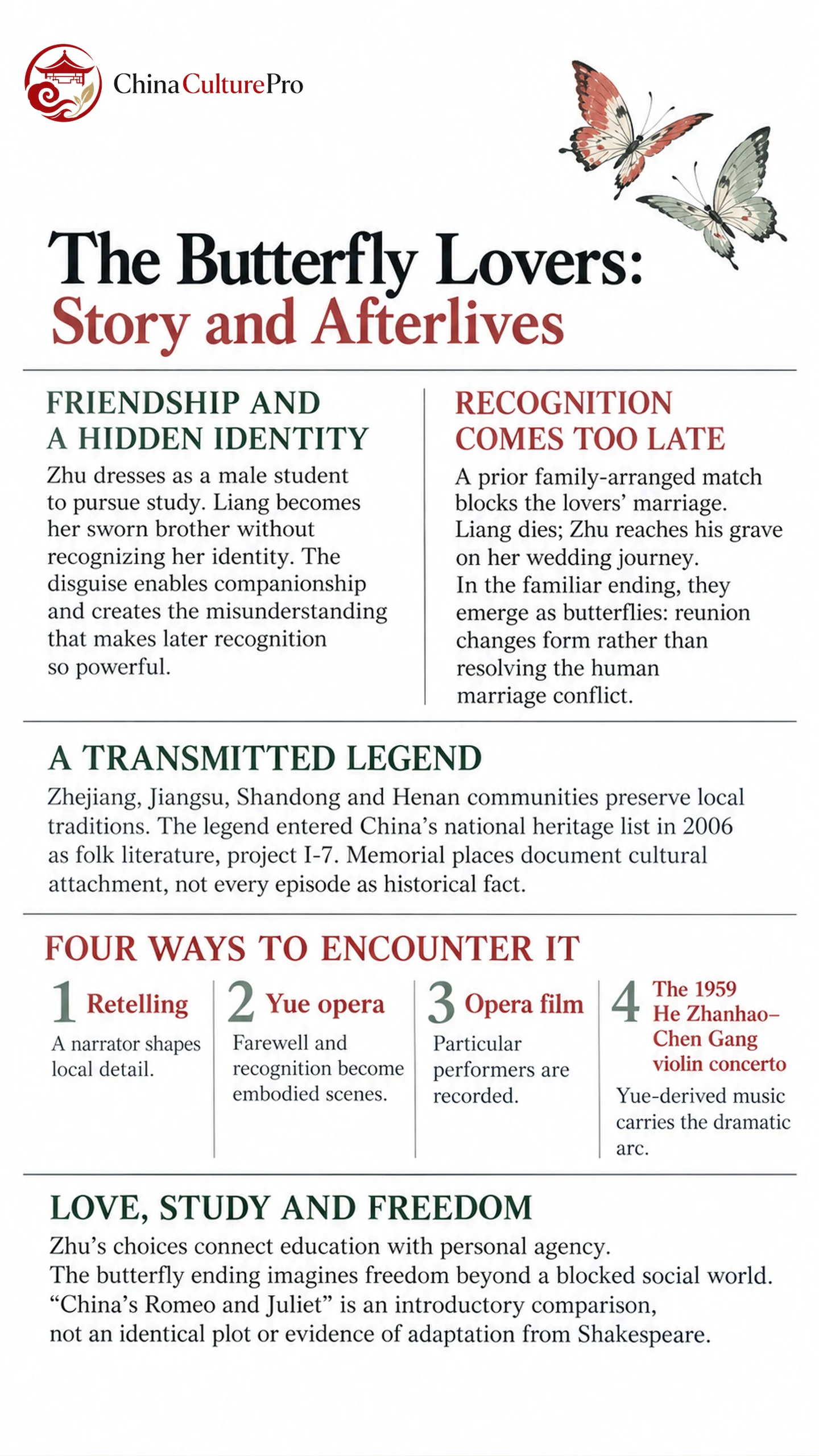
- A hidden identity: Zhu disguises herself as a male student and becomes Liang’s close companion.
- A blocked marriage: Their love cannot overcome an existing family-arranged match.
- A lasting image: The lovers emerge as butterflies in the best-known ending.
This is a developing folk tradition with regional and artistic versions, rather than one fixed novel or a proven historical biography.
Two butterflies fly together where a human couple could not. The ending gives this Chinese folk tale its English name, but much of its emotional power comes earlier: in shared study, an unrecognized identity and a farewell full of missed hints. Knowing those scenes makes both the tragedy and its many adaptations easier to follow.
Zhu Yingtai’s Disguise and the School Friendship
In a familiar Zhejiang telling, Zhu Yingtai wants an education beyond what her expected role allows. She dresses as a boy and goes to study in Hangzhou, where she meets Liang Shanbo. They form a close friendship and become sworn brothers. Liang understands their intimacy as companionship between male students; Zhu gradually experiences it as love. [1]
The disguise drives the plot rather than serving as a brief visual joke. It gives Zhu access to study and to sustained companionship with Liang, while preventing him from understanding what that companionship means to her. Their time together makes the eventual recognition emotionally important.
When Zhu must return home, the farewell becomes a scene of indirect disclosure. She hints at her feelings, but Liang misses the message. Later, at her family home, he learns that his classmate is a woman. What had seemed a friendship can now become a proposed marriage—except that her family has already promised her to someone else. [1][2]
The tale’s educational barrier belongs to its narrative setting. It should not be enlarged into a claim that every girl in every period of Chinese history was forbidden to learn.
Separation, the Grave and the Butterflies
Recognition comes too late to resolve the marriage obstacle. Liang’s hopes collapse when he discovers the existing betrothal; in the familiar telling, he becomes ill and dies. On Zhu’s wedding journey, she comes to his grave. The tomb opens, she enters it, and the couple finally appears as two butterflies flying together. [2]
The transformation changes the form of their reunion. They do not win permission, marry and resume ordinary social life. Instead, the story imagines a union outside the human arrangements that prevented it. This is why the ending can feel liberating while remaining a tragedy.
Retellings differ in how much attention they give to the rival marriage, Zhu’s father, the grave scene and the transformation itself. A stage production can prolong the grief; a short oral account can move quickly to the butterflies. The recognizable emotional sequence survives even when the scene-by-scene treatment changes.
A Folk Legend with Regional Versions
Zhejiang is an important setting and transmission center, alongside communities in several other provinces. The national heritage entry names Ningbo, Shangyu, Hangzhou, Yixing, Jining and Runan among its important centers. The Liang Zhu legend entered China’s first national intangible heritage list in 2006 as folk literature, project I-7. Several communities are represented under that shared project. [3]
This is evidence of a widespread, locally maintained tradition. It does not establish one exclusive birthplace or demonstrate that every episode happened to a particular historical couple. Memorial tombs, temples and local accounts show how communities have attached the legend to places; they must be interpreted in that cultural role.
The story also belongs to the group commonly called China’s four great folk legends, alongside the White Snake legend, the Cowherd and Weaver Girl, and Meng Jiangnü. The grouping brings together different kinds of storytelling, rather than establishing one common historical origin.
From Yue Opera to the Violin Concerto
Yue opera(越剧,Yuèjù)has given the lovers an especially influential stage life. The farewell journey and the later terrace meeting offer different dramatic situations: one depends on misunderstanding, the other on recognition followed by devastating news. Performers can reveal Zhu’s intelligence and frustration through movement, phrasing and interaction, not only through a synopsis. [4]
Film carries those performance choices to another audience. A 1954 color opera film starring Yuan Xuefen and Fan Ruijuan is cataloged by the Hong Kong Film Archive. It is an adaptation of the legend through a specific performance tradition, rather than the first existence of the story. [5]
The violin concerto by He Zhanhao and Chen Gang, dating to 1959, offers a different route. It draws on Yue opera material and organizes the lovers’ meeting, resistance to the arranged marriage and transformation through a Western concert form. Musical contrasts let listeners follow the drama without spoken dialogue. [6]
| Form | What it makes especially available |
|---|---|
| Oral or written retelling | A narrator can select local details and explain the plot directly. |
| Yue opera | Singing and embodied scenes develop the farewell, recognition and grief. |
| Opera film | A recorded interpretation preserves particular performers and staging choices. |
| Violin concerto | Musical themes and contrasts carry a dramatic arc without a spoken script. |
For a next step, explore Yue opera or Chinese classical music pieces according to whether the scenes or their musical transformation interest you most.
What the Butterfly Ending Means
The tale can be read through love, access to education and the conflict between personal choice and family authority. Zhu’s initiative matters throughout: she seeks study, forms the friendship and tries to make herself understood. The final transformation gives the pair a freedom their social world has withheld.
Calling it “China’s Romeo and Juliet” can introduce the broad idea of lovers prevented from marrying. The comparison is less useful when it replaces the actual story. The student disguise, delayed recognition and butterfly transformation have their own dramatic work to do; they are not equivalents of every scene in Shakespeare’s play.
FAQs About the Butterfly Lovers
Is the Butterfly Lovers story true?
It is a folk legend with regional memorial traditions. Those traditions do not verify the full plot as a historical biography.
Why did Zhu Yingtai dress as a man?
In the familiar telling, the disguise lets her pursue study in a male educational setting. It also creates the misunderstanding central to her friendship with Liang.
Is it the Chinese Romeo and Juliet?
That is a popular comparison for its tragic romance. It does not mean the plots are identical or that one was adapted from the other.
Who composed the Butterfly Lovers concerto?
He Zhanhao and Chen Gang created the celebrated violin concerto associated with 1959. The older folk legend and its stage traditions supplied its story world.
Sources
[1] Hangzhou government. Butterfly Lovers legend and Wansong Academy
[2] Zhejiang Provincial Department of Culture and Tourism, via Zhejiang International Communication Center. Butterfly Lovers
[3] China Intangible Cultural Heritage. Liang Zhu legend, project I-7
[4] Hong Kong Arts Festival. An interview on Yue opera interpretation
[5] Hong Kong Film Archive. The Butterfly Lovers, 1954 film
[6] Hong Kong Chinese Orchestra. 2019 tour programme notes