
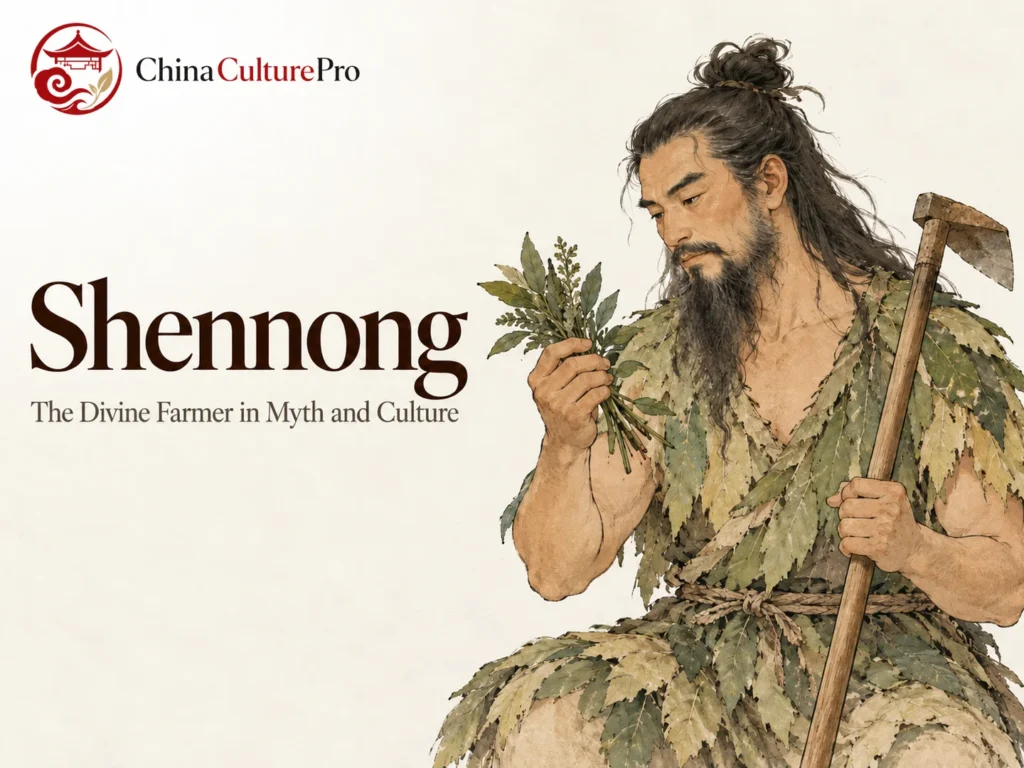

Quick Answer: Who Is Shennong?
Shennong(神农,Shénnóng), the “Divine Farmer” or “Divine Husbandman,” is a Chinese culture hero associated with agriculture and knowledge of plants. His traditions explain how essential skills became available to people.
- Farming: He teaches cultivation and is credited with tools and organized exchange.
- Plant knowledge: His famous testing of plants includes encounters with poison.
- Later memory: Medical texts, tea stories and local observances gather around his name.
These traditions do not establish a single verified emperor who discovered every crop or personally wrote the medical classic attributed to him. Their cultural significance is different from evidence for the safety or effectiveness of a remedy.
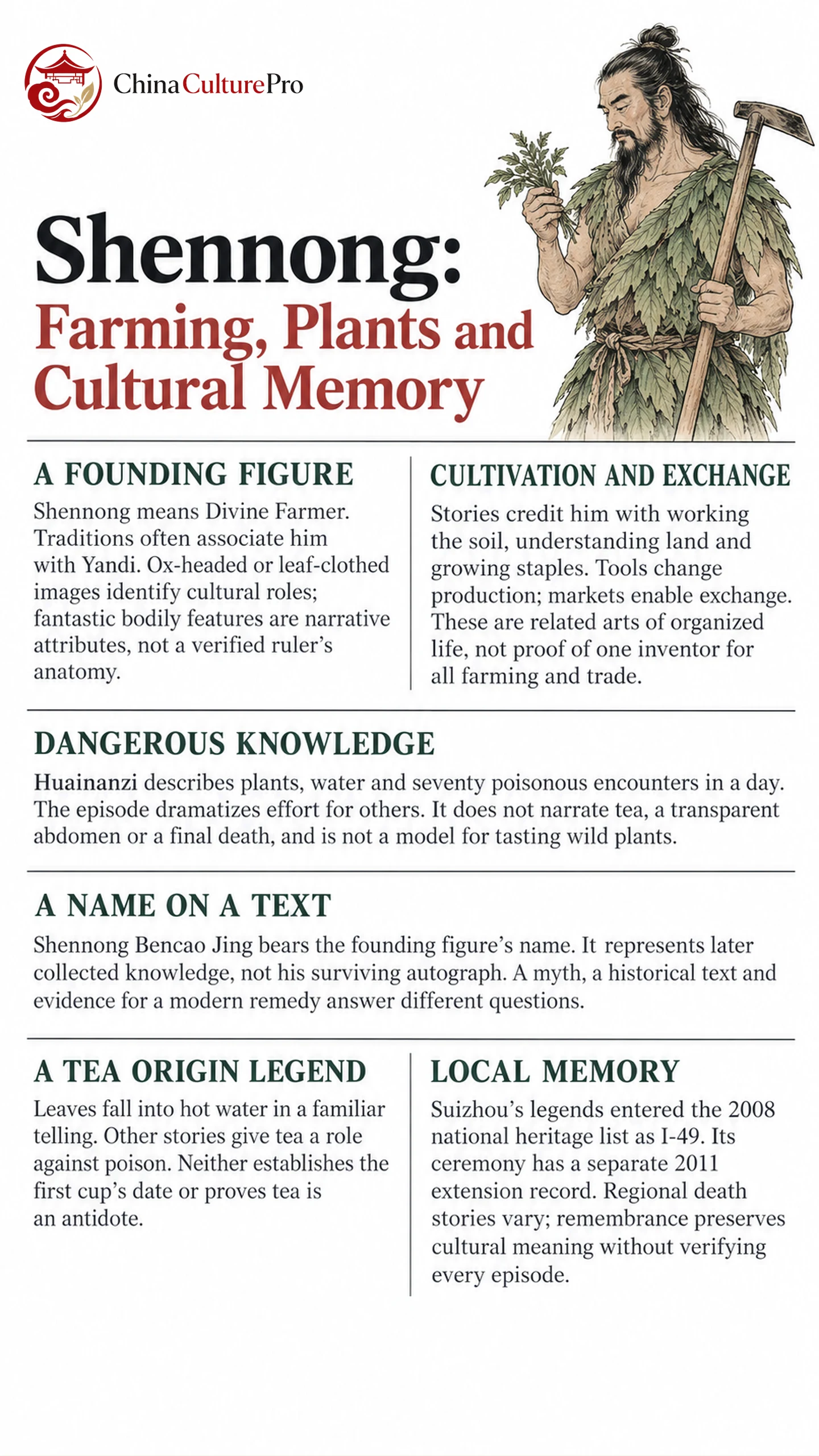
A farmer works the soil; a founding sage examines a plant. Both images belong to Shennong. His stories connect the search for food with the risks of learning what the natural world can offer. Understanding that connection reveals a richer figure than either a list of inventions or a picturesque anecdote about the first cup of tea.
The Divine Farmer and the Yandi Traditions
Shennong is frequently associated with Yandi(炎帝,Yándì), the Yan or Flame Emperor. Received traditions can combine the names as Yandi Shennong, while their genealogies and descriptions vary. A classical compilation preserves a form with a human body and ox’s head, making the farming association visible in an extraordinary body. [1]
Other images present a more human figure examining vegetation or wearing leaves. Such attributes identify a role; they are not realistic portraits or evidence of a person’s anatomy. The same principle applies to fantastic transparent-body versions: they make plant-testing imaginable through a supernatural figure. [2][3]
Like Fuxi, Shennong belongs to accounts of cultural beginnings. The narratives explain how people learned to live differently. Legendary dates and founding genealogies should be understood within those traditions, rather than used as a secure historical reign.
Teaching Agriculture and Exchange
Shennong’s farming role concerns more than identifying something edible. Classical accounts associate him with working the soil, cultivating staple grains and recognizing differences between land: wet or dry, fertile or poor, high or low. They imagine cultivation as knowledge of conditions, not simply the possession of a seed. [1]
Wooden agricultural tools and the establishment of markets are also attributed to him in transmitted cultural accounts. The tool changes how people obtain food; the market lets them exchange what they produce. These are related but distinct contributions to a more organized way of living. [1][2]
These stories make shared, useful knowledge central to Shennong’s role. It does not establish that the long development of farming and trade can be reduced to one inventor acting at one moment. Nor does a general reference to staple grains imply one universally fixed list across every text and period.
Tasting the Hundred Plants
Huainanzi(淮南子,Huáinánzǐ)places Shennong’s plant-testing within a world where people suffer harm from what they consume. He examines plants and water so that people can learn what to approach and what to avoid. The account says he encounters seventy poisons in a day. Farming, environmental knowledge and exposure to danger appear together. [4]
The force of the episode is his willingness to undertake the dangerous work himself. “The hundred plants” expresses the breadth of the task; the passage is not a modern inventory of a hundred identified species. Its extraordinary number of poisonous encounters belongs to the narrative, not a measured experimental report.
Later tales give the task different endings, including fatal poisoning. They may also add a transparent abdomen or an antidote. Those scenes should not be read back into this brief Huainanzi passage, which does not narrate them. A cultural account of self-sacrifice is also not a model for testing unfamiliar wild plants by tasting them.
Did Shennong Write a Medical Classic?
The Shennong Bencao Jing(神农本草经,Shénnóng Běncǎo Jīng), often translated as the Divine Farmer’s Classic of Materia Medica, bears his name. That does not make it a surviving book written by the mythical farmer. Museum scholarship describes it as accumulated experience and collective knowledge compiled under an attributed ancient authority. [5]
The distinction separates three useful kinds of evidence:
| Material | What it helps a reader understand |
|---|---|
| A plant-testing myth | How a tradition imagines the beginnings and cost of useful knowledge. |
| A named materia medica | How later textual knowledge is collected under a revered founding figure. |
| A modern safety or treatment claim | A separate question requiring appropriate contemporary evidence. |
For the broader textual and cultural setting, see traditional Chinese medicine. The history of a named classic and the evidence for an individual remedy are different questions.
Shennong and the Discovery of Tea
In one familiar tea legend, leaves fall into Shennong’s hot water. He notices the resulting drink and discovers its flavor. The small accidental event gives a founding figure a moment of curiosity that readers can readily picture. [6]
This is an origin story, not a documented first brewing or a secure prehistoric date. The plant-testing passage discussed above does not mention tea. Combining the two into an uninterrupted ancient eyewitness account would hide the difference between their sources.
Other tea stories give the drink a role against poison. That is a supernatural solution within a tale, not evidence that tea can be relied on as an antidote. The cultural story can be appreciated without turning it into a health instruction.
Local Stories and Ritual Remembrance
The Yandi Shennong legends of Suizhou entered the second national intangible heritage list in 2008 as folk literature, project I-49. The official record also identifies transmission in the Shennongjia region, where stories connect the landscape with the gathering of plants. [7]
Ritual practice has a separate record. The Suizhou Shennong ceremony was listed as a 2011 extension under the Yandi ceremony project X-33. In another local tradition, the Baoji entry tells of his death after tasting a plant popularly called duanchangcao(断肠草,duànchángcǎo). That is a locally transmitted death legend, not a verified medical cause or a reliable botanical identification. [8][9]
These examples place Shennong among the Chinese sacred figures remembered through narrative and observance. They preserve a recurring concern with food, knowledge and service to others while allowing local stories to differ.
FAQs About Shennong
Was Shennong a real emperor?
He is a legendary founding figure. His full biography and ancient reign dates are not established as the life of a securely documented ruler.
Did Shennong discover tea?
That is a famous origin legend. It does not establish a verified first cup or an exact historical discovery date.
Did Shennong write the Shennong Bencao Jing?
The classic is traditionally attributed to him. It represents later collected knowledge, not a surviving autograph by the mythic farmer.
How did Shennong die in the legends?
Some later and local tales give him a death through plant poisoning. The details differ, and the Huainanzi plant-testing passage does not narrate that ending.
Sources
[1] Taiping Yulan, volume 78. Classical extracts on Yandi Shennong
[2] David K. Jordan, University of California San Diego. The Divine Farmer
[3] Shen Yun Performing Arts. A modern Divine Farmer retelling
[4] Huainanzi. Xiuwu chapter
[5] National Museum of Traditional Chinese Medicine. Shennong tasting plants and the attributed classic
[6] Taft Museum of Art. Chinese tea culture
[7] China Intangible Cultural Heritage. Yandi Shennong legends, Suizhou
[8] China Intangible Cultural Heritage. Suizhou Shennong ceremony
[9] China Intangible Cultural Heritage. Yandi ceremony, Baoji