

Quick Answer: Who Is the Yellow Emperor?
Huangdi(黄帝,Huángdì), the Yellow Emperor, is a legendary ruler, culture hero and ancestral figure in Chinese tradition. Stories place him at the beginnings of political order and associate him with the arts of civilization.
- Narrative ruler: Received accounts describe victories over rival powers and the organization of government.
- Cultural authority: Inventions and important texts gather around his name, sometimes through associated figures.
- Ancestral memory: Ceremonies and expressions of shared descent give him continuing significance.
His traditional biography is not established as the life of a securely documented prehistoric monarch. He is also distinct from Qin Shi Huang, the historical First Emperor.
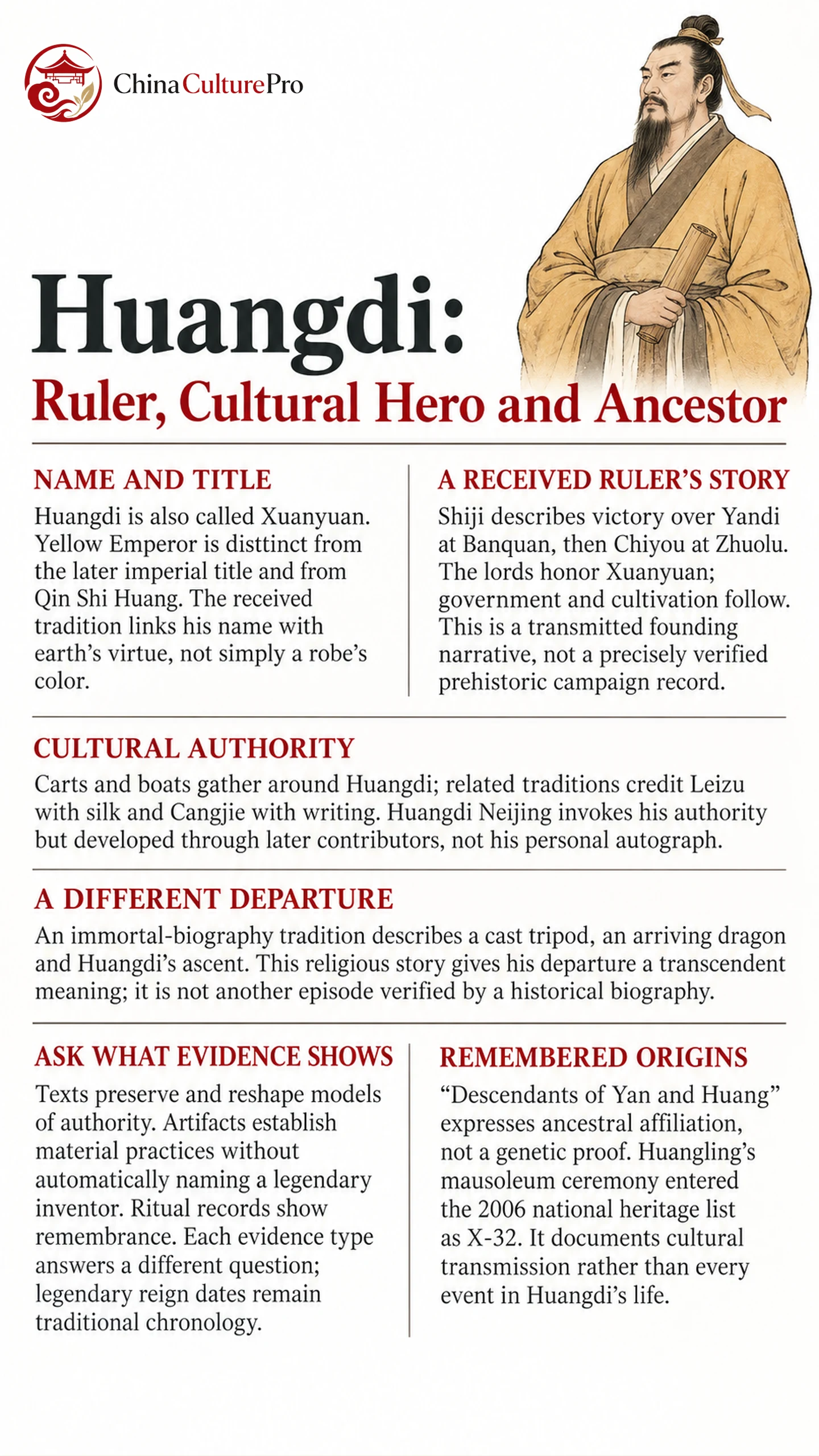
The Yellow Emperor appears as a victorious ruler, a seeker of knowledge and an ancestor remembered in ceremony. His significance comes from the ways different texts and communities use him to explain beginnings. Reading those uses separately reveals more than treating every invention, battle and miraculous departure as one continuous historical record.
Huangdi, Xuanyuan and the Meaning of the Name
Xuanyuan(轩辕,Xuānyuán)is another familiar name for Huangdi. In English, “Yellow Emperor” is conventional, but the Chinese characters matter. The figure’s name uses 黄, “yellow”; the later imperial title 皇帝 begins with a different character, 皇. The words sound alike in modern Mandarin, which can conceal the distinction.
The difference is especially useful when comparing him with Qin Shi Huang, whose title belongs to the historical Qin empire. Calling Huangdi a founding sovereign does not make him that First Emperor or place him in the Qin dynasty. [1]
The Shiji(史记,Shǐjì)itself explains his title through an auspicious sign of earth’s virtue. This is a cosmological explanation within received tradition, not evidence that the name simply describes a robe or a physical feature. [2]
Yandi and Chiyou in the Shiji Narrative
The Shiji, or Records of the Grand Historian, begins its Annals of the Five Emperors with Huangdi. Its account describes a weakened order in which regional lords fight and ordinary people suffer. Xuanyuan develops military strength and becomes a center around whom others gather. [2]
The narrative gives him two distinct confrontations. Against Yandi(炎帝,Yándì), the Yan or Flame Emperor, he fights at Banquan and prevails after three engagements. Against Chiyou(蚩尤,Chīyóu), he calls together the lords and fights at Zhuolu, where Chiyou is captured and killed. The lords then honor Xuanyuan as their ruler. [2]
Victory is followed by a larger portrait of rule: journeys, appointments, cultivation and attention to the patterns of the world. The account makes authority depend on more than defeating an opponent. It presents the beginnings of an ordered realm around an exemplary sovereign. [2]
This is the structure of the received account. It should not be converted into a precisely dated campaign history or combined automatically with every later magical battle episode. The Shennong traditions and Yandi associations also have their own textual layers; a shared name does not remove those differences.
Cultural Inventions and the Texts Bearing His Name
The Yellow Emperor’s cultural world includes several founders, rather than a solitary inventor. Legends credit him with carts and boats; related stories associate Leizu(嫘祖,Léizǔ)with silk and Cangjie(仓颉,Cāngjié)with writing. Preserving those separate roles explains how a founding court can become an imaginative setting for the arts of civilization. [3]
The same care applies to the Huangdi Neijing(黄帝内经,Huángdì Nèijīng), the Yellow Emperor’s Inner Canon. Its name invokes his authority, but it is not a surviving book personally written by a prehistoric monarch. The National Museum of China describes the received medical work as the product of more than one person and period. [4]
A dialogue in which an ancient ruler asks questions gives knowledge a prestigious voice. It does not make the exchange an eyewitness transcript. Readers interested in traditional Chinese medicine should distinguish the cultural authority of a named classic from its compilation history and from evidence for any individual modern treatment.
The Dragon Ascent and Religious Traditions
Another Huangdi is the figure who leaves the human world. The Liexian Zhuan(列仙传,Lièxiān Zhuàn), a collection of immortal biographies, tells of a bronze tripod being cast and a dragon arriving to receive him. He ascends, while those unable to follow are left looking upward in grief. The story turns a ruler’s departure into a scene of transcendence. [5]
This is a different narrative task from the battle account. The ruler who orders life below becomes a figure able to pass beyond it. Religious and literary traditions can draw on that image without providing evidence that a human body literally rode into heaven.
Nor does the existence of several roles require choosing just one label for him. “Legendary sovereign,” “culture hero,” “ancestor” and “religious figure” identify different contexts in which Huangdi is remembered.
What Can History Establish?
An old text is evidence that an account was written and transmitted. Establishing the events it describes requires another argument. Scholarship on Huangdi examines how early narratives reshape a mythic figure into persuasive accounts of rulership and cultural beginnings. That historical process is itself worth studying, even when a literal biography cannot be verified. [6]
| Evidence | The question it can help answer |
|---|---|
| Received texts | What stories and models of authority were transmitted or reworked? |
| Archaeological material | What practices and technologies existed, without automatically identifying a legendary inventor? |
| Ritual records | How do communities remember and honor a founding figure? |
Legendary reign dates belong to traditional chronology. They should not be given the same status as securely established dates for later rulers. The distinction allows readers to value the sources without asking each one to prove something it cannot establish alone.
Ancestral Identity and Ritual Remembrance
Yan Huang zisun(炎黄子孙,Yán Huáng zǐsūn), “descendants of Yan and Huang,” is an expression of ancestral affiliation. A dictionary definition explains its connection with traditions that identify Yandi and Huangdi as founding ancestors. In cultural use, such language expresses shared origins and belonging; it is not a genetic demonstration of every person’s family tree. [7]
Ritual gives that memory a public form. The Yellow Emperor mausoleum ceremony in Huangling, Shaanxi, entered the first national intangible heritage list in 2006, project X-32. Its official record describes formal and popular observance, including offerings, ceremonial bows and the reading of a commemorative text. [8]
The ceremony documents a tradition of remembrance. It does not independently verify the identity of a prehistoric grave occupant or every event in the legendary life. As with Chinese ancestor worship, the meaning of the practice lies partly in the relationship it creates among the living and their remembered origins.
FAQs About the Yellow Emperor
Was the Yellow Emperor a real person?
His full legendary biography and precise reign are not securely established. Texts, artifacts and ritual traditions answer different questions about his history and memory.
Is Huangdi the same as Qin Shi Huang?
No. The Yellow Emperor is a legendary founding figure. Qin Shi Huang is the historical First Emperor of the Qin empire.
Did Huangdi write the Yellow Emperor’s Inner Canon?
The text bears his name and authority, but it developed through later contributors and periods. It is not his surviving personal manuscript.
Does “descendants of Yan and Huang” describe proven genealogy?
It is an expression of ancestral and cultural affiliation, not proof of a single documented or biological descent for everyone who uses it.
Sources
[1] Smithsonian National Museum of Asian Art. Qin dynasty
[2] Sima Qian. Shiji: Annals of the Five Emperors
[3] Chinese Embassy in Nepal. Legendary story of Huangdi
[4] National Museum of China. Lingshu and Suwen
[5] Liexian Zhuan. Huangdi
[6] Research article, abstract. From Myth to History: Yellow Emperor narratives
[7] Ministry of Education, Revised Mandarin Chinese Dictionary. Yan Huang zisun
[8] China Intangible Cultural Heritage. Yellow Emperor mausoleum ceremony