


Quick Answer: What Is Bagua?
Bagua (八卦, bāguà) means the eight trigrams: eight figures made from every possible combination of three solid or broken lines. They form part of the symbolic vocabulary of Chinese thought.[1][2]
- The lines express yin and yang (阴阳, yīnyáng), with broken and solid forms respectively.
- Each trigram has a name and traditional associations, including a natural image.
- Two trigrams combine into a six-line hexagram.
- Different arrangements assign the same trigrams to different compass positions.
A trigram’s identity comes from its line pattern; its direction depends on the arrangement being used.[3]
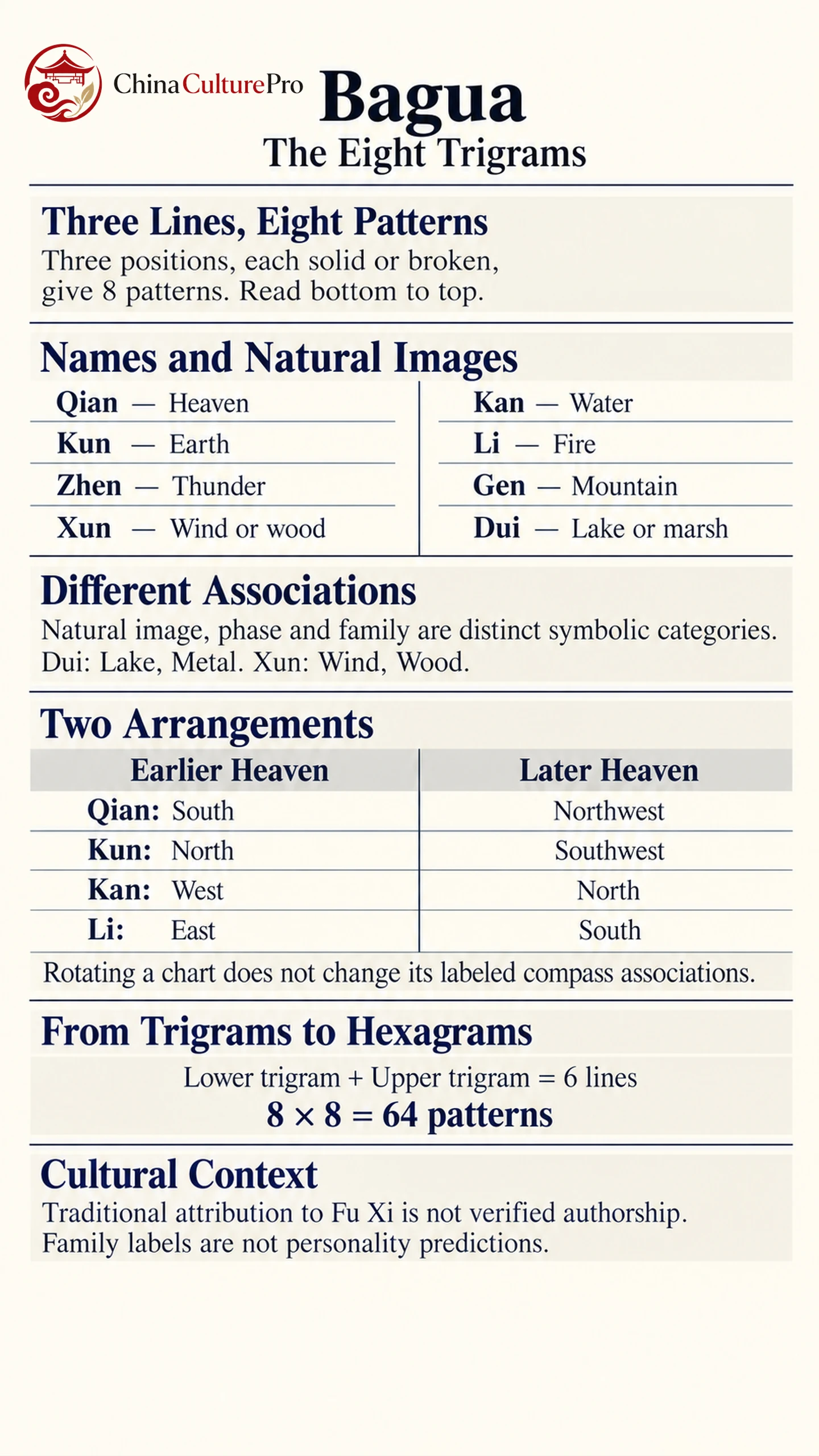
An octagonal chart is only one way to display Bagua. The eight figures also appear individually, in textual diagrams and as components of the I Ching (易经, Yìjīng). Begin by identifying the three-line pattern, then check which associations and arrangement the particular chart applies.
How Three Lines Produce Eight Trigrams
A trigram has a bottom, middle and top line. Each position can be solid or broken, giving eight possible patterns. Read the positions from the bottom upward. Turning a figure upside down can produce a different trigram, so orientation matters.[2][3]
The Unicode symbols in the table below show the figures in their conventional upright form. Their appearance can vary slightly by font, but a solid line stays unbroken and a broken line has a central gap. The names identify the patterns independently of a particular circle or grid.
For recognition, compare where the differing line sits. A figure with two broken lines and one solid line changes identity when that solid line moves from bottom to middle to top. Counting only how many lines are solid is therefore insufficient.[2]
The Eight Names and Their Associations
Shuo Gua (说卦, Shuōguà), or Discussion of the Trigrams, records influential natural images, qualities and family associations. The phase column uses the received Wuxing (五行, wǔxíng) correspondences commonly paired with the directional system.[1][4]
| Trigram | Figure | Natural image | Quality | Family association | Phase |
|---|---|---|---|---|---|
| Qian (乾, Qián) | ☰ | Heaven | Strength | Father | Metal |
| Kun (坤, Kūn) | ☷ | Earth | Receptivity | Mother | Earth |
| Zhen (震, Zhèn) | ☳ | Thunder | Movement | Eldest son | Wood |
| Xun (巽, Xùn) | ☴ | Wind or wood | Penetration | Eldest daughter | Wood |
| Kan (坎, Kǎn) | ☵ | Water | Peril or the pit | Middle son | Water |
| Li (离, Lí) | ☲ | Fire | Clinging | Middle daughter | Fire |
| Gen (艮, Gèn) | ☶ | Mountain | Stopping | Youngest son | Earth |
| Dui (兑, Duì) | ☱ | Lake or marsh | Joy | Youngest daughter | Metal |
These associations form a symbolic network, not eight literal substances. For example, Xun can represent wind as well as wood; Dui’s watery natural image does not make its phase Water. The Five Phases framework and the trigram images perform different classificatory jobs.
English glosses also vary. “Receptivity,” “compliance” and “yielding” can appear in descriptions of Kun; “lake” and “marsh” can both render Dui’s image. Compare the Chinese name and line pattern before assuming two translations identify different figures.
Earlier Heaven and Later Heaven Directions
Earlier Heaven (先天, xiāntiān), often associated traditionally with Fu Xi, places complementary figures opposite one another. Later Heaven (后天, hòutiān), traditionally associated with King Wen, uses a different ordering connected with directional and seasonal relationships.[3]
| Trigram | Earlier Heaven | Later Heaven |
|---|---|---|
| Qian | South | Northwest |
| Kun | North | Southwest |
| Zhen | Northeast | East |
| Xun | Southwest | Southeast |
| Kan | West | North |
| Li | East | South |
| Gen | Northwest | Northeast |
| Dui | Southeast | West |
The direction table describes these two named arrangements. It does not mean that a trigram changes its three-line identity when its assigned position changes.[3][4]
Check the chart’s orientation as well. Traditional diagrams often put south at the top; many modern displays put north at the top. Rotating an entire chart changes what appears at the top of the page, while the labeled compass associations remain the same.
For practical chart interpretation, compare the Bagua map guide with the discussion of feng shui directions. An entrance-aligned grid and a compass-based arrangement should not be silently substituted for one another.
How Trigrams Become Hexagrams
Stacking one trigram above another produces a hexagram with six lines. Eight choices for the lower trigram and eight for the upper produce 64 combinations. A hexagram may repeat one trigram or combine two different ones.[2]
The lower and upper positions matter. Reversing the order of two different trigrams generally produces a different six-line figure. When using a lookup table, check whether the row describes the lower trigram or the upper one before selecting an entry.
The I Ching’s attached statements and commentaries then give the six-line figure a textual context. Reading a hexagram solely by adding two short natural-image labels omits that part of the tradition.
Reading Bagua in Cultural Context
Traditional narratives credit Fu Xi with discovering or creating the trigrams. They are part of the cultural history of the symbols, while the precise development of their earliest forms remains a subject of research. Legendary attribution should not become an exact, verified date of invention.[5]
Bagua belongs within a wider history of Chinese cosmology. Its figures also appear in feng shui, ritual objects and other cultural settings. The same visual vocabulary can serve different interpretive purposes.
The family associations reflect a historical symbolic model. They should not be treated as evidence that actual people must display a trigram’s quality because of gender or birth order. Likewise, identifying a compass association does not establish a guaranteed effect on health, wealth or events.
FAQs About Bagua
Is Bagua the same as the I Ching?
No. Bagua is the eight-trigram set. The I Ching includes 64 hexagrams, associated statements and layers of commentary that use and interpret those patterns.
Why do two Bagua charts put Qian in different places?
They may use different arrangements. Qian is South in Earlier Heaven and Northwest in Later Heaven. Chart rotation can also change its apparent place on a page.
Does rotating a chart change its compass associations?
No. If all labels rotate together, the assigned compass directions stay the same. What changes is which direction appears at the top of the page.
Are the family labels personality predictions?
They are traditional symbolic associations. They do not establish what a real father, daughter or son must be like.
Sources
[1] Chinese Text Project. Book of Changes: Discussion of the Trigrams
[2] Stanford Encyclopedia of Philosophy. Chinese Philosophy of Change: Appendices
[3] David K. Jordan, University of California San Diego. The Eight Trigrams, the Canon of Changes, and Tally Divination
[4] Get Chinese Astrology. Bagua: Eight Trigrams and Two Heaven Arrangements
[5] Bent Nielsen. Notes on the Origins of the Hexagrams of the Book of Change