


Quick Answer: Which Way Does a Bagua Map Face?
A bagua (八卦, bāguà) map in feng shui (风水, fēngshuǐ) may follow compass directions or align with the entrance wall, depending on the school. Identify that reference before placing the map over a floor plan.
- Compass-aligned maps keep their directional associations attached to actual directions.
- Entrance-aligned BTB maps place the entrance along the map’s bottom edge.
- A common square version has eight outer areas and a center.
- A whole-home map and a room-level map use different boundaries.
A symbolic map does not establish that one corner controls health, relationships or income.
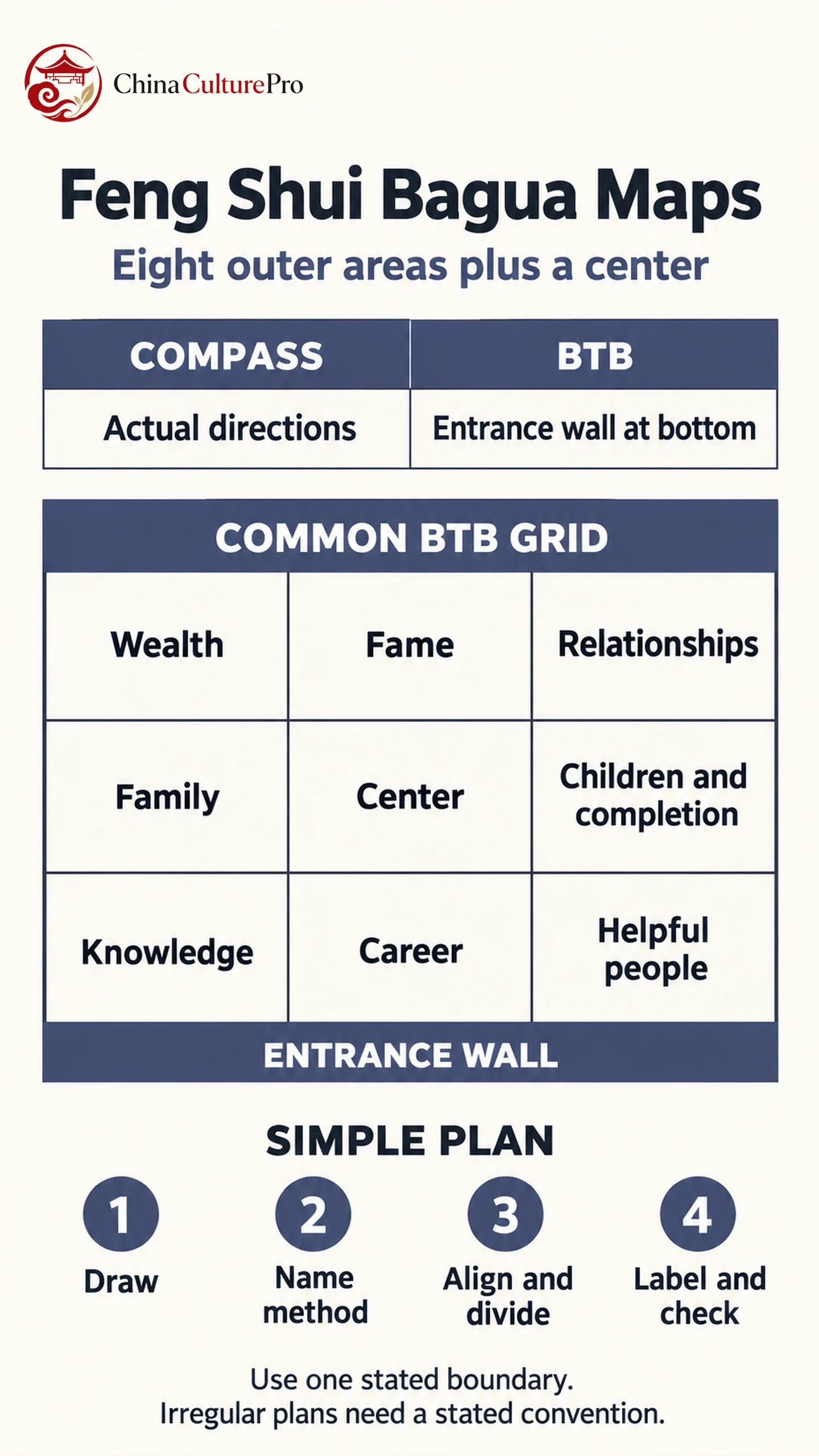
Two maps can put the same life-area label in different parts of a room without either being rotated incorrectly within its own method. The problem arises when instructions from one map are applied to the other. Start with the method, then the space, then the label.
This guide explains the comparison and gives one simple rectangular example. The wider feng shui overview provides the cultural setting.
Eight Trigrams, Nine Map Areas
Bagua means eight trigrams: the three-line figures associated with the Book of Changes. Their Later Heaven (后天, hòutiān) arrangement connects each with a direction; another arrangement assigns them differently.[5] The eight trigrams guide keeps those symbols and arrangements distinct.
A common floor-plan map uses a three-by-three grid: eight outer areas plus a center. The center is an additional map area, not a ninth trigram. The grid is a way of organizing a plan; its familiar life-area labels should not be mistaken for a description of every historical compass technique.
Compass-Aligned and Entrance-Aligned Maps
| Question | Compass alignment | Entrance-aligned BTB |
|---|---|---|
| What fixes orientation? | Compass directions and the chosen assessment method | The entrance wall of the chosen space |
| Does north stay north? | Yes, within a directional map | The bottom edge need not face north |
| Where is the reference entrance? | Relevant to assessment, but not a replacement for compass orientation | Along the map’s bottom row |
| What must be recorded? | Directions, plan boundary and method | Chosen entrance, plan boundary and BTB convention |
Compass-school teaching uses a proportioned floor plan with directional information.[4] BTB teaching instead aligns its map to the formal front door of a home, or the main entrance of a room.[2][3] This is a difference in reference system, not simply two drawings of a universally identical chart.
For example, the far-left area from the entrance is a relative position. Southeast is a compass direction. They coincide only in particular orientations. The directions guide explains why location, facing and personal favorable directions are separate questions.
A Common BTB Grid, Read from the Entrance
Orient the plan so the entrance wall is at the bottom of the page. The following simplified BTB reference is read from the far row toward the entrance row, left to right. Wording varies: a modern teaching map may call the family area “New Beginnings,” for example.[1]
| Left | Center | Right |
|---|---|---|
| Wealth and abundance | Fame and reputation | Relationships |
| Family and new beginnings | Center and health | Children and completion |
| Knowledge and self-cultivation | Career and life path | Helpful people and travel |
The entrance belongs somewhere along the bottom row; it does not have to be centered in Career. Nor should the whole grid be shifted sideways to force that result.[3] Read “health” here as a symbolic area label, not a diagnostic statement about the people occupying that part of the home.
The map can be a prompt for looking at a space, but labeling a corner does not establish that placing an object there will produce its named outcome. Phase and color symbolism has its own framework, explained in the Five Elements guide.
Apply a Map to a Simple Rectangular Plan
- Draw the chosen space: Sketch one rectangular room or level in proportion, marking its entrance and fixed features.
- Name the mapping method: Record whether you are using compass alignment or an entrance-aligned BTB map.
- Align and divide the plan: Use the chosen reference consistently and divide the simple rectangular outline into nine areas.
- Label and check the result: Add the map’s labels, check the orientation and retain access and ordinary room functions.
This exercise suits the simple nine-area grid format shown here. It is not a complete professional compass assessment. For a home map, note the formal front door; when mapping one room, begin again with that room’s own boundary and entrance rather than carrying over the whole-home square.
Irregular Plans, Multiple Floors and Practical Limits
An L-shaped plan raises a real method question: what outline is being divided? One published overlay convention encloses the shape in a rectangle and calls the uncovered portion a “missing area.”[6] That is a stated convention, not proof that part of a person’s life is missing.
Similarly, specify which level, room or property boundary a drawing represents. A room can occupy one part of the home’s map while also receiving a separate room-scale map. These are different levels of interpretation, not a reason to combine every label onto the same corner.
Keep the diagram subordinate to the room’s use. A bedroom needs feasible bed access, and an office needs a usable workstation. Choose one coherent mapping approach before adding another layer; the school comparison explains the broader differences.
FAQs About Feng Shui Bagua Maps
Is the wealth area always the far-left corner?
That is a common entrance-aligned BTB position when looking into the space. It should not be substituted automatically for a compass-based southeast label.
Should I rotate the map to my most-used door?
In the BTB teaching described here, the home map uses the formal front door, even when another entrance is used more often. State the method rather than choosing a door to obtain a preferred result.
Does the center represent a ninth trigram?
No. The common nine-area grid adds a center to eight outer areas; bagua still refers to eight trigrams.
Is a missing area a prediction of misfortune?
No. It describes how a particular mapping convention treats an irregular outline. It does not establish a future event or personal deficiency.
Sources
[1] Anjie Cho. Feng Shui 101: The Bagua Map
[2] Mindful Design Feng Shui School. Which door do I use for the bagua?
[3] Anjie Cho. Q&A Sunday: How to Lay the Bagua in BTB Feng Shui
[4] American Feng Shui Institute. FS101: Beginning Feng Shui
[5] David K. Jordan, University of California San Diego. The Eight Trigrams, the Canon of Changes, and Tally Divination
[6] Baguame. Bagua Map Full Guide: How to Make a Feng Shui Map