


Quick Answer: What Is a Luopan?
A Luopan (罗盘, luópán) combines a magnetic compass with concentric reference scales used in Feng Shui (风水, fēngshuǐ), the Chinese tradition of interpreting sites and spatial relationships.
- Measurement: The needle supplies a magnetic direction, subject to interference and handling.
- Reference rings: Printed scales connect that direction with named sectors and traditional classifications.
- Models: Different instruments carry different rings for different methods.
- Interpretation: A measured bearing does not establish the truth of predictions attached to it.
The printed correspondences belong to a tradition; the compass direction is a physical observation.
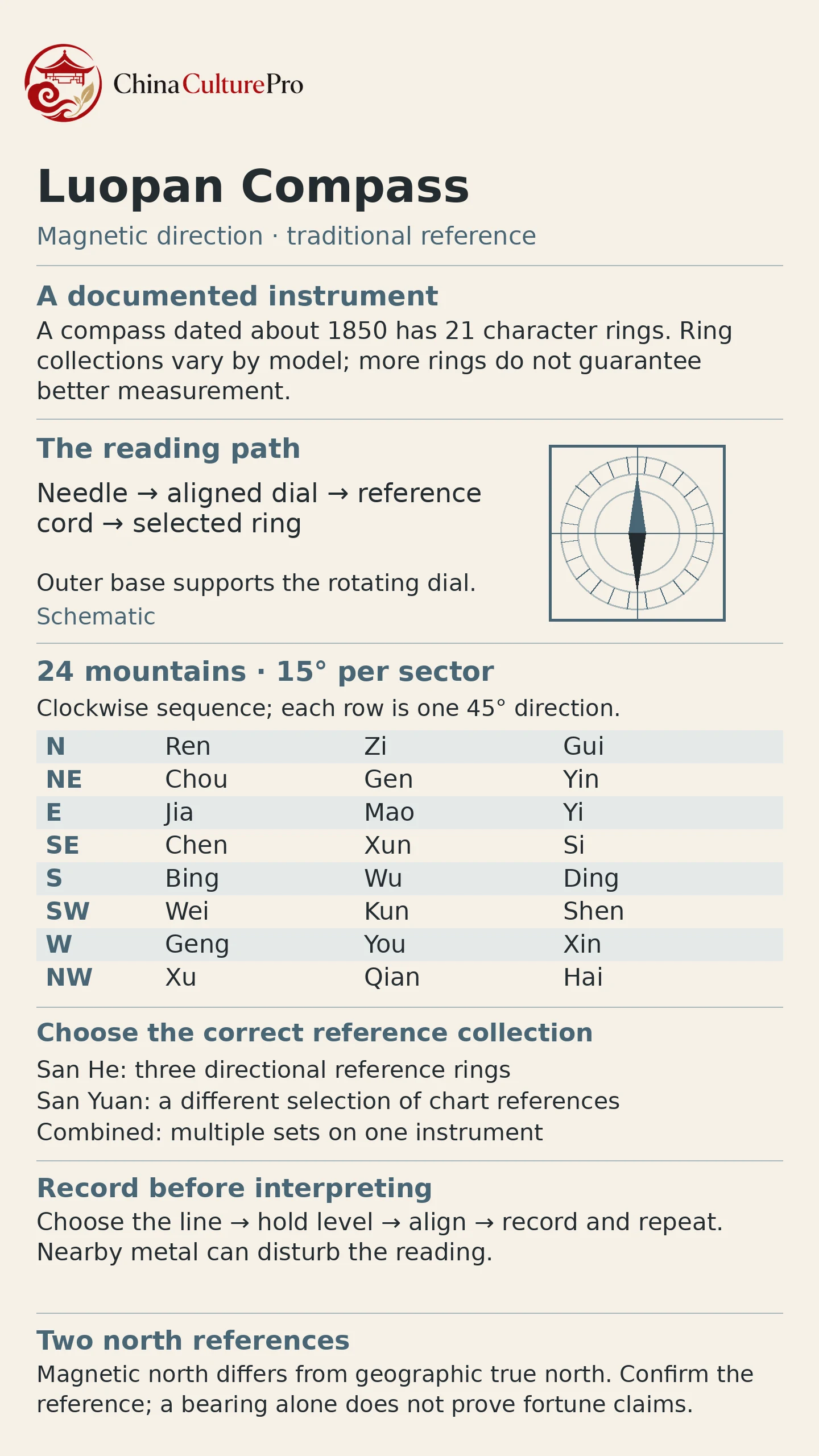
A luopan can look like a coded diagram, but its basic reading path is manageable: find the needle, identify the relevant ring and follow the reference line. The dense writing is a set of lookups around a compass, rather than information the needle itself detects.
For the broader tradition, begin with feng shui principles; this guide concentrates on the instrument.
A Magnetic Instrument with a Historical Record
An eleventh-century discussion in Mengxi Bitan (梦溪笔谈, Mèngxī Bǐtán), or Dream Pool Essays, describes rubbing a needle with lodestone, alternative ways to suspend it and a small departure from exact south. It also acknowledges needles pointing north. This is evidence about magnetized needles, not a description of every feature of a modern multi-ring luopan.[1]
A surviving instrument dated approximately 1850, made by Lin Jun-zhou, has 21 concentric character rings on a circular wooden body. Its central glass and needle are missing. The object therefore documents a particular instrument’s construction and inscriptions, rather than demonstrating its present working accuracy.[2]
Neither record establishes a single invention date for every later luopan design.
The Main Parts of a Luopan
On a common square-based instrument, the central needle chamber is the Tian Chi (天池, tiānchí), literally “Heavenly Pool.” Around it, the Nei Pan (内盘, nèipán), or inner dial, carries concentric scales and rotates within the Wai Pan (外盘, wàipán), the outer support. Some instruments have a circular body instead of this square frame.[3][5]
Two perpendicular reference cords can cross the dial. Once the needle and dial are aligned according to the model’s markings, a cord identifies readings on the selected scales. The cords provide a reading line; they do not independently measure an invisible influence.[3]
Rings may include the eight trigrams, Heavenly Stems and Earthly Branches or twenty-eight lunar mansions. Their presence and ordering depend on the instrument. The ring collection serves particular methods.
The Twenty Four Mountains: Names and Degrees
The Twenty Four Mountains (二十四山, èrshísì shān) divide 360° into twenty-four sectors of 15°. “Mountains” here means named directional sectors. The names combine twelve branches, eight stems and four diagonal trigrams.[4][5]
The following is the standard unshifted directional sequence. Bearings run clockwise from north at 0° or 360°. The N2 interval crosses north; the paired endpoints mark sector boundaries, where measurement uncertainty needs particular care.[4]
| Sector | Name | Degree interval |
|---|---|---|
| N1 | Ren mountain (壬, rén) | 337.5°–352.5° |
| N2 | Zi mountain (子, zǐ) | 352.5°–7.5° |
| N3 | Gui mountain (癸, guǐ) | 7.5°–22.5° |
| NE1 | Chou mountain (丑, chǒu) | 22.5°–37.5° |
| NE2 | Gen mountain (艮, gèn) | 37.5°–52.5° |
| NE3 | Yin mountain (寅, yín) | 52.5°–67.5° |
| E1 | Jia mountain (甲, jiǎ) | 67.5°–82.5° |
| E2 | Mao mountain (卯, mǎo) | 82.5°–97.5° |
| E3 | Yi mountain (乙, yǐ) | 97.5°–112.5° |
| SE1 | Chen mountain (辰, chén) | 112.5°–127.5° |
| SE2 | Xun mountain (巽, xùn) | 127.5°–142.5° |
| SE3 | Si mountain (巳, sì) | 142.5°–157.5° |
| S1 | Bing mountain (丙, bǐng) | 157.5°–172.5° |
| S2 | Wu mountain (午, wǔ) | 172.5°–187.5° |
| S3 | Ding mountain (丁, dīng) | 187.5°–202.5° |
| SW1 | Wei mountain (未, wèi) | 202.5°–217.5° |
| SW2 | Kun mountain (坤, kūn) | 217.5°–232.5° |
| SW3 | Shen mountain (申, shēn) | 232.5°–247.5° |
| W1 | Geng mountain (庚, gēng) | 247.5°–262.5° |
| W2 | You mountain (酉, yǒu) | 262.5°–277.5° |
| W3 | Xin mountain (辛, xīn) | 277.5°–292.5° |
| NW1 | Xu mountain (戌, xū) | 292.5°–307.5° |
| NW2 | Qian mountain (乾, qián) | 307.5°–322.5° |
| NW3 | Hai mountain (亥, hài) | 322.5°–337.5° |
The broader feng shui directions guide explains the eight-direction framework. This finer division matters because a reading can remain broadly “south” while moving between three different named sectors.
San He, San Yuan and Combined Models
San He (三合, sānhé), “Three Harmonies,” and San Yuan (三元, sānyuán), “Three Cycles,” identify major methodological families. A combined instrument is often called Zong He (综合, zōnghé). The labels describe the references supplied for interpretation, rather than three different physical kinds of magnetism.
In a documented San He arrangement, three twenty-four-mountain rings serve different tasks:[5]
- Earth ring: The Earth ring (地盘, dìpán) supplies the unshifted directional reference.
- Human ring: The Human ring (人盘, rénpán) is offset 7.5° counterclockwise from that reference and is used for landform relationships.
- Heaven ring: The Heaven ring (天盘, tiānpán) is offset 7.5° clockwise and is used for water relationships.
Here “Earth ring” means a named scale. It should not be confused with the physical outer wooden base, which some English descriptions also call an earth plate.
San Yuan instruments emphasize another selection of references, often including the unshifted ring and hexagram correspondences. Combined models bring multiple sets together. Flying Star feng shui uses directional information alongside time-based calculations; the compass does not generate the time chart itself. The Form School and Compass School comparison explains how landscape observation and directional calculation overlap.
Taking and Recording a Bearing
A useful reading records what was measured before assigning traditional meaning. The building’s interpreted facing is not automatically identical to its entrance direction; specify the reference rather than silently substituting one for the other.[5]
- Choose the reference: Identify the wall or facing line being measured and record why it was selected.
- Set up the instrument: Hold the luopan level, clear of nearby metal, and let the needle settle.
- Align and read: Align the needle with the instrument’s own reference marks, then read the intended ring under the reference cord.
- Record and repeat: Write down the degree reading, location and north reference, then compare readings taken away from possible interference.
Metal objects and reinforced structures can disturb a magnetic compass. Repeating the measurement is a check on the observation, not proof that a preferred symbolic interpretation is correct.[6]
Facing and sitting are opposite ends of the same axis, 180° apart. Preserve the numerical bearing alongside its named sector so another reader can see which scale and boundary were used.
Magnetic North and Traditional Interpretation
A compass responds to the horizontal component of the local magnetic field. It does not point directly at one single magnetic-pole location. Magnetic declination is the angle between magnetic north and geographic true north, varying with location and time.[7]
When converting a magnetic bearing to a true bearing, add declination with east positive and west negative. However, first establish which reference the intended feng shui method uses and whether the instrument already applies a correction. An unexplained conversion can produce a second, different reference rather than a comparable reading.
The measurement can be checked physically. Claims about fortune, prosperity or a person’s future require separate evidence; accurate degrees do not by themselves validate the meanings printed around them.
FAQs About the Luopan
Does a red needle always point north?
No. Color conventions differ: some Chinese compasses use red for the south-pointing end. Follow the particular instrument’s markings and instructions instead of applying a color rule from another compass.[4]
Can a phone compass replace a luopan?
A phone can provide a bearing, but its north setting, calibration and exposure to magnetic interference still matter. It does not automatically reproduce the selected luopan ring or establish the traditional method used to interpret that reading.
Why do luopans have different numbers of rings?
They contain different collections of reference information for particular methods and users. Extra scales expand the available lookups; they do not guarantee a better needle, clearer alignment or more reliable predictions.
Sources
[1] Shen Kuo. Mengxi Bitan, Volume 24
[2] Whipple Museum of the History of Science. Geomantic compass by Lin Jun-zhou, approximately 1850, accession 0075
[3] Spurlock Museum. Compass, accession 2001.04.0004
[4] Feng Shui Natural. Feng Shui Compass: The Twenty-Four Mountains
[5] Pierfrancesco Ros. The Zhong He Luopan: Explanation and Guide, 2010
[6] U.S. Geological Survey. How to Get Your Map and Compass to Face the Same Direction
[7] NOAA National Centers for Environmental Information. Magnetic Declination