
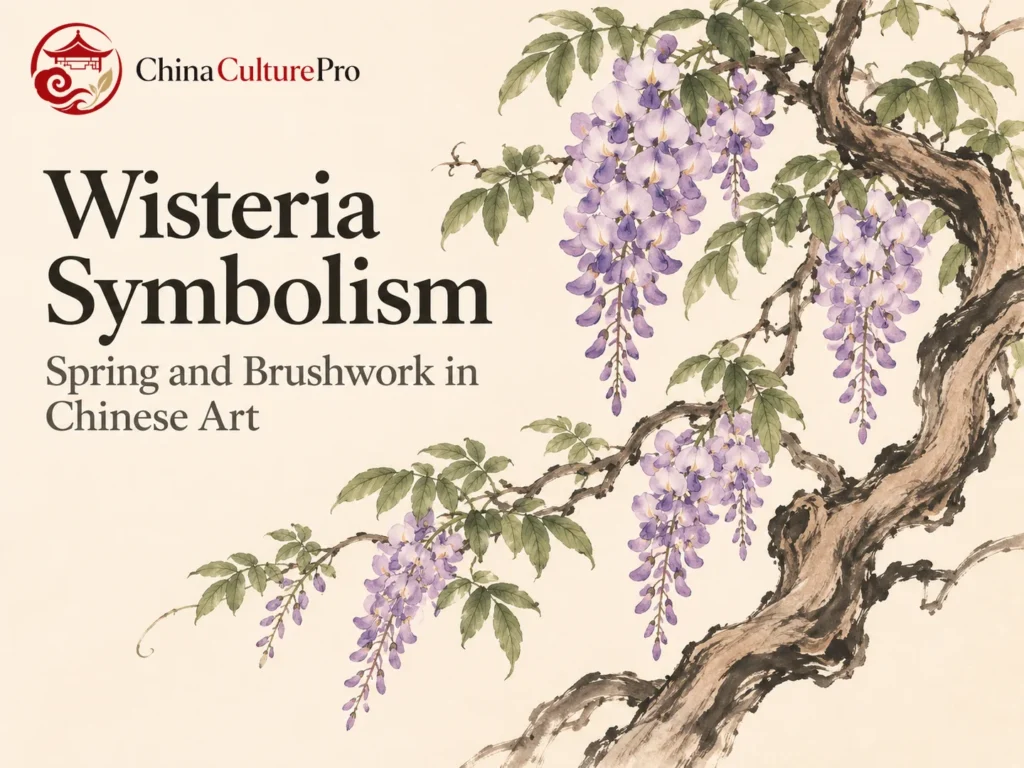

Quick Answer: What Does Wisteria Suggest in Chinese Art?
Wisteria (紫藤, zǐténg) can help signal spring in Chinese painting. Its trailing blossoms and twisting stems also give the artist a way to show movement. An inscription or the album’s seasonal title can show how it was read.[1][2][3]
- Hanging clusters. The flowers fall in elongated sprays.[1][4]
- Twining wood. The stem can curl across or descend through the picture.[3][4]
- Spring setting. The plant appears in Qing albums devoted to seasonal flowers.[1][2]
Read the inscription and surrounding plants before assigning the flower a particular blessing.
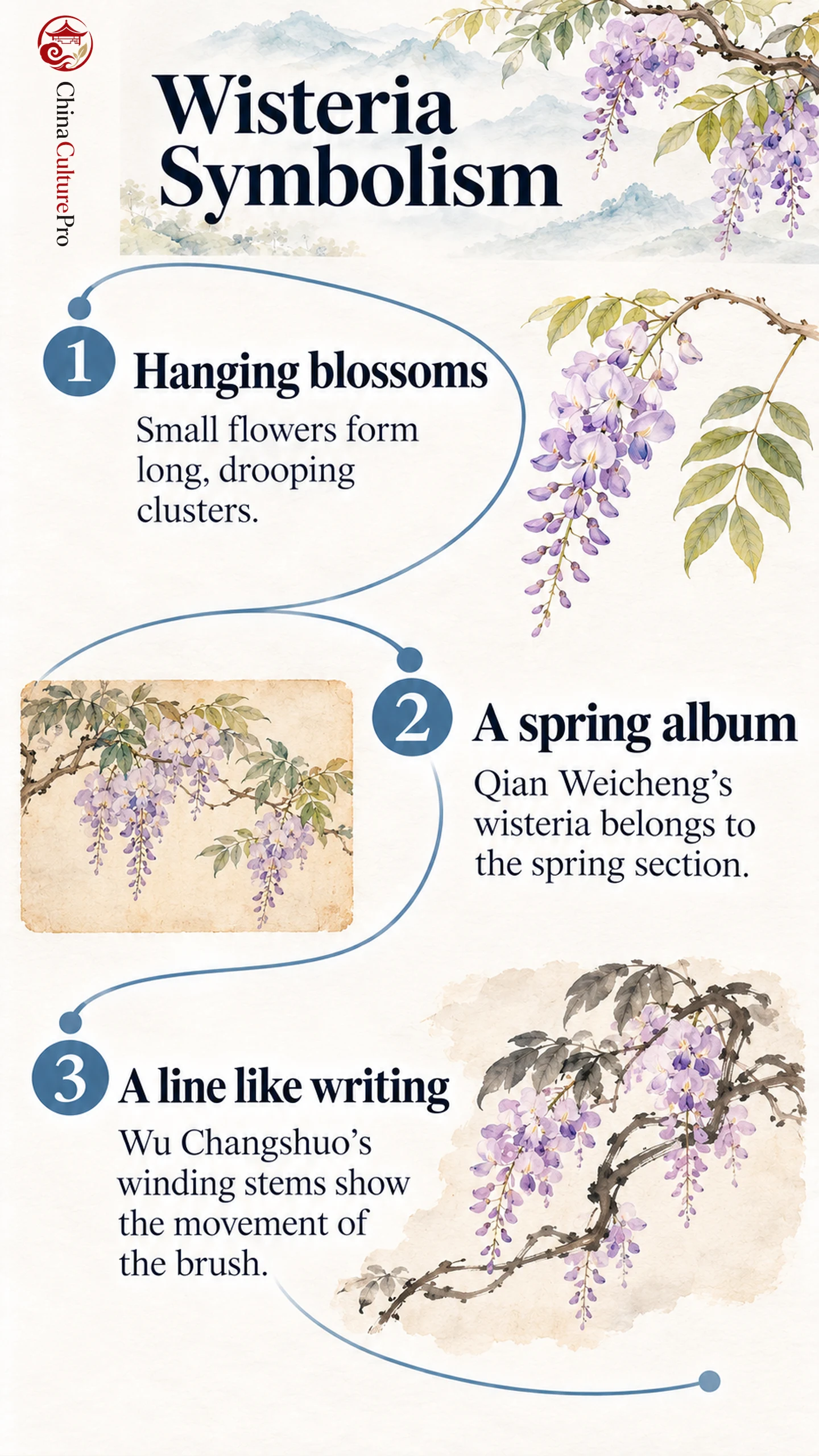
On a small Qing album leaf, a cluster of wisteria can be studied at close range. On a tall Wu Changshuo scroll, the vine gives the eye a path through the whole picture. The same flower can mark a season and give a painter a different kind of line to work with.[1][2][3]
Recognizing a Flowering Wisteria Vine
Look for long, hanging clusters of many small blossoms beside a twisting woody stem. Chinese wisteria commonly has blue-violet, pea-shaped flowers and leaves made of separate leaflets. A painter may simplify those features. The clusters and the shape of the vine can still distinguish wisteria from upright sprays or blooms that grow singly.[3][4]
In oriole paintings, a bird’s song or flight can give spring a sense of movement. In a wisteria picture, the direction of the hanging stems and flowers can carry movement across the picture.[2][3]
Wisteria in Two Qing Album Leaves
Ma Yuanyu’s Wisteria, dated 1703, is a small painting on silk in an album of flowers. The National Palace Museum classifies it as meticulous brushwork. At about 24 centimeters across, the leaf brings the flower into a compact field.[1]
Qian Weicheng’s Blooming Wisteria appears in the spring section of a four-seasons flower album. Qianlong’s inscription describes drooping purple flowers with wind and dew. It also draws attention to the absence of a tall supporting branch. The missing support gives the viewer a detail to consider alongside the flower’s seasonal setting.[2]
How Wu Changshuo Uses the Twisting Stem
In Wu Changshuo’s Dew-Moistened Pearls, dated 1922, tangled vines and cascading blossoms are central to the design. The title brings moisture and shine to mind. Strong ink and pigment make the light flower clusters stand out against the heavier strokes.[3]
A separate wisteria scroll in the Palace Museum uses strokes associated with highly cursive calligraphy. The line can turn and loop with the plant. This helps explain why wisteria was a useful subject for a painter interested in the movement of writing.[5]
FAQs About Wisteria Symbolism in Chinese Art
Do purple blossoms alone identify wisteria?
No. Look for the hanging clusters, a twining stem and compound leaves. A title or inscription can resolve the identification in a loose ink painting.[1][3][4]
Does wisteria always represent wealth or longevity?
Its documented roles include seasonal imagery and a subject for expressive brushwork. Read any specific auspicious interpretation from the work’s inscription, companions or context.[2][3][5]
Sources
[1] National Palace Museum. Ma Yuanyu, Wisteria
[2] National Palace Museum. Qian Weicheng, Blooming Wisteria
[3] The Metropolitan Museum of Art. Wu Changshuo, Dew-Moistened Pearls
[4] NC State Extension. Chinese Wisteria
[5] Palace Museum. Wu Changshuo, Wisteria hanging scroll