


Quick Answer: What Is Good Chinese Gift Giving Etiquette?
Good Chinese gift giving etiquette starts with the recipient, your relationship and the occasion. A thoughtful, manageable gift usually communicates more than an impressive price tag.
- Suitable choices: Consider tea, snacks, fruit or a regional keepsake that matches the person’s tastes.
- Symbolic cautions: Clocks, pears, umbrellas and certain colors or numbers have associations that some recipients prefer to avoid.
- The exchange: Present the gift attentively, thank the giver when receiving, and respect a clear refusal.
These are social conventions rather than a single national checklist. A family visit, wedding and professional meeting call for different judgments; personal preferences remain essential.
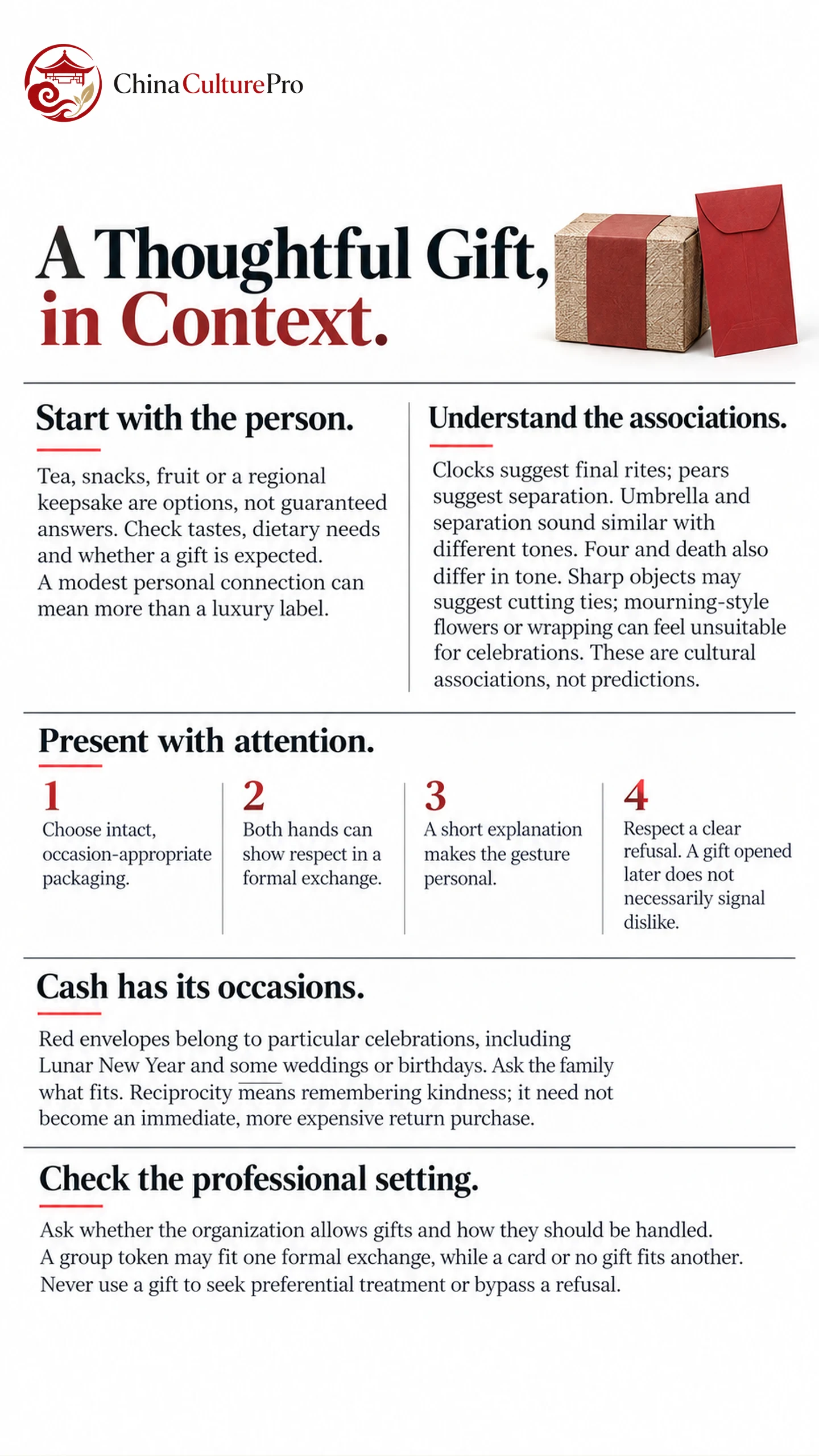
A box of tea brought to a family dinner and a red packet presented at a wedding do different social work. One thanks a host; the other participates in a celebration. Understanding that distinction makes Chinese etiquette easier to navigate than memorizing a long list of forbidden objects.
Choose for the Person and the Occasion
Start by asking what the person would enjoy, what the invitation involves and whether a gift is expected. A modest item with a connection to your home region can give you something personal to explain without putting the recipient under pressure. In formal exchanges, local meaning and an appropriate price can matter more than luxury branding. [1]
For a home visit, possible gifts include packaged biscuits, seasonal fruit, tea or a small craft. Food, fruit, handicrafts and everyday items also appear in Chinese community accounts of celebratory gift giving. Treat them as a starting menu of options rather than a guaranteed answer. [2] A person who rarely drinks tea may prefer something else; unfamiliar sweets may be unsuitable if their ingredients are unclear.
Before buying food, check allergies, dietary restrictions and whether the household can use or store it. Alcohol suits a recipient who wants it; it should not be an automatic choice for an elder, colleague or host. For children, ask a parent about age suitability and preferences instead of assuming every family welcomes sweets or toys.
A close friend’s requested practical gift has a different meaning from an unsolicited gift to someone you barely know. Likewise, wedding gifts and gifts for a new baby belong to their own family arrangements. A quick question to the person who invited you is often more useful than a supposedly universal shopping list.
Common Gift Taboos and What They Mean
Many familiar cautions depend on language or associations with parting and mourning. They describe meanings people may attach to a gesture; the object does not cause the event. Clock, pear and number-four associations feature in published gift guidance, but their importance differs between recipients. [3]
| Gift or detail | Traditional association | How to use the information |
|---|---|---|
| A clock | “Give a clock,” 送钟 (sòng zhōng), sounds identical to 送终 (sòng zhōng), attending someone at death or arranging their final rites | Choose another unsolicited celebratory gift when you do not know the person’s view |
| Pears | 梨 (lí), pear, sounds like 离 (lí), to leave or separate | Be cautious about a symbolic gift to a couple; this is not a ban on eating pears |
| An umbrella | 伞 (sǎn) resembles 散 (sàn), to disperse or part; their tones differ | A requested useful umbrella and a symbolic relationship gift need not be read alike |
| Four items | 四 (sì), four, resembles 死 (sǐ), death; their tones differ | Avoid a prominently emphasized four when choosing a traditional celebratory set |
| Knives or scissors | Sharp edges can suggest severing a relationship | Check before giving an unsolicited symbolic gift; do not assume every cook rejects a requested knife |
| White chrysanthemums or mourning-style wrapping | Associations with funerals in some traditional settings | Ask about the occasion; do not generalize this into a ban on all white flowers or modern white packaging |
The umbrella association is explicitly taught as a similar sound in Chinese-language cultural materials, not an identical pronunciation. Sharp-object and separation associations also appear in community tradition guides. [2][4] Those distinctions matter: English lists often flatten every example into “a homophone” or “always forbidden.”
If a friend has asked for a particular item, you can check whether its symbolism matters to them rather than overriding their request. For an unfamiliar host or formal birthday celebration, a different gift is an easy way to avoid ambiguity. The broader context of Chinese superstitions explains why such associations can remain recognizable without being everyone’s personal belief.
Wrapping, Presenting and Receiving a Gift
Use clean, intact packaging suited to the occasion. Red or gold can look festive; a recipient’s preferred color or understated professional packaging may be more suitable in another setting. Avoid turning a traditional mourning association into a rule that every black box or white ribbon is offensive.
When formally presenting a gift, offering and receiving with both hands is a familiar way to show attention and respect. University guidance also allows a single gift as well as a pair, so neither the hand gesture nor the item count needs to become an elaborate performance. [5] Add a short explanation: “This is a specialty from my hometown; thank you for inviting me.”
Do not make acceptance a contest. An initial “You shouldn’t have” can express modesty, but a clear refusal can reflect preference, discomfort or a rule the recipient must follow. Acknowledge it and stop. Leaving the object behind after someone has declined can create the very obligation you meant to avoid.
When receiving, thank the giver and acknowledge the thought behind the gift. It may be put aside and opened later; this is a documented convention and need not signal disappointment. [6] Opening immediately is also possible when the giver or occasion invites it. You can simply ask, “Shall I open it now?” rather than guessing at a universal rule.
Red Envelopes and Returning the Gesture
A cash gift in a hongbao(红包,hóngbāo), or red envelope, belongs to specific occasions in occasions such as Lunar New Year and some family celebrations. New Year gifts from older relatives to children are one familiar example. That does not make cash the default answer to every dinner invitation or friendship. [3]
For a wedding or birthday, ask someone close to the family whether a present, red packet or no gift is preferred. Community accounts record red packets at celebratory events, including gifts conveyed when the invited person cannot attend, but that is evidence of a custom rather than a requirement for every invitation. [2] Relationship, household expectations and local practice matter more than an online cash-amount formula. Our red envelope guide covers that separate tradition.
Reciprocity can mean remembering the kindness and finding a suitable later opportunity to respond. It need not mean immediately buying something more expensive or keeping a strict running account. A thoughtful thank-you and a later invitation may better fit a friendship than a competitive exchange of purchases. For the social pressures around generosity and embarrassment, see face in Chinese culture.
Gifts at Work and Institutional Boundaries
A personal celebration and an official or professional relationship require different checks. Before bringing a workplace gift, ask the organization whether gifts are allowed, who can receive them and whether they must be declared. This is a practical boundary check, not a claim that one rule covers every employer or jurisdiction.
Formal delegation guidance describes modest gifts linked to the giver’s region and, in some situations, a group gift presented through delegation leaders. That example should not be transferred automatically to a private visit or an individual employee. [1] A thank-you card, shared token or no gift may be the appropriate choice where the institution says so.
Do not attach an expectation of preferential treatment to a gift, or assume that guanxi and social relationships excuse institutional rules. If the recipient declines on policy grounds, accept the explanation without proposing cash, a private delivery or another route around it.
FAQs About Chinese Gift Giving
Is tea always a suitable gift?
No. It can be thoughtful for a tea drinker, but taste, storage and personal preferences still matter. Ask before choosing an expensive or unfamiliar variety.
Should I insist if someone refuses my gift?
Do not treat every refusal as ritual modesty. If the person clearly declines, thank them for explaining and stop rather than leaving the gift behind.
Do Chinese gifts have to come in pairs?
No. Pairs have auspicious associations in some celebrations, but a single appropriate gift is also possible. Four is a separate symbolic caution, not a rule against all even numbers.
What if I accidentally give an unlucky gift?
Listen to the recipient. If it bothers them, briefly explain your intention and offer to exchange it. A considerate response is more useful than arguing about the belief.
Sources
[1] Trade Commissioner Service of Canada. Business etiquette in China
[2] Singapore Federation of Chinese Clan Associations. Social etiquette in Chinese culture, Oneness 43, page 53
[3] ChinaCulture.org. The art of giving to Chinese
[4] Confucius Institute Headquarters / Hanban. Taboo Gifts in China, cultural language lesson
[5] Huaqiao University. Etiquette
[6] Peking University International Students Division. Chinese Culture and Customs