

Quick Answer: What Does This Chinese Culture Glossary Cover?
This glossary introduces nineteen cultural terms through English meanings, Chinese characters—hanzi(汉字,hànzì)—and Mandarin pronunciation written in pinyin(拼音,pīnyīn). Tone marks help distinguish spoken syllables; characters and context help identify what a term means.[1]
- Relationships: Vocabulary used to discuss conduct, responsibilities and social connections.
- Ideas: Terms found in accounts of nature, change and order.
- Festivals and arts: Names connected with celebrations and cultural practices.
These are concise entry points. A philosophical term may have different meanings in different texts, while a festival or art can vary between communities.
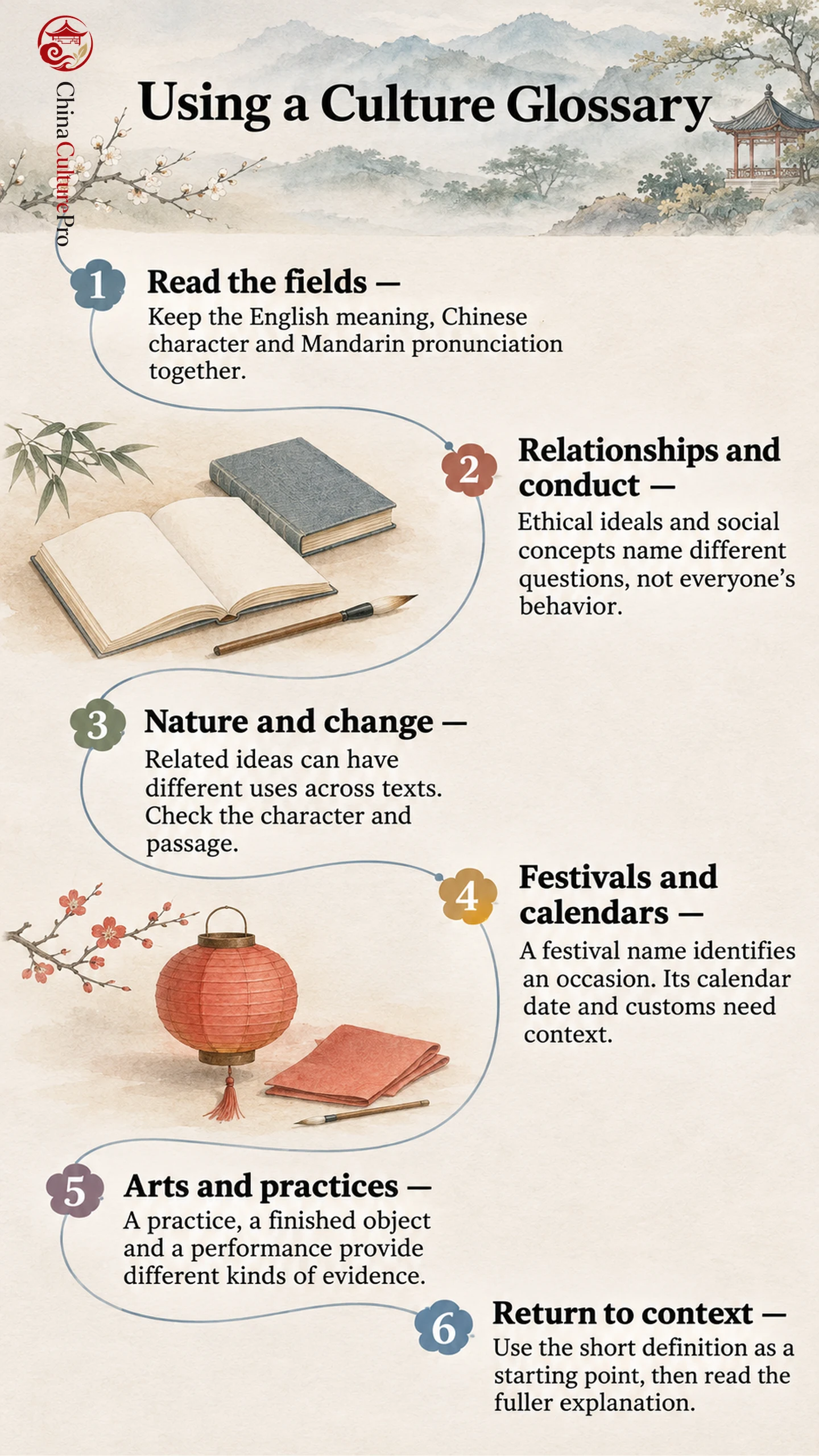
A short English gloss can help you enter a discussion, but it rarely explains a cultural term completely. This reference keeps the character, pronunciation and meaning together so you can identify a word, avoid common confusions and choose a more detailed subject to explore next.
How to Read the Entries
Each table gives an English label, simplified Chinese characters, Mandarin pronunciation and a short meaning. Pronunciation is not an English translation. Mandarin has four main tones and a neutral tone; a syllable without a tone mark may be neutral rather than incorrectly printed.[1]
Use the pinyin guide alongside the introduction to Chinese characters if these fields are new to you. Matching the letters alone is not enough to identify every word: different characters can share a pronunciation.
The entries are grouped by subject rather than by a claim that all the ideas belong to one religion or historical period. Start with the group relevant to what you are reading. The links lead to fuller explanations; the short definitions help you decide which one you need.
Relationships and Ethical Vocabulary
Several terms below appear in discussions of ethical conduct and relationships. They name ideas people have debated, not behaviors that every Chinese person automatically follows.[2]
| Term, characters and pronunciation | Concise meaning |
|---|---|
| Humaneness(仁,rén) | Benevolence or humane concern for others in ethical thought.[2] |
| Ritual propriety(礼,lǐ) | Fitting conduct, rites and forms of respect within relationships and occasions.[2] |
| Rightness(义,yì) | What is morally fitting or righteous, rather than merely advantageous.[2] |
| Filial piety(孝,xiào) | Responsibilities and care directed toward parents within family ethics.[2] |
| Harmony(和,hé) | A valued condition of relationships whose interpretation depends on context.[2] |
| Face(面子,miànzi) | Socially recognized standing or reputation in interactions.[3] |
| Guanxi(关系,guānxi) | Relationships and connections that can involve trust and reciprocal expectations.[3] |
A discussion of a virtue asks what people ought to do. An account of an interaction asks what they actually did and why. Keep those questions separate when moving from a definition to an example. A person’s choices need their own context; a familiar keyword cannot supply the whole explanation.
Ideas about Nature, Change and Order
These terms occur in several intellectual traditions. The meanings given here identify a reading context rather than a scientific classification of the world.
| Term, characters and pronunciation | Concise meaning |
|---|---|
| Dao(道,dào) | A way or path, extended to questions of conduct and how things unfold.[2] |
| Qi(气,qì) | A traditional concept connected with breath and dynamic material processes; meanings vary.[4] |
| Yinyang(阴阳,yīnyáng) | Related polar tendencies used to describe cycles, interaction and change.[4] |
| Wuxing(五行,wǔxíng) | An interacting scheme of wood, fire, earth, metal and water in traditional thought.[5] |
| Li as pattern(理,lǐ) | Pattern or coherence, especially in later philosophical accounts of how things are organized.[4] |
The two forms pronounced lǐ in these tables have different characters: 礼 concerns ritual propriety, while 理 concerns pattern or principle. This is why keeping the character beside a romanized word matters.[2]
Older English sources may write Tao where newer works write Dao. Different romanization systems can produce different spellings of the same source word; spelling alone does not establish a separate philosophy.[6]
Festivals and the Cultural Calendar
Festival names identify occasions, not identical programs followed by every family. The month-and-day descriptions below use the traditional lunar-month count within the Chinese lunisolar calendar.
| Term, characters and pronunciation | Concise meaning |
|---|---|
| Spring Festival(春节,Chūnjié) | The traditional new-year celebration, associated with reunions and welcoming a new year.[7] |
| Lantern Festival(元宵节,Yuánxiāo Jié) | The festival on the fifteenth day of the first lunar month.[7] |
| Dragon Boat Festival(端午节,Duānwǔ Jié) | Festival on the fifth day of the fifth lunar month, with boat races and local customs.[8] |
| Mid-Autumn Festival(中秋节,Zhōngqiū Jié) | Festival on the fifteenth day of the eighth lunar month, associated with family gatherings and the moon.[8] |
An English festival name and its Chinese name may emphasize different features. Use both when checking a reference. To find a celebration’s date on a Gregorian calendar, check the relevant year rather than treating the lunar-month description as a fixed Gregorian date.
Arts and Cultural Practices
An art’s name identifies a practice or instrument. Understanding an example also requires attention to its maker, material, setting and audience.
| Term, characters and pronunciation | Concise meaning |
|---|---|
| Calligraphy(书法,shūfǎ) | Writing practiced as an expressive visual art.[9] |
| Paper-cutting(剪纸,jiǎnzhǐ) | An art of cut-paper designs with varied motifs, techniques and occasions.[10] |
| Guqin(古琴,gǔqín) | A seven-string plucked zither without movable bridges along its strings.[11] |
A definition guides your attention; looking and listening add different evidence. A musical performance and a photograph of its instrument convey different information. A character’s meaning and its treatment in an artwork also answer different questions.
Moving from a Term to Its Context
When a word matters to your reading, keep a small record of the character, pronunciation, passage and source. Then ask what the author is doing with it. Is it an ethical ideal, the name of an occasion or an interpretation of an object?
If two translations differ, compare their source passage before choosing a favorite English word. A longer explanation may be more accurate than a single-word equivalent. Use a glossary to orient yourself, then return to the full text or practice that gave the term its meaning.
FAQs About Chinese Culture Terms
Are pinyin and Chinese characters the same thing?
No. One writes pronunciation with Roman letters; the other is the character writing system. Keep both when identifying a term.
Why do some words have no tone mark on one syllable?
That syllable may have a neutral tone. Check the word’s pronunciation rather than adding a mark by guesswork.
Are Tao and Dao different ideas?
Those spellings commonly reflect different romanization systems for 道. Check the source before treating spelling as a conceptual difference.
Does each Chinese term have one exact English translation?
No. Translation depends on the passage, period and purpose. A brief gloss identifies a starting meaning, not every possible use.
Sources
[1] The Open University. Beginners’ Chinese: Tones
[2] David K. Jordan, University of California San Diego. Chinese Philosophical Terms
[3] Kwang-kuo Hwang. Face and Favor: The Chinese Power Game
[4] Stanford Encyclopedia of Philosophy. Metaphysics in Chinese Philosophy
[5] Internet Encyclopedia of Philosophy. Wuxing
[6] Internet Encyclopedia of Philosophy. Romanization Systems for Chinese Terms
[7] National Museum of Asian Art. Lunar New Year
[8] Hong Kong Tourism Board. Celebrate With These Time-Honoured Chinese Festivities
[9] The Metropolitan Museum of Art. Chinese Calligraphy
[10] UNESCO Multimedia Archives. Chinese Paper-cut
[11] Hong Kong Leisure and Cultural Services Department. A Rendezvous with the Guqin