

Quick Answer: How Do Chinese and Western Cultures Differ?
Chinese and Western cultural settings can differ in expectations about relationships, communication, learning and individual choice. However, research finds multiple ways of combining independence and interdependence, rather than two opposite cultural personalities.[1]
- Compare specific settings: A mainland university and a US university are more clearly defined than “China” and “the West.”
- Separate ideas from behavior: A valued ideal does not predict every person’s choices.
- Keep variation visible: Region, generation, resources, institutions and the immediate relationship can change what happens.
Cultural comparisons can identify useful patterns. They become misleading when a group-level pattern is treated as a rule about an individual.
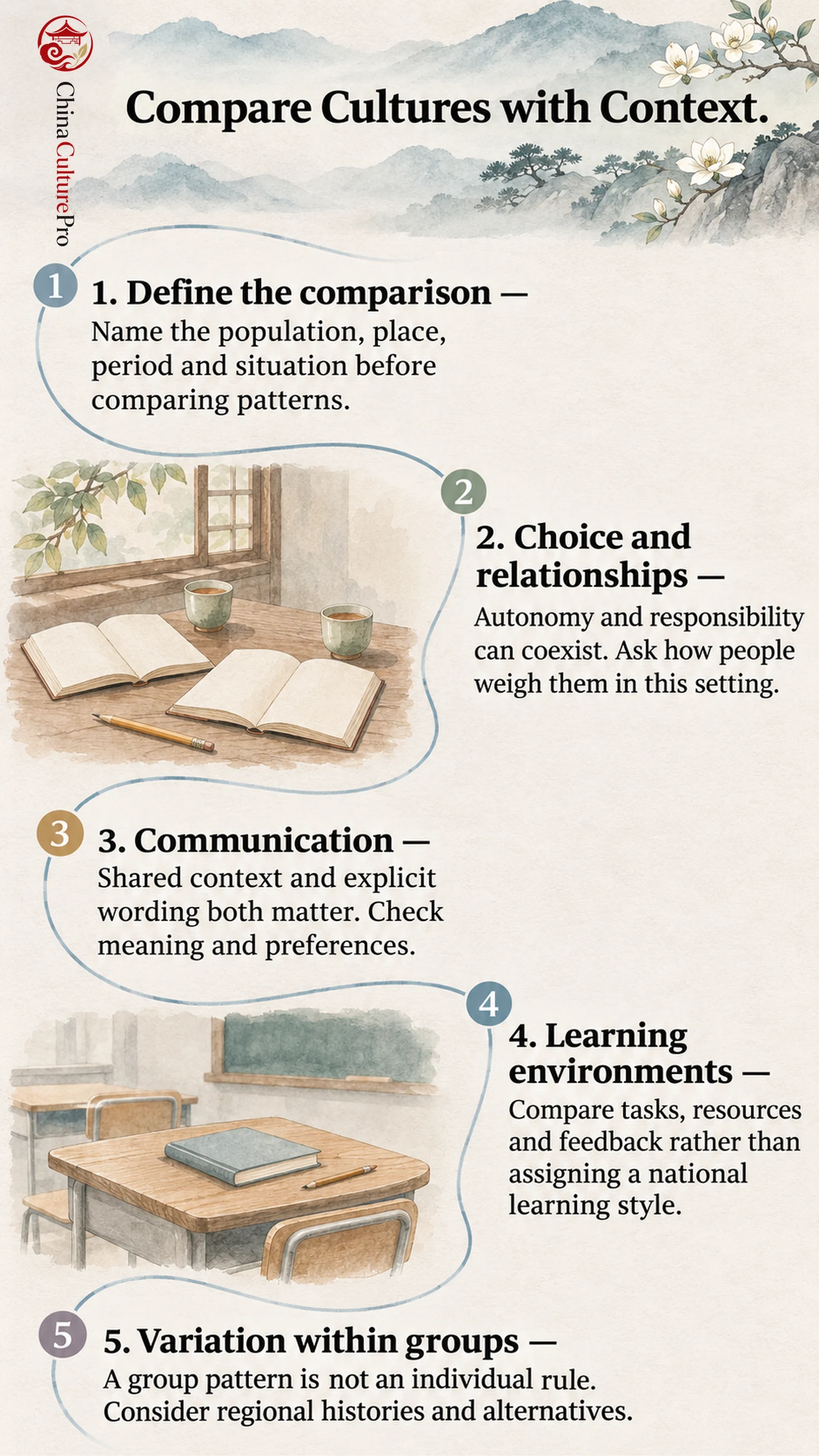
A quiet classroom, a family discussion and a workplace meeting can produce very different impressions of culture. The useful question is what each setting asks people to do. This guide compares common themes while showing how to distinguish a supported difference from an assumption that merely sounds familiar.
Define the People, Place and Situation First
“The West” is a broad label, not one population with a single upbringing. China also contains substantial internal variation. In a 2016 multinational project, a seven-dimensional model captured ways of being independent and interdependent better than a simple East–West split. Its validation sample included 7,279 adults from 55 cultural groups in 33 nations.[1]
A separate methodological concern is whose experiences become the default. Research based on Western, educated, industrialized, rich and democratic populations—often abbreviated WEIRD—cannot automatically describe humanity as a whole. Nor can an American student sample represent everyone in Europe or North America.[2]
Use these topics as questions to investigate:
| Common comparison | What to examine instead |
|---|---|
| Individual versus group | Which decisions can someone make, and whom do they consult? |
| Direct versus indirect | What is being said, to whom, through which medium? |
| Obedience versus independence | What responsibilities and opportunities does each person have? |
| Memorization versus creativity | What does the particular lesson or assessment require? |
| Traditional versus modern | Which practice, place and period are being compared? |
Use that detail to make the comparison precise. Replace “Western families do this” with an identified group and a clearly described practice whenever the evidence allows.
Individual Choice, Family and Relationships
Confucian thought(儒家,rújiā) offers an influential relational ethic: a good life includes responsibilities within relationships. Filial piety(孝,xiào) concerns duties toward parents, but historical discussions also consider judgment and tensions between obligations. This is more complex than a rule that the group always defeats the individual.[3]
The philosophical distinction between harmony and sameness is useful here. A workable relationship can involve differing views. Ethical ideals concerning care and conduct should not be mistaken for proof that all Chinese households reach decisions in the same way.[3]
For example, two hypothetical families considering a child’s move abroad might both value education and staying connected. One may emphasize proximity; another may favor the opportunity while arranging regular contact. National labels alone cannot tell you how either family will decide.
Read Chinese cultural values for the historical vocabulary, then ask how the people concerned interpret their responsibilities. Autonomy and care are not automatically mutually exclusive, and neither concern belongs exclusively to one region of the world.
Communication, Context and Disagreement
A familiar comparison labels Chinese communication “high-context” and Western communication “low-context.” The underlying question is how much meaning depends on shared knowledge and the situation, rather than explicit words. A 2011 systematic review found inconsistent and weak support for many country classifications attached to that framework.[4]
This does not mean communication styles never differ. It means a country label is a poor substitute for observing the interaction. A private conversation between friends and a public disagreement with a manager involve different relationships, even when everyone shares a language.
Face(面子,miànzi) names a concern with socially recognized standing.[5] The topic of face in Chinese culture can help you ask why public criticism feels different from private feedback. It should not become an assumption that every Chinese person dislikes direct speech or that everyone elsewhere welcomes it.
In practice, make consequential details explicit and invite clarification. Ask whether someone prefers written feedback, a private discussion or questions during a presentation. Treat silence as a reason to check understanding, not automatic agreement.
Education: Look beyond Rote Learning and Creativity
The contrast between Chinese memorization and Western creativity mixes educational ideals with stereotypes about learners. A 2024 analysis of PISA 2015 data compared school resources and disciplinary climate in four mainland Chinese jurisdictions, Japan, the United States and the United Kingdom. These were selected systems, not samples of every Chinese or Western school.[6]
The analysis found comparable types of school profiles across the systems, alongside differences in their proportions. Schools with stronger disciplinary climates were associated with higher science performance in both cultural groupings. This does not establish that national culture caused the outcome, or that orderly learning excludes independent thought.[6]
To compare classrooms, look at the task, feedback, curriculum, assessment and available resources. A student might memorize vocabulary in one lesson and construct an argument in another. Describing those activities tells you more than assigning the student a permanent learning style based on origin.
The history of Chinese education traditions adds context, but it cannot replace evidence about a particular contemporary classroom.
Differences within China and Better Comparisons
A 2014 study involving 1,162 Han Chinese(汉族,Hànzú) participants at six sites found differences on psychological tasks between people from historically rice-growing and wheat-growing areas. The researchers proposed agricultural legacies as an explanation for those measured differences. This was a regional research finding, not evidence that eating rice determines a person’s mind.[7]
Such research changes the comparison question. Instead of assuming a national average describes everyone, ask how local histories and institutions might matter. Keep the study’s participants, measures and proposed explanation separate from claims about all people living in those regions today.
A useful comparison identifies both differences and similarities, then tests alternative explanations. If behavior changes when a meeting becomes private, relationship and setting may matter alongside cultural expectations. If two schools differ in resources, national tradition is not the only possible explanation. Cultural knowledge works best when it improves observation rather than replacing it.
FAQs About Chinese and Western Culture
Is Chinese culture collectivist and Western culture individualist?
That is a common shorthand, but too broad on its own. Independence and interdependence have several dimensions, and groups combine them differently.
Are Chinese people always indirect?
No. Relationship, purpose, medium and individual preference matter. Check what someone means rather than interpreting every message through a national label.
Is critical thinking a uniquely Western skill?
No. Comparing learning requires examining actual tasks and educational settings, not equating a student’s origin with ability.
Which culture is better?
A broad cultural ranking is not a useful conclusion. Compare a particular practice against an explicit purpose while considering its effects on the people involved.
Sources
[1] Vivian L. Vignoles and colleagues. Beyond the East–West Dichotomy: Global Variation in Cultural Models of Selfhood
[2] Joseph Henrich, Steven J. Heine and Ara Norenzayan. The Weirdest People in the World?
[3] Stanford Encyclopedia of Philosophy. Chinese Ethics
[4] Markus G. Kittler, David Rygl and Alex Mackinnon. Beyond Culture or Beyond Control?
[5] Kwang-kuo Hwang. Face and Favor: The Chinese Power Game
[6] Yu Hu. How Do Confucian Schools and Anglo Schools Differ?
[7] T. Talhelm and colleagues. Large-Scale Psychological Differences within China Explained by Rice versus Wheat Agriculture