

Quick Answer: What Is Cultural Appreciation?
Cultural appreciation means engaging with another culture through learning, respect and acknowledgment of the people behind a practice. With Chinese culture, the useful question is how a particular garment, artwork, celebration or custom is being used.
- Understand the context: Learn what the object or practice means in its actual setting.
- Listen to people involved: An invitation, a maker’s explanation and a host’s expectations provide relevant guidance.
- Represent it accurately: Give credit, avoid caricature and distinguish your adaptation from an inherited tradition.
Good intentions are a starting point. They do not answer every question about access, portrayal or the effects of a particular use.

A dress worn at a wedding, a brush lesson and a photograph of a ceremony raise different questions. Understanding the setting helps you participate thoughtfully and respond to a concern. You can enjoy learning without asking one person to authorize your relationship with an entire culture.
Appreciation and Appropriation: Look at the Use
Appreciation involves valuing a practice and acknowledging its source. Concerns about appropriation arise when borrowing involves disrespect, stereotyping, exploitation or stripping away important context. Educational guidance connects respectful cultural engagement with learning and an ongoing willingness to examine one’s assumptions.[1]
Intent and effect can differ. Someone may intend a compliment while presenting a living community as a decorative image. Conversely, participating in an activity offered to visitors need not mean claiming that tradition as one’s invention. Look at what is happening and who is involved before reaching a conclusion.
| Situation | A useful question |
|---|---|
| Attending a public celebration | What activities are visitors invited to join? |
| Wearing a garment for a family occasion | What does this particular family or host expect? |
| Learning a craft | Who made the teaching model, and what does its design mean? |
| Posting a photograph or recording | Have the people involved agreed to this kind of sharing? |
| Adapting an existing design | Have I identified its source and described my changes honestly? |
These are questions for different situations. They are not a checklist that guarantees agreement or turns any one person’s answer into universal permission.
Clothing, Festivals and Learning an Art
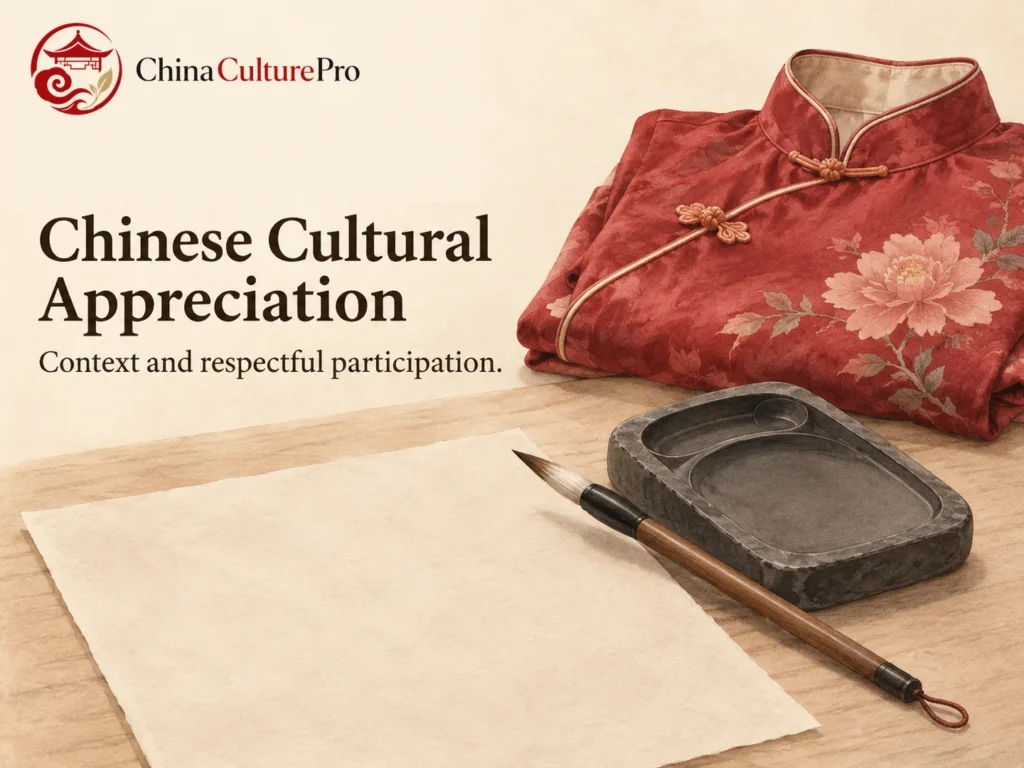
The qipao(旗袍,qípáo), also called cheongsam in English, illustrates why clothing debates need context. Interviews published in 2021 recorded differing responses to a widely discussed prom dress and to Chinese-inspired fashion. The interviewees welcomed respectful interest while questioning mocking or exoticizing presentations. Those were particular voices, not a survey establishing what everyone of Chinese heritage thinks.[2]
For an actual invitation, ask the host about the occasion, garment and expectations. Learning the background of qipao and cheongsam also gives you more to work with than the idea of a generic “Chinese costume.” Avoid treating one garment as the clothing of every region, period or community.
Some settings explicitly invite broad participation. A public Lunar New Year festival announced for February 2026 included museum tours, family activities, performances and a food-and-maker market. It provides a concrete example of cultural learning offered to visitors. The invitation concerned the advertised activities; it did not establish unrestricted access to every space or participant.[3]
Chinese calligraphy(书法,shūfǎ) offers another route into learning. Brush and ink, controlled movement and established stroke order contribute to the work; it is more than a decorative pattern resembling writing.[4] A beginner’s calligraphy lesson can begin with understanding the model and its meaning. Label practice as practice, and check characters rather than inventing shapes that merely look plausible.
Community Voices, Access and Credit
Living heritage involves people who maintain and transmit it. UNESCO’s ethical principles give those communities a primary role, emphasize dialogue and consent, and recognize that customary access restrictions can matter. They also address the interests of practitioners when others document, promote or adapt their heritage. These are aspirational safeguarding principles, not a universal criminal rule governing every cultural encounter.[5]
In a particular setting, ask the people responsible for the activity about participation and sharing. A festival organizer can explain that event’s expectations; a teacher can explain their lesson; an artist can explain a commissioned work. Each speaks from a particular position. One friendly answer does not establish that every related practice is unrestricted.
Credit should be specific enough to be useful: name the maker, teacher, community or documented tradition when known. If you purchase work directly, learn how its creator describes it. Ask separately how the maker wants the work identified and whether the intended presentation fits the setting.
The wider subject of Chinese intangible cultural heritage is therefore connected to practitioners and transmission, as well as objects that can be displayed.
Sharing and Adapting with Clear Context
Respect does not require treating traditions as frozen. Living heritage is continually recreated, and safeguarding principles explicitly recognize its dynamic character.[5] An adaptation can be described openly without claiming to represent every practitioner or reproduce a historical original.
For a classroom display, caption or personal project, identify the particular example and the limits of what you know. “My practice after a brush-writing lesson” makes a different claim from “authentic ancient Chinese writing.” Explain a change instead of hiding it behind a vague label.
If someone raises a concern, ask which feature is troubling: inaccurate wording, an inappropriate setting, missing credit or an unwanted recording. Correct the specific issue where you can. The discussion becomes more useful when it concerns an actual choice, rather than asking people to defend or condemn all cultural exchange. Recognizing cultural stereotypes can help you notice when an image has replaced attention to living people.
FAQs About Chinese Cultural Appreciation
Can someone without Chinese heritage wear a qipao?
Yes, it can be welcomed. Learn about the garment and occasion, follow the host’s expectations and avoid presenting it as a caricature. Opinions can differ.
Does buying an item settle every question about its use?
No. Purchase, accurate attribution and the expectations surrounding a practice are different matters. Ask about the particular use you intend.
Can traditions change without losing their value?
Yes. Living traditions are recreated by their practitioners. Be clear about whose practice you are describing and what you have adapted.
Sources
[1] Arizona State University. Student Government Racial Bias Toolkit
[2] USC US-China Institute. Say Yes to the West: Globalization of the Qipao
[3] National Museum of Asian Art. 2026 Lunar New Year Festival Announcement
[4] Dawn Delbanco, Metropolitan Museum of Art. Chinese Calligraphy
[5] UNESCO. Ethics and Intangible Cultural Heritage