


Quick Answer: What Was Ancient Chinese Culture?
Ancient Chinese culture includes changing practices of government, belief, writing, craftsmanship and daily life. This guide concentrates on the Shang dynasty(商朝,Shāngcháo) through the Han dynasty(汉朝,Hàncháo), approximately the second millennium BCE to 220 CE.[1]
- Ideas and institutions: Ritual obligations, political authority and competing explanations of good government developed together.
- Material culture: Objects and inscriptions reveal skilled production, social differences and exchanges between regions.
- Everyday practices: Food, clothing and work depended on location, resources and household circumstances.
“Ancient” has no single endpoint in every book. Always check the dates attached to a practice rather than treating several millennia as one moment.
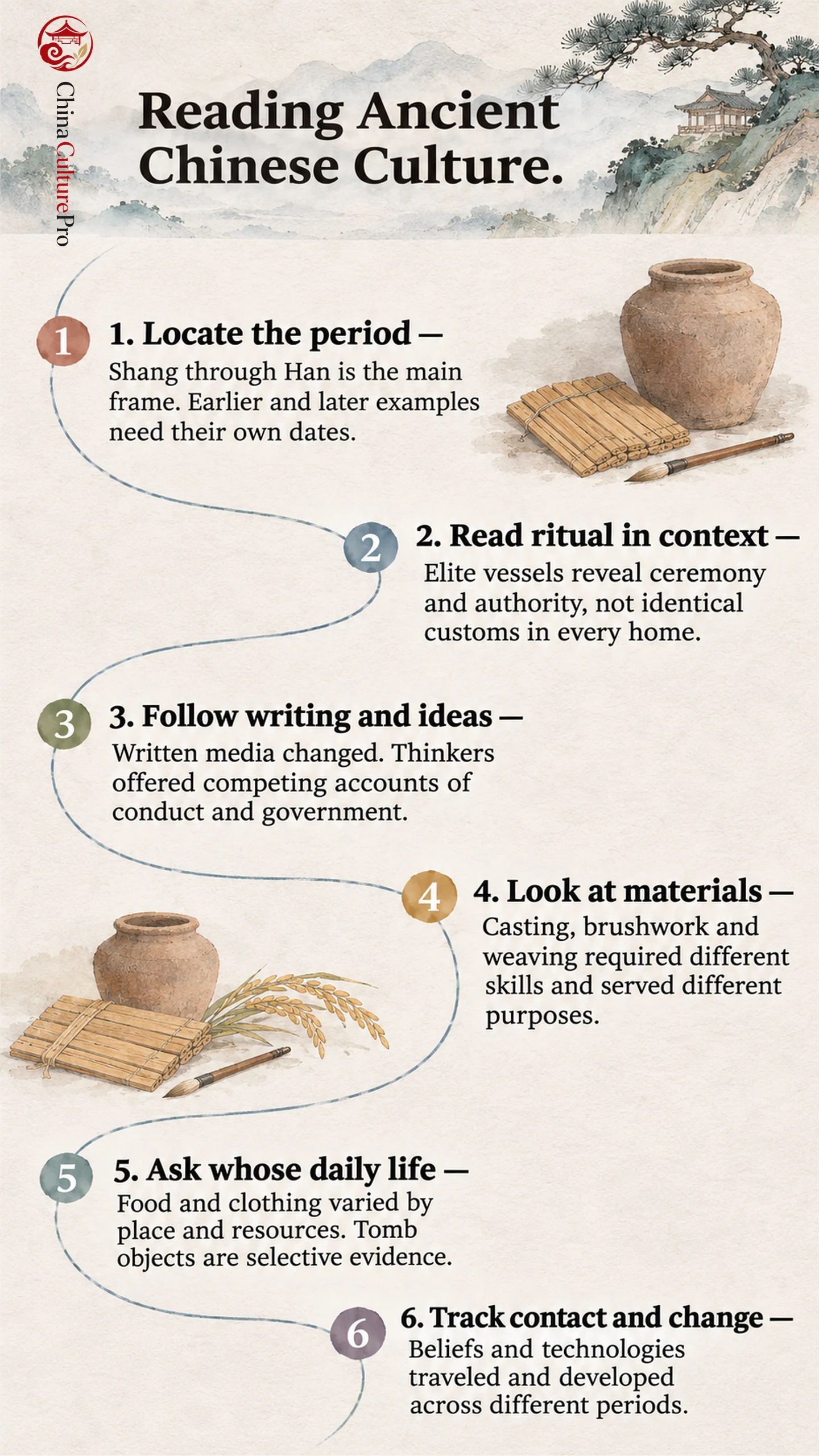
A bronze vessel, a written bamboo strip and a clay granary tell different stories about ancient China. One concerns ceremony, another records language, and another represents provisions for an afterlife. Reading them together helps connect ideas with material life—while asking whose experiences the surviving evidence actually represents.
Periods, Regions and the Evidence We Have
Earlier farming settlements and regional craft traditions preceded the states discussed here. Even during the Shang period, important bronze-producing centers existed beyond the royal heartland. Ancient China was never simply one city expanding an identical culture everywhere.[1]
| Period | Approximate dates | Useful cultural evidence |
|---|---|---|
| Shang | c. 1600–1050 BCE | Royal inscriptions and ritual bronzes |
| Zhou dynasty(周朝,Zhōucháo) | c. 1050–256 BCE | Changing ritual forms and philosophical debates |
| Qin dynasty(秦朝,Qíncháo) | 221–206 BCE | Imperial standardization and administrative materials |
| Han | 206 BCE–220 CE | Written documents, tomb objects and wider exchanges |
The Zhou royal house ended in 256 BCE; the Warring States continued until Qin unification in 221 BCE. Use a Chinese dynasties timeline to keep these different boundaries clear.[1]
Texts require questions about authorship, transmission and later editing. Archaeological objects require questions about place, date and use. A richly furnished tomb is evidence of selective investment in burial; it is not a representative household inventory. Combining different kinds of evidence produces a stronger account than making one spectacular discovery explain everyone.
Ritual, Ancestors and Social Authority
Bronze vessels held food and drink for offerings to ancestors and other powers. Their manufacture and ceremonial use connected skilled labor, wealth and authority in elite settings. A vessel’s shape, inscription and archaeological setting can help establish its particular function; attractive decoration alone cannot explain the whole ceremony.[2]
These objects often survive from elite contexts. They show that ritual mattered to powerful households, but they do not establish that every farming family owned comparable sets. Ancestor-related practices also changed over time. It is misleading to reconstruct a single nationwide household ritual from royal tombs.
For a closer look, Chinese bronze vessels explain how form and use belong together. Some striking animal-like designs remain difficult to interpret. Recognizing that uncertainty is more useful than assigning every motif a confidently stated spiritual meaning.[2]
Writing and Competing Ideas about a Good Life
Oracle-bone inscriptions(甲骨文,jiǎgǔwén) preserve an early, developed form of Chinese writing. Incised bone, cast bronze and brush-written surfaces offered different possibilities for making characters. Chinese calligraphy grew through changing writing practices and styles; it was not invented fully formed in a single moment.[3]
Bamboo and wooden strips also carried documents. Surviving writing reflects administrative and learned activity particularly strongly; the existence of written records does not mean that everyone could read them.[4]
Thinkers disagreed about how people should live and how rulers should govern:
- Confucian thought(儒家,rújiā): Traditions associated with Confucius(孔子,Kǒngzǐ) connected cultivated character, ritual conduct and obligations within relationships. Confucianism cannot be reduced to unquestioning obedience; responsibilities involved more than one side of a relationship.[5]
- Daoist thought(道家,dàojiā): Early texts questioned rigid human prescriptions and explored the dao(道,dào), or way. Daoism encompasses later developments too; early philosophical discussions should not be equated with every subsequent religious practice.[6]
- The fa tradition(法家,fǎjiā): Often called Legalism, this later classification groups thinkers concerned with standards, institutions and effective government. It was not a unified organization calling itself a school, and “law” in the modern sense does not exhaust the meaning of fa.[7]
Arts, Materials and Skilled Production
Craftsmanship combined knowledge of materials with demanding work. In piece-mold bronze casting, a model and sectional molds helped establish the vessel’s form and surface design. The decoration was therefore part of production, not simply an image painted onto a finished pot.[2]
Writing likewise depended on trained movement and suitable tools. A brush could vary a stroke’s thickness and direction in ways that an incised line could not. These choices made writing expressive as well as practical.[3]
Materials also carried different social meanings. Stone, metal, clay, wood and textile were not interchangeable expressions of one style. A useful museum reading begins with material and technique, then asks about ownership and function. Comparing a ritual vessel with a writing surface reveals different kinds of expertise rather than a ranking of “advanced” and “primitive” objects.
Food, Clothing and Everyday Work
Food varied by region and means. Millet and wheat were important in northern settings, while rice was prominent farther south. Grain-centered ordinary meals differed from the elaborate provisions placed in wealthy tombs. There was no single ancient menu eaten by the entire population.[4]
Plant-fiber cloth, including hemp, served practical needs; silk could express considerable wealth. The fine gauze garment associated with Xin Zhui(辛追,Xīn Zhuī), also called Lady Dai, demonstrates exceptional weaving and elite consumption. It does not show that everyone wore similarly delicate silk.[4][8]
Clay granaries and other tomb models represent an expectation of provisions after death. They also offer clues about storage, buildings and work, provided that their funerary purpose remains visible in the interpretation.[4]
The broader subject of ancient Chinese daily life therefore needs several scales of evidence: settlements and tools, written obligations, household resources and burial choices. A farmer, craft worker and court official could inhabit the same period while having very different routines.
Contacts, Change and Later Traditions
Ancient communities exchanged goods, techniques and ideas. Buddhism(佛教,Fójiào) reached China from India during the Han period through wider networks of contact. Its later importance does not make it a belief present throughout the earlier Shang and Zhou worlds.[9]
Technology also needs a timeline. Paper developed during the Han, alongside continued use of other writing materials. Surviving ninth-century printed almanac fragments belong to a much later setting: evidence for printing should not be moved backward merely because paper and printing now seem inseparable.[1][10]
The history of the Silk Road provides a useful next step for understanding exchange. Cultural continuity involved adaptation and selection, not the unchanged preservation of every early custom. Modern practices may draw on ancient language or objects while acquiring purposes that early users would not have recognized.
FAQs About Ancient Chinese Culture
When does ancient Chinese culture begin and end?
Definitions vary. This guide centers on Shang through Han, with earlier context and explicitly identified later developments. Check a source’s own period boundaries.
Did everyone in ancient China share the same beliefs?
No. Regions, social positions and periods differed, and surviving texts preserve debates rather than one universally accepted philosophy.
Did ordinary people wear silk?
Silk use varied with resources and circumstances. Elite silk garments cannot represent everyone’s clothing; plant-fiber textiles were important too.
Were all famous Chinese inventions ancient?
No. Developments associated with China emerged in different periods. Give each technology its own evidence and chronology.
Sources
[1] Princeton University Art Museum. China: Historical Timeline
[2] The Metropolitan Museum of Art. Shang and Zhou Dynasties: The Bronze Age of China
[3] The Metropolitan Museum of Art. Chinese Calligraphy
[4] Smithsonian Institution. Art and Archaeology of Ancient China
[5] Stanford Encyclopedia of Philosophy. Confucius
[6] Stanford Encyclopedia of Philosophy. Daoism
[7] Stanford Encyclopedia of Philosophy. Legalism in Chinese Philosophy
[8] Hunan Museum. Plain Unlined Gauze Gown
[9] National Museum of Asian Art. Han Dynasty
[10] Susan Whitfield, British Library. Calendar and Conquest: A Piece of Ninth-Century Chinese Propaganda