

Quick Answer: What Does He Mean?
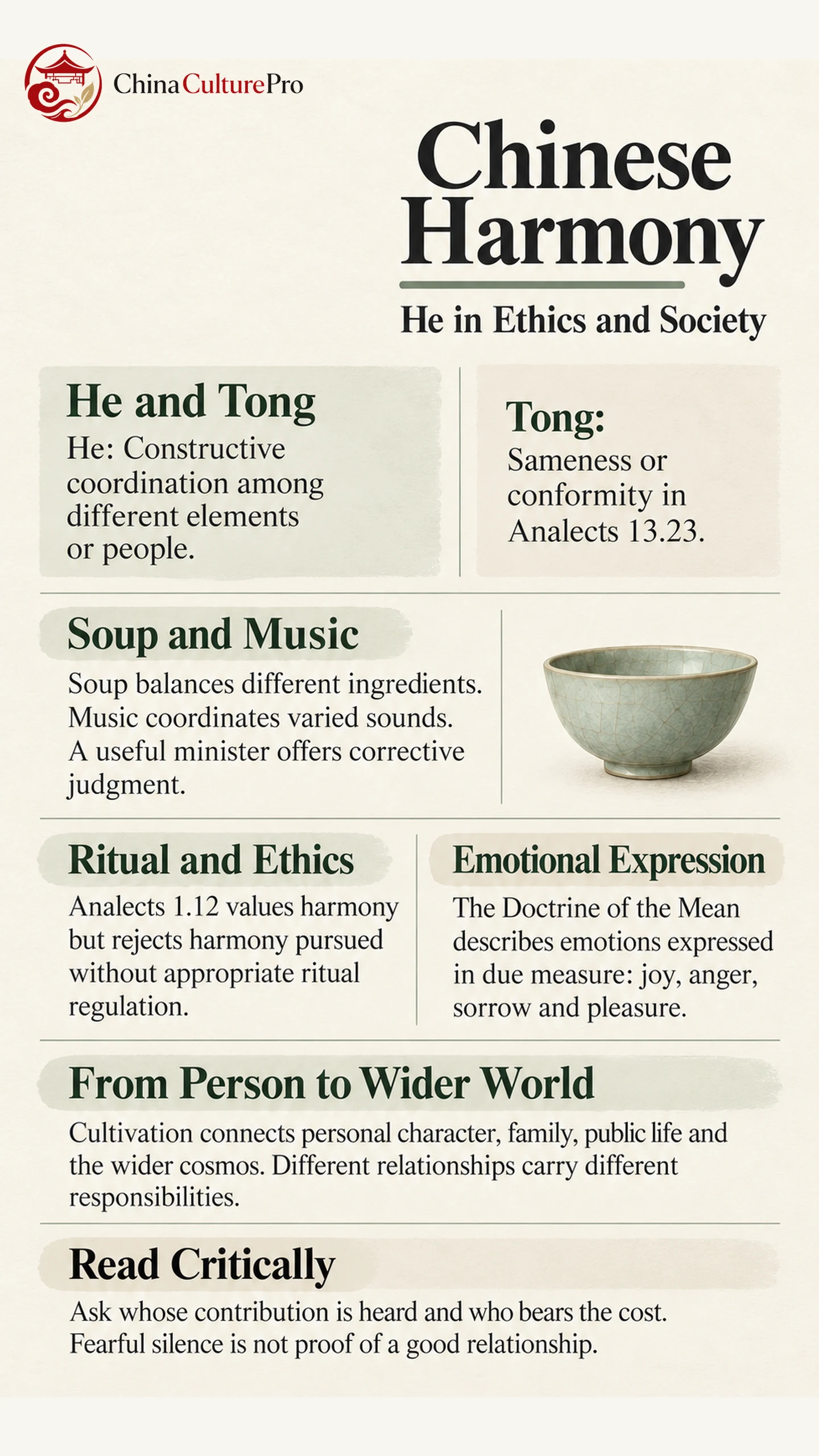
He (和, hé), usually translated as harmony, concerns constructive coordination among different elements or people. In classical Confucian ethics, it can include difference and disagreement.[1][6]
- Tong (同, tóng) means sameness or conformity in the famous contrast with harmony.
- Cooking and music illustrate how distinct contributions can form a worthwhile whole.
- Ritual and moral judgment help distinguish harmony from agreeable appearances.
- Harmony can describe emotions, relationships, society and the wider cosmos.
It is an ethical ideal developed across texts and periods, not a claim that Chinese society has always been free of conflict.[4]
A group can agree because its members have worked through their differences, or because nobody dares to object. Chinese discussions of harmony help explain why those situations differ. Within Chinese philosophy, the important question is how relationships can work well while their participants retain distinct responsibilities and perspectives.
He and Tong: Harmony and Sameness
Harmony without uniformity (和而不同, hé ér bù tóng) is associated with a passage in the Analects (论语, Lúnyǔ), 13.23. It contrasts the junzi (君子, jūnzǐ), the ethically exemplary person, with someone whose agreement fails to produce a genuinely harmonious relationship.[1]
| Term | Meaning in the contrast | What to notice |
|---|---|---|
| He | Constructive coordination among different elements or people | Contributions need not be identical |
| Tong | Sameness or conformity, contrasted with harmony in Analects 13.23 | Apparent agreement can conceal a poor relationship |
This passage gives difference a positive role. Disagreement about what should be done can coexist with commitment to a shared relationship. Matching another person’s words may reveal little concern for that person’s good. The junzi ideal concerns character and judgment, rather than sociability alone.
Why Classical Texts Compare Harmony to Soup and Music
The Zuo Commentary (左传, Zuǒzhuàn), in its account of Duke Zhao’s twentieth year, records Yan Ying distinguishing harmony from sameness. His cooking example combines water, fire, vinegar, sauce, salt and plum to prepare fish or meat. The cook adjusts deficiencies and excesses; adding water to water cannot accomplish the same task.[2]
The political comparison is pointed. A useful minister contributes an objection when the ruler’s proposal contains a problem, or identifies merit in something the ruler has rejected. Merely repeating approval or disapproval offers no corrective contribution. Harmony involves judgment about how different contributions fit together.
Music supplies a related image: varied sounds, durations and qualities become a coordinated performance. Repeating one undifferentiated sound misses the relationship among parts. These metaphors show why harmony can involve active adjustment rather than a fixed, peaceful appearance.[2][4]
Ritual Gives Harmony an Ethical Shape
Ritual propriety (礼, lǐ) gives conduct a patterned form within relationships. Analects 1.12 values harmony in the practice of ritual but also rejects pursuing harmony without appropriate ritual regulation. Read beside 13.23, it prevents harmony from becoming a license to accept anything for an easy agreement.[1]
The connection between Confucian virtues and ritual propriety matters here. A courteous response can preserve another person’s dignity while leaving room for correction. Empty politeness, however, can make a harmful arrangement look successful. The ethical quality of the relationship matters alongside its smoothness.
For example, imagine siblings discussing care for a parent. One sibling’s quiet acceptance of an impossible burden would not by itself demonstrate a well-ordered relationship. Asking who has time, what support is available and which obligations can be shared is a contemporary illustration of harmonizing through adjustment.
Emotional Harmony Is Appropriate Expression
The Doctrine of the Mean (中庸, Zhōngyōng) connects equilibrium (中, zhōng) with harmony in its opening chapter. It distinguishes emotions before their arousal from their expression in due measure. Joy, anger, sorrow and pleasure can all enter the discussion; harmony is not simply the absence of strong feeling.[3]
This distinction changes how “balance” should be read. It concerns a fitting response, not an arithmetic midpoint between feeling nothing and feeling intensely. Grief may belong to loss, and anger may register a wrong. The philosophical question is whether the expression fits the circumstances and one’s relationships.
The text then connects cultivated equilibrium and harmony with Heaven, Earth and the flourishing of things. That is a classical moral and cosmological claim, rather than a medical promise that controlling emotions guarantees health.
From Family Relationships to the Wider World
In Confucian thought, cultivating a person and improving relationships are closely connected. Discussions of harmony extend from the family to public life and, in some texts, the cosmos. These levels share an interest in coordinated flourishing, but they do not all require identical conduct.[4]
A friend, parent and public official occupy different relationships and answer to different responsibilities. The useful question is how their actions support a relationship without making another participant’s legitimate interests disappear. The same concept can therefore connect personal character with social judgment.
This wider outlook also belongs beside the Chinese philosophical relationship between humanity and nature. The cosmic language gives human conduct a place in a larger order; it should not be mistaken for evidence that every historical Chinese school taught one environmental doctrine.
Reading Harmony Critically Today
The classical texts arose in societies marked by unequal rank and authority. Their resources for disagreement are significant, but they do not automatically amount to a modern theory of equal rights or unrestricted pluralism. Contemporary interpretations must explain how an old ethical ideal addresses different institutions and expectations.[5]
A practical way to evaluate an appeal to harmony is to ask whose contribution is heard and who bears the cost of agreement. Silence produced by fear can coexist with an orderly surface. A claim of harmony therefore deserves examination of the actual relationships it describes.[5][6]
Constructive accommodation also has limits. Some interests remain in tension, and achieving a satisfactory relationship is not guaranteed. Reading harmony as an ongoing ethical task makes more sense than treating it as a permanent state in which all disagreement has vanished.[6]
FAQs About Chinese Harmony
Does harmony mean never disagreeing?
No. The classical contrast with sameness allows disagreement to contribute to a better relationship or decision. How the disagreement is handled still matters.
Is harmony the same as yin and yang?
No. Yin and yang (阴阳, yīnyáng) describe relational contrasts and transformations. Harmony is a broader ideal or condition; the two ideas can connect without being interchangeable. The comparison of yin and yang with the Five Elements explains neighboring systems.
Does emotional harmony mean suppressing anger?
The Doctrine of the Mean associates harmony with emotions expressed in due measure. Its account includes anger rather than requiring emotional numbness.
Did Confucius invent the idea of harmony?
No. Textual discussions draw on earlier practices and images, including cooking and music. Confucian thinkers developed the concept within an evolving tradition.
Sources
[1] Robert Eno, Indiana University. The Analects of Confucius: A Teaching Translation
[2] Chinese Text Project. Zuo Commentary: Duke Zhao, Twentieth Year
[3] Classical Chinese Text Archive. Doctrine of the Mean: Original Chinese Text
[4] Chenyang Li. The Philosophy of Harmony in Classical Confucianism
[5] David B. Wong, Duke University manuscript. Soup, Harmony, and Disagreement
[6] Stanford Encyclopedia of Philosophy. Chinese Ethics