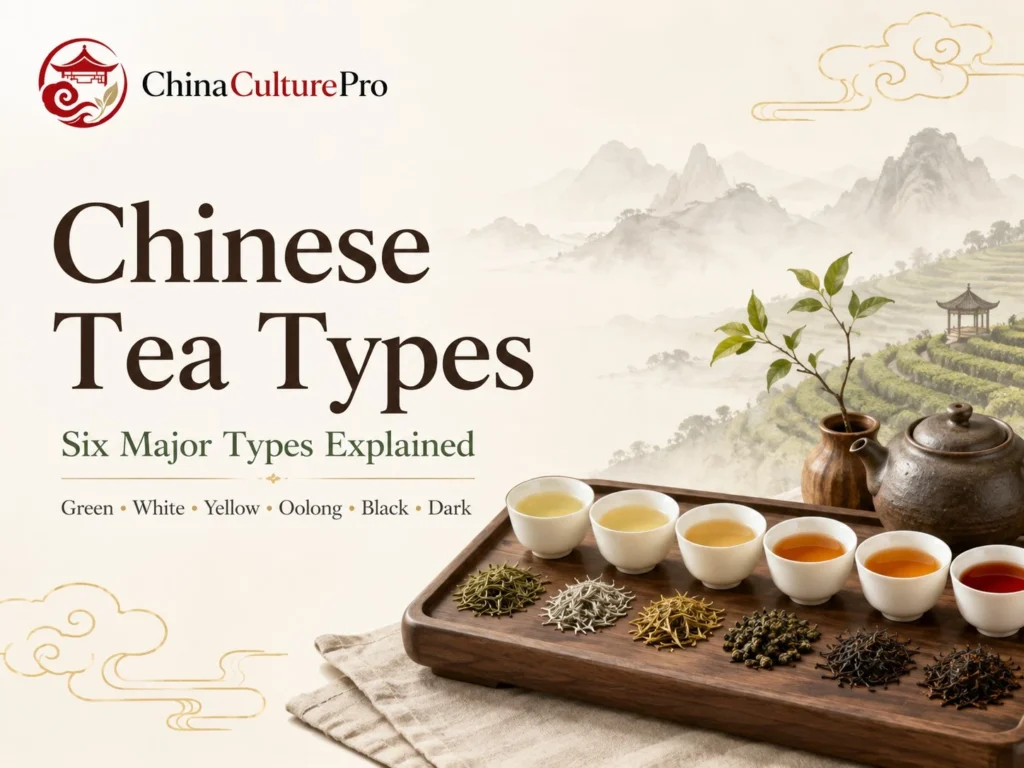

Quick Answer: What Are the Main Types of Chinese Tea?
Chinese tea is usually classified into six major types. The classification is based on processing method, not simply the color of the dry leaves or tea liquor.
Green Tea / Lü Cha (绿茶): fixed early by Sha Qing to preserve fresh, clear, grassy flavor.
White Tea / Bai Cha (白茶): lightly processed through withering and drying, creating a soft, sweet, gentle taste.
Yellow Tea / Huang Cha (黄茶): shaped by Men Huang, or yellowing, which makes the tea smoother and less grassy than green tea.
Oolong Tea / Wulong Cha (乌龙茶): partially oxidized and often roasted, with the widest aroma range among Chinese tea types.
Black Tea / Hong Cha (红茶): fully oxidized, with sweet, malty, honey-like, and red-bright character. In English, Hong Cha is called black tea.
Dark Tea / Hei Cha (黑茶): post-fermented tea shaped by piling, microbial transformation, compression, storage, and time.
Pu-erh tea is often discussed within the dark tea world, but it deserves separate treatment because of its Yunnan material, sun-dried maocha, Sheng and Shou systems, and storage culture.
Key Point: Chinese tea types are not defined by color alone. They are defined by how craft changes the leaf. The same tea plant can become very different teas depending on whether it is fixed, withered, yellowed, oxidized, roasted, fermented, compressed, or stored.
How Chinese Tea Types Are Classified
Chinese tea classification is based on processing and transformation, not plant species. True tea comes from the tea plant, Camellia sinensis. The difference between tea types comes from what happens after the leaves are picked.
A Chinese tea master would not begin by asking only whether the tea soup is green, yellow, red, or dark. The better question is: What did the craft do to the leaf?
The main craft points include:
- Sha Qing / Kill-Green: used in green tea, yellow tea, oolong tea, and Sheng Pu-erh, but for different purposes.
- Withering: central to white tea, also important in oolong and black tea.
- Oxidation: limited in green tea, partial in oolong tea, full in black tea.
- Men Huang / Yellowing: the defining step of yellow tea.
- Zuoqing and Yaoqing: the shaking and resting process that helps create oolong aroma.
- Roasting: especially important in many oolong teas.
- Post-Fermentation: central to dark tea and ripe Pu-erh.
- Storage: especially important for Pu-erh and many dark teas.
This is the key to understanding Chinese tea types: craft creates taste. Green tea preserves freshness. White tea develops gentle sweetness. Yellow tea softens green sharpness. Oolong tea builds aroma layers. Chinese black tea becomes sweet and red-bright through full oxidation. Dark tea develops aged depth through fermentation and storage.
Chinese Tea Types at a Glance: Craft, Taste, and Use
This comparison table is the fastest way to understand the six major Chinese tea types.
| Tea Type | Chinese Name | Core Craft | Oxidation / Fermentation Direction | Taste Direction | Famous Examples | Best For |
|---|---|---|---|---|---|---|
| Green Tea | 绿茶 | Sha Qing / kill-green | none or very low oxidation | fresh, grassy, clear | Longjing, Biluochun, Maojian | fresh daily drinking |
| White Tea | 白茶 | withering and drying | minimal processing, light natural change | sweet, floral, gentle | Silver Needle, White Peony, Shou Mei | soft and gentle tea |
| Yellow Tea | 黄茶 | Men Huang / yellowing | low oxidation, yellowing step | mellow, smooth, sweet | Junshan Yinzhen, Huoshan Huangya | rare mellow tea |
| Oolong Tea | 乌龙茶 | partial oxidation, shaking, roasting | partial oxidation | floral, roasted, layered | Tie Guan Yin, Da Hong Pao, Dan Cong | aroma and Gongfu Cha |
| Black Tea / Hong Cha | 红茶 | full oxidation | full oxidation | sweet, malty, red-bright | Keemun, Dian Hong, Jin Jun Mei | sweet warm drinking |
| Dark Tea / Hei Cha | 黑茶 | post-fermentation and storage | post-fermented | earthy, woody, aged | Liu Bao, Fu Brick, Anhua Dark Tea | thick aged tea |
This table is only a map. Real tea is more complex. A green tea can be nutty, a white tea can become deeper with age, an oolong can be floral or heavily roasted, and dark tea can range from smooth Liu Bao to Golden Flower Fu Brick. Still, the core logic is clear: processing creates category.
Green Tea: Fresh, Clear, and Fixed Early
Green tea, or Lü Cha (绿茶), is one of the most widely produced and widely consumed Chinese tea types. Its core craft is Sha Qing, often translated as kill-green or fixation. Heat is used early to stop enzyme activity and preserve the fresh character of the leaf.
Green tea is usually associated with:
- Core craft: Sha Qing, rolling, drying.
- Oxidation level: none or very low.
- Taste direction: fresh, grassy, bean-like, chestnut-like, clear, lightly sweet.
- Famous examples: Longjing, Biluochun, Maojian, Lu’an Guapian.
- Brewing direction: usually 80–85°C, glass cup or gaiwan, short infusion.
- Best for: fresh daily drinking, office tea, clear and light tea sessions.
Green tea is important, but it is not the default form of all Chinese tea. Many English readers meet Chinese tea through green tea first, so they may assume Chinese tea is mainly fresh, light, and grassy. In reality, green tea is only one branch of a much larger craft system.
For fresh and clear tea, read our Chinese Green Tea guide.
White Tea: Lightly Processed and Naturally Sweet
White tea, or Bai Cha (白茶), is one of the least processed Chinese tea types. Its core craft is withering and drying. It is not “unprocessed tea,” but it uses less intervention than many other tea categories.
White tea is usually associated with:
- Core craft: withering and drying.
- Processing style: light, slow, and relatively natural.
- Taste direction: sweet, floral, gentle, hay-like, soft, clean.
- Famous examples: Silver Needle, White Peony, Gong Mei, Shou Mei.
- Brewing direction: tender white tea needs gentler water; Shou Mei and aged white tea can handle hotter water or boiling.
- Best for: soft daily drinking, gentle sweetness, beginner-friendly tea sessions.
The phrase “lightly processed” should not be misunderstood. Good white tea still depends on clean material, careful withering, proper drying, and good storage. Its natural sweetness does not happen by accident.
For lightly processed sweet tea, read our Chinese White Tea guide.
Yellow Tea: Mellow Tea Shaped by Men Huang
Yellow tea, or Huang Cha (黄茶), is the rarest of the six major Chinese tea types. Its defining craft is Men Huang (闷黄), often translated as yellowing. After Sha Qing, the leaves are gently covered, wrapped, or piled under controlled warmth and moisture.
Yellow tea is usually associated with:
- Core craft: Sha Qing, Men Huang, drying.
- Key difference from green tea: yellow tea has a yellowing step.
- Taste direction: mellow, smooth, sweet, nutty, less grassy than green tea.
- Famous examples: Junshan Yinzhen, Huoshan Huangya, Mengding Huangya.
- Brewing direction: usually 80–90°C, glass cup or gaiwan, short infusion.
- Best for: drinkers who want something softer than green tea but still light and clean.
Yellow tea is not stale green tea. It is not green tea that turned yellow after poor storage. It is an independent tea type with its own craft standard. Good yellow tea should be yellow but not stuffy, gentle but not flat, sweet but not cloying.
For rare mellow tea shaped by yellowing, read our Chinese Yellow Tea guide.
Oolong Tea: Partially Oxidized and Highly Aromatic
Oolong tea, or Wulong Cha (乌龙茶), is one of the most complex Chinese tea types. Its core is partial oxidation, supported by withering, shaking, resting, fixation, rolling, and roasting.
Oolong tea has the widest flavor range among the six major tea types. It can be light and floral, creamy and soft, fruity and honeyed, roasted and deep, or mineral and powerful.
Oolong tea is usually associated with:
- Core craft: withering, Zuoqing, Yaoqing, Sha Qing, rolling, roasting.
- Oxidation level: partial, often ranging widely by style.
- Taste direction: floral, creamy, fruity, roasted, mineral, woody, layered.
- Famous examples: Tie Guan Yin, Da Hong Pao, Wuyi Rock Tea, Phoenix Dan Cong, Dong Ding.
- Brewing direction: usually 90–100°C, gaiwan or clay teapot, Gongfu style.
- Best for: aroma exploration, Gongfu Cha, layered tasting.
Oolong is not one fixed taste. A light Tie Guan Yin, a roasted Wuyi rock tea, and a high-aroma Phoenix Dan Cong can feel like completely different tea worlds. What connects them is craft: partial oxidation, leaf movement, aroma building, and often roasting. This layered style is also closely suited to Gongfu Cha.
For aromatic partially oxidized tea, read our Chinese Oolong Tea guide.
Chinese Black Tea / Hong Cha: Fully Oxidized and Sweet
Chinese black tea is called Hong Cha (红茶) in Chinese. This is one of the most important naming points for English readers. In English, it is called black tea. In Chinese, it is red tea because the liquor is often red or red-bright.
Chinese black tea is not Hei Cha, or dark tea.
Hong Cha is usually associated with:
- Core craft: withering, rolling, full oxidation, drying.
- Oxidation level: full oxidation.
- Taste direction: sweet, malty, honey-like, fruity, cocoa-like, red-bright.
- Famous examples: Keemun, Dian Hong, Lapsang Souchong, Jin Jun Mei.
- Brewing direction: often 90–95°C; tender bud teas may use slightly gentler water.
- Best for: warm daily drinking, sweet tea liquor, plain drinking or milk tea depending on style.
The naming can be confusing, but the craft is clear. Black Tea / Hong Cha is fully oxidized. Dark Tea / Hei Cha is post-fermented. They are not the same category.
To avoid confusing Hong Cha with Hei Cha, read our Chinese Black Tea guide.
Dark Tea / Hei Cha and Pu-erh: Post-Fermented Tea
Dark tea, or Hei Cha (黑茶), is a post-fermented Chinese tea type. Its core is not dark color, but post-fermentation, compression, storage, and time.
Dark tea is usually associated with:
- Core craft: Sha Qing, rolling, piling or fermentation, drying, compression, storage.
- Transformation: microbial and storage-driven change.
- Taste direction: earthy, woody, mellow, smooth, jujube-like, fungal, aged.
- Famous examples: Liu Bao Tea, Anhua Dark Tea, Fu Brick Tea, Qing Brick Tea.
- Brewing direction: usually 95–100°C; many compressed dark teas can be boiled.
- Best for: thick liquor, aged aroma, daily boiling, post-fermented tea culture.
Pu-erh tea is often discussed within the dark tea world, but it has its own strong identity. It uses Yunnan material, sun-dried maocha, Sheng and Shou paths, mountain identity, and storage culture. For English readers, Pu-erh also has a separate search intent, so it is useful to treat it as a related but independent guide.
The key distinction:
- Hong Cha / Chinese Black Tea: full oxidation.
- Hei Cha / Chinese Dark Tea: post-fermentation.
- Pu-erh Tea: a Yunnan tea system often connected with dark tea, but culturally and commercially independent.
For post-fermented tea and brick tea culture, read our Chinese Dark Tea guide. For Yunnan tea, Sheng Pu-erh, Shou Pu-erh, and storage, read our Chinese Pu-erh Tea guide.
How to Choose a Chinese Tea Type
Choosing Chinese tea is not about finding the “best” category. It is about matching tea style with taste, mood, and drinking scene.
| What You Want | Choose This Tea Type | Why |
|---|---|---|
| Fresh and clear | Green Tea | bright, clean, and refreshing |
| Soft and sweet | White Tea | gentle, floral, naturally sweet |
| Rare and mellow | Yellow Tea | smooth, subtle, less grassy |
| Aromatic and layered | Oolong Tea | widest range of fragrance and texture |
| Sweet and warm | Chinese Black Tea | full oxidation, honeyed and malty |
| Thick and aged | Dark Tea / Pu-erh | post-fermented depth and storage character |
| Gongfu Cha practice | Oolong / Pu-erh / Dark Tea | strong multi-infusion changes |
| Easy daily drinking | Green / White / Black Tea | accessible and flexible |
A practical approach is to begin with the taste direction, not the name. If you want freshness, try green tea. If you want softness, try white tea. If you want aroma, try oolong. If you want sweetness and warmth, try Hong Cha. If you want aged depth, try dark tea or Pu-erh.
An experienced Chinese tea drinker often chooses tea by situation: green tea for clarity, oolong for tasting, black tea for warmth, white tea for gentleness, and Pu-erh or dark tea for depth and longer sessions.
Common Confusions About Chinese Tea Types
Chinese tea types are easy to confuse, especially in English. A table works best here because most mistakes have a direct correction.
| Common Confusion | Better Understanding |
|---|---|
| Chinese Black Tea means Hei Cha | No. Chinese Black Tea is Hong Cha. Hei Cha is Dark Tea. |
| Dark Tea means Hong Cha | No. Dark Tea is post-fermented Hei Cha. Hong Cha is fully oxidized black tea. |
| Pu-erh is all dark tea | No. Pu-erh is related to dark tea, but dark tea also includes Liu Bao, Anhua Dark Tea, Fu Brick, and more. |
| Yellow Tea is stale green tea | No. Yellow Tea has Men Huang, a controlled yellowing process. |
| White Tea has no processing | No. White tea uses withering and drying. Light processing is still processing. |
| Oolong has one fixed taste | No. Oolong ranges from light floral styles to roasted mineral rock teas. |
| Herbal Tea is one of the six Chinese tea types | No. Herbal tea or tisane does not come from Camellia sinensis. |
| Chinese tea types are based only on color | No. The main classification logic is processing craft. |
These distinctions affect how the tea tastes, how it should be brewed, and how it connects to Chinese tea culture.
How Chinese Tea Types Connect to Brewing and Teaware
Different tea types need different water temperatures, vessels, tea amounts, and infusion times. This is why tea classification matters in daily brewing.
| Tea Type | Water Temperature | Useful Teaware | Brewing Direction |
|---|---|---|---|
| Green Tea | 80–85°C | glass cup, gaiwan | short infusions, do not over-steep |
| White Tea | 80–100°C depending on type | glass cup, gaiwan, kettle | tender tea gentle; Shou Mei can be boiled |
| Yellow Tea | 80–90°C | glass cup, gaiwan | gentle brewing, short infusions |
| Oolong Tea | 90–100°C | gaiwan, clay teapot | Gongfu style, many infusions |
| Black Tea / Hong Cha | 90–95°C | gaiwan, porcelain teapot, glass cup | medium-short infusion |
| Dark Tea / Hei Cha | 95–100°C | gaiwan, clay pot, boiling kettle | high heat, some teas can be boiled |
| Pu-erh Tea | 95–100°C | gaiwan, clay pot, boiling kettle | Gongfu style, rinse if needed |
Light tea types are usually less tolerant of rough brewing. Green tea and yellow tea can become bitter or dull if the water is too hot or the infusion is too long. Oolong and Pu-erh often benefit from Gongfu brewing because they change across many infusions. Dark tea and some aged teas may need high heat or boiling to release body and sweetness.
For brewing temperatures and methods, read our How to Brew Chinese Tea guide. For gaiwans, teapots, cups, and tea tools, read our Chinese Teaware guide.
How This Guide Connects to Chinese Tea Culture
This guide is the main Chinese tea types hub under the Chinese Tea Culture guide. It helps readers understand the classification system before they move into individual tea categories, brewing methods, teaware, etiquette, and tasting.
- To understand the cultural background behind tea classification, read our Chinese Tea Culture guide.
- For serving rules and guest behavior, read our Chinese Tea Etiquette guide.
- For aroma, mouthfeel, aftertaste, and tasting judgment, read our Chinese Tea Tasting guide.
This page should work as a map. The detailed learning happens in the deeper guides.
Final Thoughts
Chinese tea types are not classified simply by dry leaf color or tea liquor color. They are classified by how processing changes the leaf.
Green tea preserves freshness, white tea creates natural sweetness, yellow tea becomes mellow through Men Huang, oolong builds aroma through partial oxidation, Chinese black tea becomes sweet through full oxidation, and dark tea develops aged depth through post-fermentation and storage.
To understand Chinese tea types, do not only memorize tea names. Understand what the craft does to the leaf. That is the real map of Chinese tea.
FAQs About Chinese Tea Types
What are the six types of Chinese tea?
The six major types of Chinese tea are green tea, white tea, yellow tea, oolong tea, black tea / Hong Cha, and dark tea / Hei Cha. Pu-erh is often discussed within dark tea, but it is commonly treated separately because of its Yunnan material, Sheng and Shou styles, and storage culture.
How are Chinese tea types classified?
Chinese tea types are classified mainly by processing method. Important craft points include Sha Qing, withering, oxidation, Men Huang, roasting, post-fermentation, and storage. The classification is not simply based on dry leaf color or tea liquor color.
Is Chinese black tea the same as dark tea?
No. Chinese black tea is Hong Cha, a fully oxidized tea category. Dark tea is Hei Cha, a post-fermented tea category. In English, this can be confusing because “black tea” sounds close to “dark tea,” but the Chinese tea categories are completely different.
Is Pu-erh a type of Chinese tea?
Yes. Pu-erh is an important Chinese tea from Yunnan. It is often connected with dark tea because of fermentation and storage, especially Shou Pu-erh. However, Pu-erh has its own material, maocha, Sheng and Shou systems, mountain culture, and storage logic, so it is often discussed separately.
What is the difference between green tea and yellow tea?
Green tea is fixed early by Sha Qing to preserve fresh, grassy, clear flavor. Yellow tea also uses Sha Qing, but adds Men Huang, or yellowing. This makes yellow tea softer, smoother, sweeter, and less grassy than green tea.
Which Chinese tea type is best for beginners?
It depends on taste. Green tea is good for freshness, white tea for gentleness, Chinese black tea for sweetness and warmth, and oolong for aroma. White Peony and Dian Hong are often beginner-friendly because they are smooth, approachable, and not too difficult to brew.
Which Chinese tea type has the most aroma?
Oolong tea usually has the widest aroma range. Light oolongs may be floral or creamy. Wuyi rock tea may be roasted, mineral, and deep. Phoenix Dan Cong can be highly fragrant with fruit, flower, or honey-like notes.
Which Chinese tea type is best for Gongfu Cha?
Oolong tea and Pu-erh tea are especially suitable for Gongfu Cha because they change across many short infusions. Wuyi rock tea, Phoenix Dan Cong, Tie Guan Yin, Sheng Pu-erh, and Shou Pu-erh are common choices for this brewing style.
Are herbal teas part of Chinese tea types?
No. Herbal teas, also called tisanes, are not part of the six major Chinese tea types because they are not made from Camellia sinensis leaves. Chinese tea types refer to true tea made from the tea plant and classified by processing craft.