


Quick Answer: What Can a Rat or Mouse Mean in Chinese Art?
The Chinese word for rat or mouse (鼠, shǔ) can underlie either English label. In art and folklore, the animal can take first place in the zodiac, act out a wedding procession or represent someone who takes more than their share.[1][2][3][4]
- Zodiac. The rodent comes before the Ox in the twelve-animal sequence.[1]
- New Year print. A bridal sedan chair and musicians identify the wedding scene.[2]
- Satire. A grain-eating rat can stand for an exploitative ruler.[3]
Look for the rest of the series or the objects it carries.
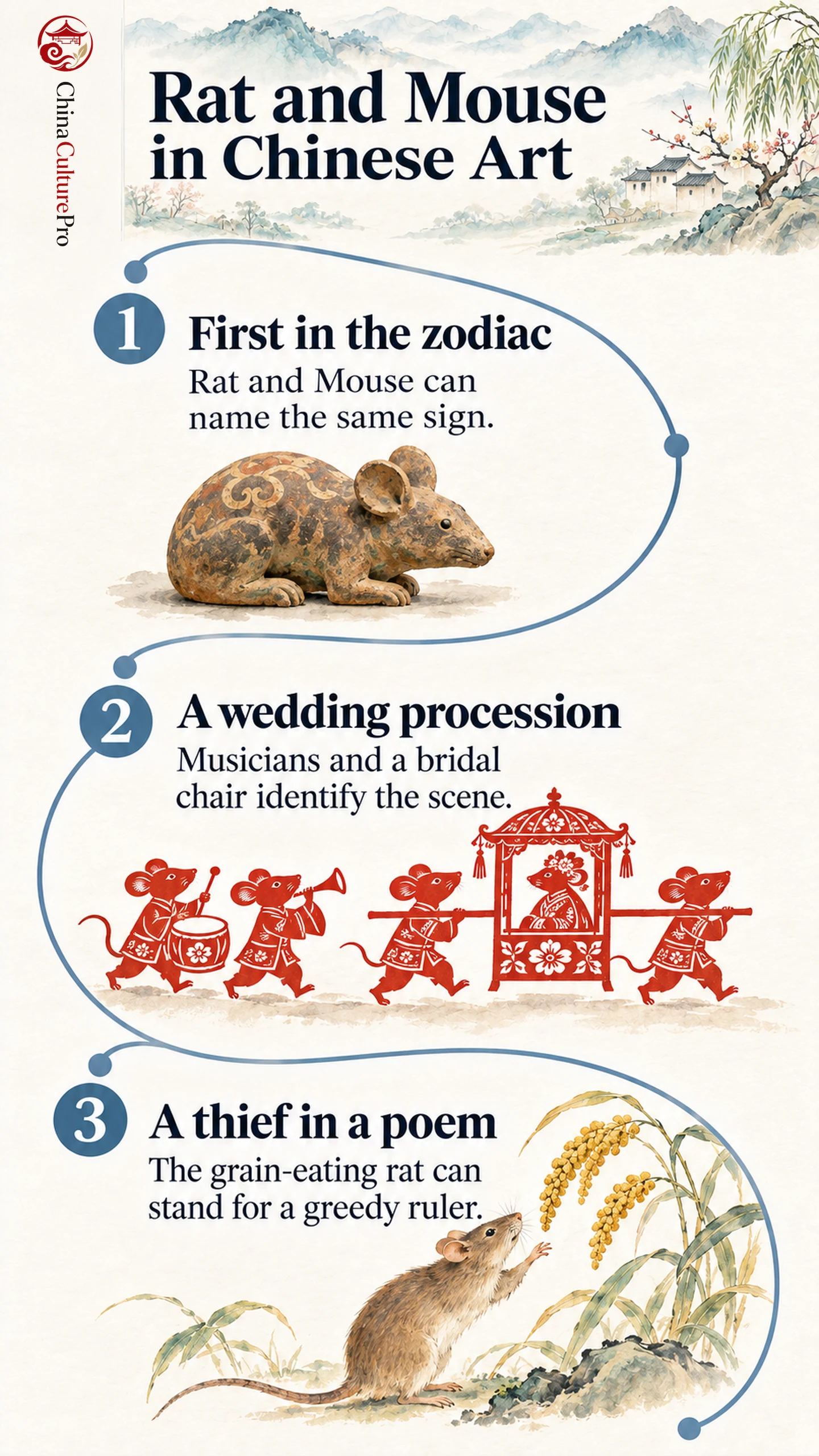
A little earthenware rodent is a zodiac figure. The same sort of animal, carrying a bride in a chair, belongs to a folk wedding. When a small animal is drawn with few details, these parts of the scene tell you more about the subject than the size of its ears or tail.[1][2][5]
The First Animal in the Zodiac
A thirteenth-century earthenware tomb figure is called a mouse in its collection record and a rat in an exhibition description. Both names refer to the same calendrical animal. Its conventional place is first, directly before the Ox in Chinese art. At the other end of the same sequence is the Pig.[1][5]
In one version of the race tale, the rat rides the ox and dismounts near the finish to come in ahead. That story can make the rat look resourceful or opportunistic. Ai Weiwei’s 2010 bronze Rat head belongs to a modern set of zodiac heads, where membership in the series supplies the calendrical clue.[4]
Mice Carrying a Bride in a New Year Print
The mouse wedding (老鼠嫁女, lǎoshǔ jià nǚ) can be recognized by a human-style wedding party made up of rodents. In a late-dynastic woodcut, the bride travels in a sedan chair, with musicians and attendants bringing a human ceremony into the rodents’ world.[2]
Versions of the motif appear in paper cuts, woodcuts and paintings. The carriers, horns and cymbals make the scene readable even when an artist compresses it into a few silhouettes. Local accounts connect the story to different nights around the New Year.[2]
A Grain Thief in Classical Poetry
In the Classic of Poetry, “Big Rat” (碩鼠, shuò shǔ) opens with a speaker telling the animal to stop eating their millet. A traditional commentary treats the large rat as an image of a ruler who takes too much from the people. The grain matters because the scene is about who benefits from the harvest.[1][3]
The rat’s ability to obtain and store food can also underlie associations with resourcefulness and wealth. In a poem about taking grain, that ability serves a different purpose.[4]
FAQs About Rat and Mouse Imagery
Why do museum labels use both rat and mouse?
Either word can translate the broad Chinese name. Look to the catalogue and surrounding figures for the subject before attempting a species identification.[1][5]
Is the mouse wedding assigned to one New Year date?
Accounts vary. Some place it on the third day of the first lunar month, while others put it on a different night. The wedding party is a steadier clue for recognizing the picture.[2]
Sources
[1] The Metropolitan Museum of Art. Celebrating the Year of the Rat
[2] David K. Jordan, University of California San Diego. The Rats Are Marrying Off Their Daughter
[3] Chinese Text Project. Mao commentary and subcommentary on the Classic of Poetry, Wei airs
[4] Smithsonian Hirshhorn Museum and Sculpture Garden. Ai Weiwei, Zodiac Heads: Rat
[5] The Metropolitan Museum of Art. Chinese Zodiac Figure, Mouse