
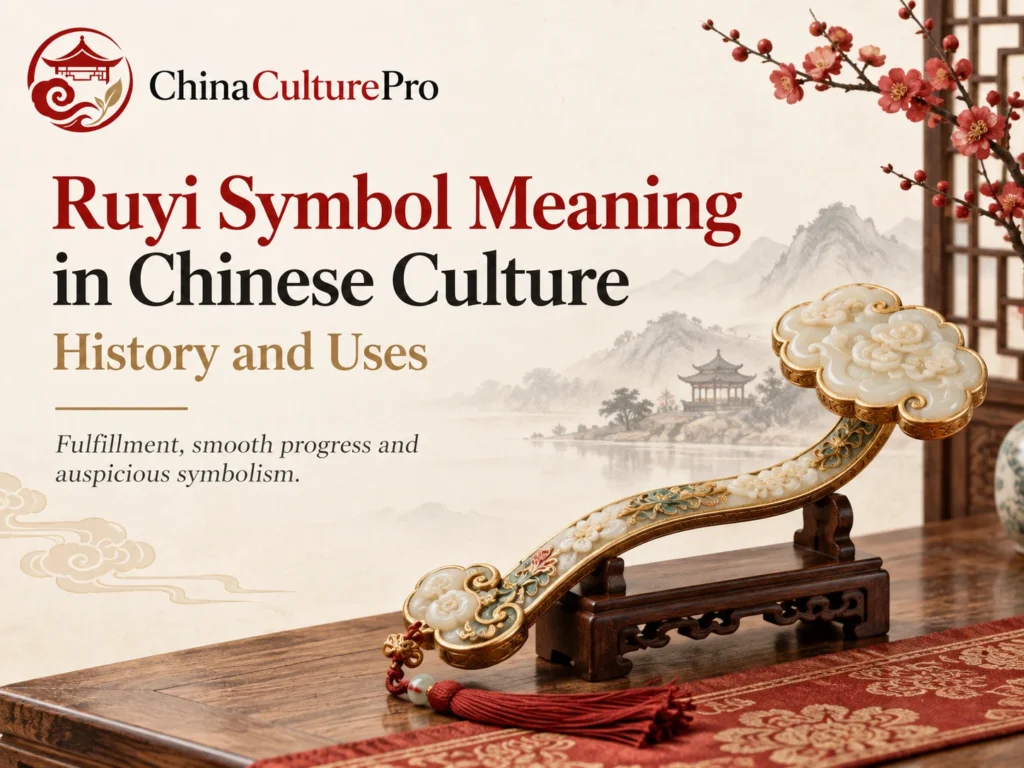

Quick Answer: What Does the Ruyi Symbol Mean?
Ruyi (如意, rúyì) is a traditional Chinese object and auspicious symbol whose name means “as you wish” or “in accordance with your wishes.” Its most stable meaning is the hope that plans and important occasions will proceed favorably.[1][2]
- Core meaning: Fulfillment, smooth progress, and circumstances that accord with one’s wishes.
- Typical form: A curved handle ending in a decorative cloud-, fungus-, or lobed-shaped head.
- Historical role: A practical implement that developed into a scholar’s accessory, display object, presentation gift, and court furnishing.
- Contextual meanings: Prestige, longevity, or blessing may be added by the material, shape, setting, or companion motifs.
Ruyi expresses cultural goodwill. It is not evidence that an object can grant wishes, change fortune, or produce wealth, health, or professional success.
Ruyi appears as a hand-held object, while a ruyi head (如意头, rúyìtóu) or ruyi pattern (如意纹, rúyìwén) may appear in jewelry, porcelain, textiles, and architecture. These forms are related but not interchangeable. Interpretation should begin with what is shown, then consider its date, material, setting, and surrounding imagery. The same method applies across Chinese auspicious objects and wider Chinese symbols and meanings.
What Is a Ruyi and What Does Its Name Mean?
In ordinary Chinese, rúyì means that something accords with one’s intention or turns out satisfactorily. The word also names a curved hand-held object whose later forms were made for display, ceremony, gift giving, and appreciation. Historical examples usually have an elongated handle and enlarged decorative head.
English museum labels often call it a “ruyi scepter.” This is convenient but not an exact equivalent of a European royal scepter. A ruyi could convey rank at court, yet it also functioned as a furnishing, scholarly accessory, congratulatory gift, or ritual object. “Wish-granting wand” reflects its auspicious name but can sound more magical than its documented history warrants.
How Did the Ruyi Develop from a Practical Tool?
From a Back-Scratcher to a Literati Object
The mainstream museum account connects the ruyi with an early back-scratching staff (搔杖, sāozhàng): a long-handled implement, sometimes with a claw-like end, that could reach an itch and work as desired. Modern dictionary definitions preserve both the practical tool and the later auspicious display object.[1][2]
Detailed studies also connect claw-shaped implements with Buddhist monastic equipment and early pictorial evidence. That material helps explain part of the form’s transmission, but it does not make every ruyi Buddhist or establish one exclusive origin story.[7]
By the Han–Jin period, the form had acquired social uses beyond scratching. It could be carried during elite conversation, gatherings, music, or performance. The head became more decorative, the neck curved, and the handle flattened. A seventeenth-century copper-alloy example attributed to Hu Wenming has a cloud-shaped head and an inscription suited to a learned gentleman’s object.[4]
This was gradual development. No reliable evidence identifies one inventor or exact year when the practical implement became an auspicious art object.
From a Display Object to a Qing Court Gift
After the Song dynasty, ruyi increasingly served as interior display pieces. Their decorative and congratulatory roles expanded during the Ming and especially the Qing dynasty. At the Qing court, they appeared in New Year presentations, imperial birthdays, weddings, rewards to officials, and gifts to foreign envoys.[2]
The Palace Museum holds more than two thousand Ming- and Qing-period ruyi made from jade, bamboo, wood, metal, bone, ivory, porcelain, and other materials. This range shows a flexible object type rather than one fixed design. Court use made some examples signs of wealth, workmanship, and status, but those meanings belong to particular objects and occasions—not to every ruyi.
What Does the Ruyi Symbolize?
The name supplies the basic meaning; setting and decoration add more specific wishes.
| Symbolic layer | Meaning | Source | Interpretive limit |
|---|---|---|---|
| Fulfillment | May affairs proceed as desired | The ordinary meaning of rúyì | The most consistent meaning |
| Ceremonial goodwill | Congratulations and favorable wishes | Presentation and gift practices | Expresses hope, not a guaranteed result |
| Prestige and authority | Rank, wealth, or elite taste | Court materials, workmanship, and use | Strongest in documented palace contexts |
| Longevity or blessing | Long life, health, or good fortune | Fungus-shaped heads, peaches, bats, or longevity characters | Added by form or companions; not inherent in every ruyi |
A plain ruyi-shaped pendant can communicate general favorable wishes. A court object combining bats, peaches, precious stones, and a longevity knot carries a more specific collection of blessings.
Ruyi Object vs. Ruyi Pattern: What Is the Difference?
Chinese art uses the ruyi idea at three related levels:
| Form | Chinese and pinyin | What it is | Common settings |
|---|---|---|---|
| Ruyi object | 如意, rúyì | A complete object with a head and handle | Court furnishings, gifts, scholarly objects, ritual settings |
| Ruyi head | 如意头, rúyìtóu | The enlarged decorative end | Scepters, jewelry, vessel handles, carved details |
| Ruyi pattern | 如意纹, rúyìwén | A motif abstracted from the head’s lobed outline | Porcelain borders, textiles, furniture, architecture |
A painted ruyi border borrows the outline and favorable association of the object but is not a miniature scepter. Cloud scrolls, lingzhi forms, and ruyi heads may overlap visually. Identification should rely on the complete design and object record, not one curved silhouette.
Placement also changes classification. A ruyi-shaped vessel handle remains part of a vessel, a repeated band is a motif, and a free-standing piece with a handle is the complete object. The outline alone does not settle the question.
How Do Shape, Material and Companion Motifs Change the Meaning?
A ruyi’s construction can add meaning without replacing its core wish for favorable fulfillment.
| Element | Added association | What not to assume |
|---|---|---|
| Cloud-shaped head | Auspicious clouds or favorable conditions | Not every cloud motif is a ruyi pattern |
| Lingzhi-shaped head | Longevity through the lingzhi (灵芝, língzhī) tradition | Not every ruyi head represents fungus |
| Jade | Refinement, durability, rank, and cultivated virtue | The layer comes from jade symbolism, not supernatural power |
| Gold, metal, enamel, or gemstones | Workmanship, display value, and courtly prestige | Expense does not create stronger spiritual effects |
| Bamboo or wood | Scholarly taste and natural craftsmanship | Simple material does not make the object less valid |
| Bat or peach | Blessing or longevity | The bat draws on Chinese bat symbolism; the peach adds a separate long-life theme |
| Persimmon | “May everything go as you wish” | The reading uses the shì/事 and shì/柿 wordplay explained in persimmon symbolism |
| Tassel or knot | Decorative completion and continuity | Chinese knotwork has its own forms and meanings |
A gold Qing ruyi presented to the Qianlong emperor in 1783 has turquoise bats and peaches on its head. The ruyi conveys good wishes, while the added motifs specify blessing and longevity.[5] Another Palace Museum example combines gold, gemstones, incense compartments, and a tassel with a longevity design.[6]
Where and How Was Ruyi Used?
Ruyi served different jobs in different settings:
- Literati use: A learned person could hold or display one during conversation and cultured social activity.
- Court ceremony: Qing examples were presented for New Year, birthdays, weddings, and other major occasions.
- Official gifts: Emperors could give ruyi to officials or foreign envoys as a prestigious expression of goodwill.
- Interior display: Ruyi were placed on stands or arranged in vases and brush pots beside other valued objects.[3]
- Religious art: Buddhist and Daoist imagery can include ruyi, but identification depends on the figure and iconographic context.[7]
The label “scepter” highlights the hand-held form and ceremonial status, but no single English term captures all these uses.
How Is Ruyi Used in Gifts, Jewelry and Modern Design?
Modern designers adapt ruyi heads and patterns for pendants, bracelets, clothing, home décor, logos, and other decorative work. The form can suit New Year, birthday, graduation, housewarming, wedding, or business-opening gifts when the message is that the recipient’s plans should go smoothly.
Choose the form by message rather than by a supposed luck ranking. A simple ruyi suits general favorable wishes; a lingzhi head or peach adds longevity, a bat adds blessing, and a precious material can add status or aesthetic value. The recipient and occasion matter more than price.
There is no national rule requiring one color, material, direction, number, or placement. For a tattoo or logo, verify that the silhouette remains recognizable and that added motifs communicate the intended message. An over-simplified cloud curve may lose its ruyi identity, while unrelated religious and secular elements can produce an unclear design.
Common Misreadings of the Ruyi Symbol
| Common claim | More accurate interpretation |
|---|---|
| A ruyi is China’s equivalent of a European royal scepter | Some were prestigious court objects, but ruyi also served as gifts, furnishings, scholarly accessories, and ritual objects |
| Ruyi was always decorative | Its history is closely connected with practical scratching implements |
| Every ruyi head is a lingzhi fungus | Cloud-shaped, fungus-shaped, and other lobed forms occur |
| Every cloud scroll is a ruyi pattern | Similar curves are insufficient; complete motif and context matter |
| Ruyi belongs only to Buddhism or Daoism | It appears in religious art but also has major courtly, scholarly, and secular histories |
| Ruyi primarily means wealth or promotion | Its core meaning is fulfillment; wealth and rank are contextual layers |
| Jade ruyi has more spiritual power | Jade changes material associations and value, not measurable efficacy |
| A ruyi can grant wishes or fix feng shui | It expresses cultural goodwill and cannot guarantee outcomes |
FAQs About the Ruyi Symbol
What Does Ruyi Mean in English?
Ruyi most directly means “as you wish,” “according to your wishes,” or “as desired.” In the phrase wànshì rúyì (万事如意), it conveys “may everything go as you wish.”
Is a Ruyi a Chinese Royal Scepter?
Not exactly. “Ruyi scepter” is a useful museum label, and some Qing examples carried courtly prestige. Ruyi was not solely a badge of sovereign office; it could also be a display object, gift, scholarly accessory, or ritual implement.
Is the Ruyi Shape a Cloud or a Lingzhi Fungus?
Both occur. Some historical ruyi have cloud-shaped heads, while others imitate lingzhi, a fungus associated with longevity. Identify the form from the complete object rather than one curve.
Is Ruyi a Buddhist or Daoist Symbol?
Ruyi is not exclusive to either religion. It appears in Buddhist and Daoist contexts but also has extensive secular, literati, and imperial uses. The surrounding figure and setting determine whether a particular example has a religious function.
Does a Ruyi Bring Good Luck or Grant Wishes?
A ruyi symbolizes the hope that events will proceed favorably. It can carry emotional, artistic, or religious significance, but there is no evidence that possessing or displaying one grants wishes or changes fortune.
Sources
[1] Ministry of Education, Taiwan. 如意 — Concised Mandarin Chinese Dictionary
[2] Ministry of Culture and Tourism of the People’s Republic of China. “Auspicious Ruyi”—Palace Museum Ruyi Exhibition
[3] The Metropolitan Museum of Art. Ruyi Scepter
[4] The Metropolitan Museum of Art. Ruyi Scepter Attributed to Hu Wenming
[5] Smithsonian’s National Museum of Asian Art. Ruyi Sceptre
[6] The Palace Museum. Gold Ruyi with Incised Floral Design
[7] The Palace Museum. 如意流变考