
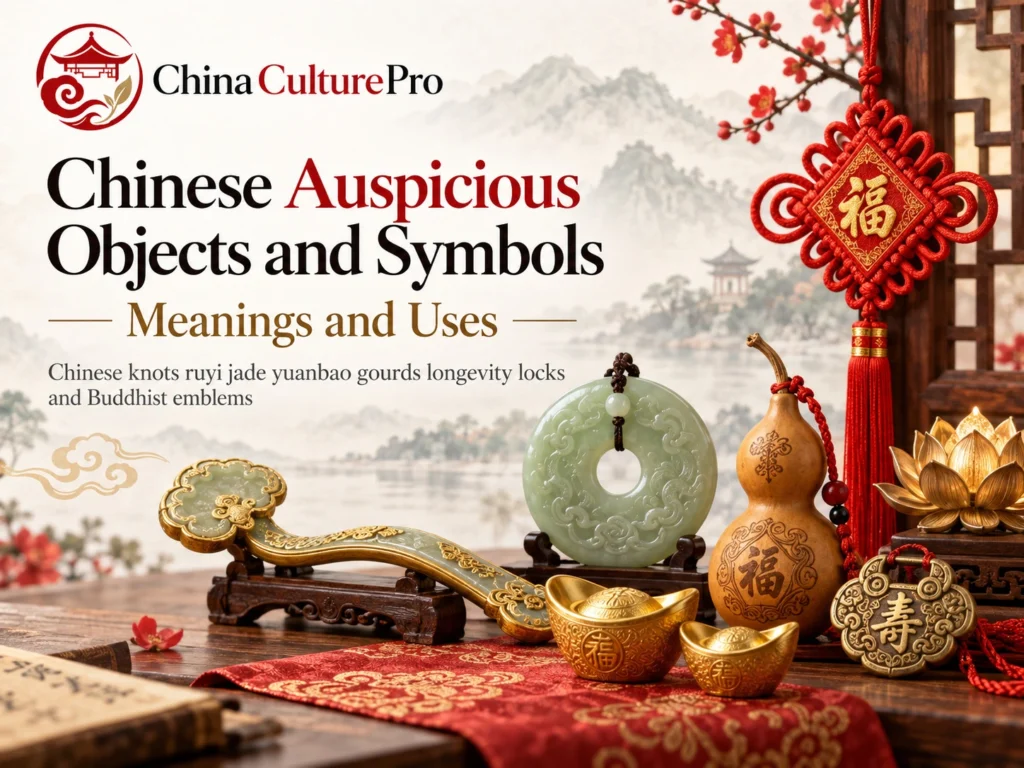

Quick Answer: What Are Chinese Auspicious Objects?
Chinese auspicious objects are objects, materials, crafts, or religious emblems that carry recognized wishes or values through their names, forms, uses, and histories.
- Main forms: Furnishings, money forms, jewelry, crafts, valued materials, and Buddhist emblems.
- Common wishes: Fulfillment, prosperity, longevity, family continuity, safety, virtue, and status.
- Meaning mechanisms: Wordplay, form, function, material, ceremony, and religious iconography.
- Context matters: An object, its painted image, and a motif based on it may serve different purposes.
They express hopes, identity, memory, or faith; they do not prove that an item produces wealth, health, or protection. Nor is the category identical to a feng shui (风水, fēngshuǐ) cure.
Chinese art turns things into a visual language of wishes: a vessel can evoke peace, a lock a child’s long life, and a court object a decorative motif. Meaning emerges from language, function, material, period, audience, and surrounding imagery.
This guide focuses on objects and related emblems. The broader guide to Chinese symbols and meanings applies the same method to other symbol types.
What Counts as an Auspicious Object or Symbol?
Physical Objects, Materials and Decorative Forms
The English phrase “auspicious object” covers several things that Chinese art does not treat as one uniform class:
- Physical objects: Tools, furnishings, forms of money, vessels, and wearable ornaments can acquire a ceremonial or congratulatory role in addition to their original function.
- Materials and crafts: A valued material can carry associations created by ritual use, rarity, workmanship, or moral comparison. A craft can produce many patterns whose meanings are not interchangeable.
- Religious and decorative emblems: A sacred emblem may appear on a ritual object and later on porcelain, textiles, or secular furnishings. Decorative use does not erase its religious history.
An object can also become an image. A hand-held court furnishing, for example, may inspire the outline of a border motif. The motif borrows the object’s associations but is not the original object itself.
What Is Outside This Page’s Scope?
This page does not classify every auspicious image in Chinese culture as an object. Dragons, bats, fish, cranes, and other creatures belong to Chinese animal symbolism. Peaches, peonies, lotus flowers, and other botanical subjects belong to Chinese flower and plant symbolism. Auspicious characters, colors, numbers, and abstract patterns also have their own interpretive systems. Keeping these categories separate prevents a useful guide from becoming an unstructured “lucky symbol” list.
How Do Chinese Auspicious Objects Get Their Meanings?
Names, Homophones and Visual Rebuses
Chinese decorative art frequently turns language into imagery. An object whose name sounds like a favorable word can stand in for that word, while several pictured objects can combine into a longer congratulatory phrase. This device is commonly called a visual rebus. Some pairings are exact homophones; others depend on near-sounds, dialects, or a convention established through repeated use. A responsible interpretation identifies which kind of relationship is operating instead of labeling every resemblance an exact pun.[1]
Function, Form and Material
An object’s original job may guide its later symbolism. A lock suggests securing or preserving; money evokes material value; a vessel can imply holding, containing, or presenting something. Form matters too: vines and seed-filled fruits can support wishes for descendants, while an unbroken line can suggest continuity.
Material adds another layer. Hardness, color, rarity, tactile quality, and the labor required to shape a material may contribute to its cultural value. These are historical and aesthetic associations, not proof of an inherent supernatural property.
Court, Family and Religious Context
Repeated use gives an object social meaning. Court presentation gifts can connect a form with rank and ceremonial goodwill. Jewelry given to a child can carry family hopes for safe growth. A Buddhist emblem belongs first to a religious iconographic system, even when it later decorates a secular bowl or robe.
This is why the same form may not mean the same thing everywhere. The period, medium, inscription, recipient, location, and accompanying motifs are part of the evidence. Museum interpretation likewise asks why a symbol was placed on a particular object rather than assuming a fixed meaning from its outline alone.[1]
Common Chinese Auspicious Objects and Symbols at a Glance
The entries below are starting points. Each meaning still depends on the dated object, inscription, use, and surrounding design.
| Object or symbol | Common association | How the meaning works | Interpretive limit |
|---|---|---|---|
| Chinese knot (中国结/中國結, zhōngguó jié) | Connection, continuity, completeness | Interlaced cord, symmetry, and the name or form of a specific knot | Chinese knotwork is a craft family; different knots do not all mean the same thing |
| Ruyi (如意, rúyì) | Wishes fulfilled, ceremonial goodwill, prestige | The name means “as wished,” reinforced by court gift and display practices | A hand-held ruyi and a ruyi-shaped border motif are related but not identical |
| Jade (玉, yù) | Cultivated virtue, refinement, durability, rank | Ritual history, valued material qualities, workmanship, and moral comparison | Jade is a broad cultural material, not a generic “protection crystal” |
| Ancient Chinese coins (古钱币/古錢幣, gǔ qiánbì) | Wealth, value, circulation, or an inscribed wish | Actual monetary use or the text and imagery of a coin-shaped charm | Circulating coins and non-currency charms must be distinguished |
| Yuanbao (元宝/元寶, yuánbǎo) | Material wealth and abundance | Historical silver or gold ingots became a recognizable visual shorthand for stored value | Historical ingots varied; the bright gold decorative form is a later stylization |
| Hulu gourd (葫芦/葫蘆, húlu) | Descendants, blessings, longevity, or containment | Many seeds, trailing vines, name-based wordplay, vessel use, and religious associations | No single reading applies to every natural, painted, or carved gourd |
| Longevity lock (长命锁/長命鎖, chángmìng suǒ) | A child’s long life and safe growth | A wearable lock form paired with inscriptions and family gifting customs | It is a child-centered ornament, not an ordinary door lock or universal charm |
| Eight Auspicious Symbols (八吉祥, bā jíxiáng) | Buddhist teaching, blessing, victory, purity, and favorable conditions | A standardized group of eight Buddhist emblems | They are not any eight attractive or valuable objects |
| Endless knot (盘长/盤長, páncháng) | Continuity, interconnection, and an unbroken teaching | An interlaced line without an obvious beginning or end | It is one emblem within the Eight Auspicious Symbols, not a synonym for all Chinese knots |
| Wan symbol (卍, wàn) | Auspiciousness and Buddhist sacred presence | An ancient South Asian sign adopted into Buddhist iconography and read as wàn in Chinese | Its meaning depends on Buddhist context and must not be collapsed into modern Nazi usage |
Wishes, Status and Prosperity Objects
Ruyi: Fulfillment and Courtly Prestige
The ruyi began with practical objects related to scratching or pointing, but it gradually developed into a refined furnishing and presentation gift. By the Ming and especially the Qing dynasty, ruyi were made in jade, metal, wood, bamboo, porcelain, and other materials. They appeared at enthronements, imperial weddings, New Year observances, birthdays, and exchanges of gifts. The Palace Museum holds more than two thousand examples, illustrating how strongly the form became associated with ceremonial goodwill and elite taste.[2]
Its auspicious force is linguistic as well as social: rúyì means “as wished” or “in accordance with one’s wishes.” The curved head also inspired ruyi-shaped cloud and border motifs. Calling the object a “magic wand” loses both its practical ancestry and its courtly history; calling it an imperial scepter is also too narrow, because it was a furnishing and gift rather than a standard badge of sovereign office.
Chinese Coins and Yuanbao
Money imagery requires several distinctions:
- Circulating cash coins: These were real money. Their use in decorative designs can naturally evoke value, payment, or material resources.
- Flower money (花钱/花錢, huāqián): These and related numismatic charms resemble coins but were not ordinary currency. Their inscriptions and images could wish for marriage, longevity, rank, good fortune, or protection. A British Museum example explicitly carries a formula for driving away harm and welcoming good fortune.[4]
- Historical yuanbao and other sycee: These were cast silver or gold ingots used within weight-based monetary systems. Their forms and stamps varied by period and region; “yuanbao” became one name used for ingots rather than a single timeless mold.[5]
- Modern decorative yuanbao: These simplify the ingot into a bright, often gold-colored emblem of wealth. That design is culturally legible, but it should not be projected unchanged onto every historical ingot.
The four categories share a connection with material value, yet their legal, ritual, and decorative functions are different. This page explains symbolism, not coin authentication, investment value, or methods for attracting money.
Longevity, Family and Protective Wishes
Jade: Material, Virtue and Status
Jade’s significance cannot be reduced to “good luck.” Jade objects served as ritual implements, burial goods, ornaments, ceremonial weapons, court treasures, and works for collectors. Their value came from the material’s rarity, toughness, polish, sound, workmanship, and long social history. Early jade objects could mark wealth or rank, while later ethical writing compared jade’s admired qualities with cultivated human character.[3]
The shape of a jade object supplies a second layer. A jade ruyi combines the material’s prestige with wishes fulfilled; a jade gourd adds the gourd’s family or longevity associations. “Jade” therefore describes the material, not one fixed symbol. Claims that every jade object automatically protects its owner belong to belief or marketing, not to a universal rule of Chinese art.
Hulu Gourds and Longevity Locks
The hulu gourd supports several readings. Its many seeds and spreading vines can express hopes for descendants and continuing family lines. Its name can participate in wordplay with terms for blessings and emolument, while its hollow vessel form connects it with storage, medicine, and figures in Daoist imagery. Palace decorations used gourd forms and vines to express abundant descendants and continuing blessings.[6] A gourd beside an immortal, however, should be read differently from a naturalistic garden painting.
The longevity lock is a wearable ornament associated especially with infants and children. Lock imagery turns the family hope of preserving life into a visible object, often reinforced by inscriptions such as “long life and wealth” or “may you live one hundred years.” Materials and customs varied by region and household; surviving examples and regional records include silver, gold, jade, coin-like pieces, and textile cords.[7] The object records affection and concern for a child’s growth. Describing that historical wish does not claim that the pendant provides physical or medical protection.
Chinese Knots and Buddhist Auspicious Symbols
Chinese Knot vs. the Endless Knot
Chinese knot is an umbrella term for decorative cord work, not the name of one universal pattern. Individual designs may take names or shapes associated with coins, ruyi, paired forms, flowers, or wishes for peace. Color can strengthen a context—red is common in festive decoration—but a knot does not cease to be Chinese knotwork because it uses another color.
The endless knot is a particular interlaced emblem. In Buddhist use, its continuous line can suggest interconnection, continuity, and the unbroken character of teaching or favorable conditions. A modern decorative knot may borrow a similar visual structure, but it is inaccurate to label every Chinese knot a “Buddhist endless knot.” Identification requires the actual pattern and its setting.
The Eight Auspicious Symbols and the Wan Symbol
The Eight Auspicious Symbols are a Buddhist group whose members are commonly identified as the wheel, conch, parasol, victory banner, lotus, treasure vase, pair of fish, and endless knot. The group developed from South Asian auspicious traditions and became especially prominent in Tibetan Buddhist art before appearing widely in Chinese Buddhist and courtly decorative arts. Chinese objects may show the complete set or select members, sometimes combining religious significance with a broader auspicious function. Qing objects confirm that the set entered later decorative arts and could be used on birthday and court objects.[8]
The wan symbol has a far older and wider history than twentieth-century European fascism. In Chinese Buddhist settings, 卍 is read wàn and may mark sacred presence, auspiciousness, or the accumulated virtues of the Buddha. The Nazi Party appropriated a form of the ancient swastika and made it an emblem of racist ideology and mass violence. Rotation or direction alone is not a safe identification test: the date, setting, surrounding imagery, and intended community matter more.[9] In international public design, that modern history creates a serious risk of misunderstanding even when the intended reference is Buddhist.
Where Are Auspicious Objects Used?
| Setting | Typical forms | What to examine |
|---|---|---|
| Court ceremony and display | Ruyi, jade furnishings, decorated vessels, precious ingots | Date, recipient, inscription, material, and ceremonial role |
| New Year, birthdays, and family celebrations | Knots, gourds, coin imagery, congratulatory objects | Occasion, household custom, and companion motifs |
| Childhood and family milestones | Longevity locks, inscribed jewelry, gourd or child imagery | Child-centered wishes, regional custom, and gift relationship |
| Ceramics, textiles, furniture, and architecture | Painted or carved object motifs, ruyi borders, endless knots | Whether the image is an object, a borrowed outline, or one element in a rebus |
| Buddhist temples and sacred art | Eight Auspicious Symbols, endless knot, wan symbol | Iconographic system, sacred figures, placement, and ritual context |
| Modern gifts, jewelry, and branding | Simplified coins, yuanbao, jade forms, knots, mixed motifs | Whether the design preserves a traditional meaning or creates a new commercial one |
The same form can move between these settings. A museum label for a dated Qing vessel and a modern shop description therefore answer different questions and should not be treated as equivalent evidence.
How to Choose or Interpret an Auspicious Object
- Identify what you are looking at. Decide whether it is a physical object, a material, a craft pattern, a pictured motif, or a religious emblem.
- Locate it in time and place. A Qing court furnishing, a regional child’s ornament, a temple image, and a contemporary pendant do not share one automatic meaning.
- Name the intended wish or function. Look for evidence of prosperity, longevity, family continuity, rank, ceremonial goodwill, protection, or religious teaching.
- Read the complete design. Inscriptions, colors, quantities, neighboring figures, and companion motifs can confirm or change the interpretation.
- Separate documentation from marketing. A museum record, historical inscription, modern designer’s explanation, and retailer’s “energy” claim carry different kinds of authority.
For a gift, choose a form whose established association fits the occasion and recipient. For a tattoo, logo, or permanent installation, verify the exact character, orientation, religious implications, and visual source with a knowledgeable speaker or specialist before production.
Common Misreadings of Chinese Auspicious Objects
| Common claim | More accurate interpretation |
|---|---|
| Every auspicious object is a feng shui cure | Auspicious objects also belong to court ritual, family custom, art, religion, dress, and gift exchange; feng shui is not the umbrella for all of them |
| Each object has one permanent meaning | Meaning changes with period, medium, inscription, recipient, and companion motifs |
| Ancient coins, coin-shaped charms, and modern pendants are interchangeable | One may be currency, another a non-circulating inscribed charm, and another a modern ornament |
| Jade is a Chinese protection crystal | Jade’s historical meanings include ritual value, status, craftsmanship, durability, and moral comparison; supernatural protection is not a universal art-historical fact |
| Every yuanbao was a uniform gold “boat” | Historical ingots varied in metal, weight, region, stamping, and form; the shiny gold ornament is a simplified modern image |
| Every Chinese knot is an endless knot | Chinese knotwork includes many patterns; the endless knot is one specific emblem and one member of the Buddhist Eight Auspicious Symbols |
| The Eight Auspicious Symbols are shared unchanged by all Chinese religions | They are a Buddhist iconographic set, although individual forms may also appear in broader decorative settings |
| Buddhist 卍 and the Nazi swastika can be distinguished only by direction | Historical period, orientation, rotation, setting, and surrounding imagery all matter; direction alone is unreliable |
| Auspicious objects must be red | Red is common in festive uses, but jade, silver, porcelain, wood, textiles, and sacred art use many colors |
| A modern product description proves an ancient tradition | Contemporary designers and retailers often combine, simplify, or invent meanings; historical claims need historical evidence |
FAQs About Chinese Auspicious Objects
Are Chinese Auspicious Objects the Same as Feng Shui Cures?
No. Chinese auspicious objects appear in court ceremony, family gifts, decorative art, children’s jewelry, Buddhist iconography, and many other settings. Some are marketed today as feng shui cures, but that modern label does not define their full history or prove that they change a person’s fortune.
What Chinese Object Symbolizes Good Luck?
There is no single universal good-luck object. Ruyi most directly expresses wishes being fulfilled, while gourds, knots, jade objects, coins, and written blessing characters carry more specific meanings determined by their form and context.
Which Chinese Objects Symbolize Wealth?
Historical coins, coin-shaped charms with wealth inscriptions, and yuanbao forms have the clearest material connection to wealth. Ruyi can accompany wishes for success or advancement, but its central idea is fulfillment rather than money alone.
Which Objects Symbolize Longevity or Protection?
Hulu gourds can support longevity and well-being themes, while longevity locks express family wishes for a child’s safe growth and long life. Particular jade pendants may add protective or long-life imagery through their carved form, but jade by itself has no single guaranteed function.
Can Foreigners Display or Give These Objects?
Yes, when the object suits the occasion and recipient. Secular gifts such as a well-chosen knot, ruyi-themed item, or jade object are generally easier to contextualize. Buddhist emblems, children’s longevity locks, and permanent designs deserve closer checking so that sacred meaning, age-specific use, and cross-cultural risks are understood.
Sources
[1] National Museum of Asian Art. Lucky Symbols
[2] The Palace Museum. Ruyi—As I Wish, Always as I Wish
[3] The Palace Museum. 盛世琳琅——故宫博物院珍藏清代宫廷玉器特展
[4] The British Museum. Coin; Charm
[5] Shanghai Museum. Yangzhou Sycee with Date Mark of 13th Year of Zhiyuan Reign
[6] The Palace Museum. Auspicious Gourds
[7] Lingtai County Bureau of Culture and Tourism. 戴锁
[8] The Metropolitan Museum of Art. Bowl with Auspicious Emblems
[9] United States Holocaust Memorial Museum. History of the Swastika