

Quick Answer: What Does Jade Symbolize in Chinese Culture?
Jade (玉, yù) symbolizes cultivated virtue, moral integrity, refinement, status, and ritual value in Chinese culture. It can also carry wishes for continuity, safety, and a long relationship, but its meaning changes with the object, motif, period, and social setting.
- Virtue: Jade’s luster, toughness, translucency, and polished surface became metaphors for the qualities of a cultivated person.
- Ritual and rank: Ancient jade objects marked ceremony, authority, and elite identity.
- Refinement: Skilled carving and the material’s tactile beauty made jade a sign of taste and disciplined craftsmanship.
- Continuity: Its durability can suggest endurance, memory, and lasting bonds.
- Blessing and protection: Jewelry and gifts may express hopes for well-being, but they do not provide proven supernatural protection.
Jade is therefore more than a Chinese “lucky stone.” Its cultural weight comes from material qualities, ritual history, ethical thought, craftsmanship, and personal relationships—not from a guaranteed power to change fortune.
Jade occupies an unusually broad place among Chinese symbols and meanings. It has served as a ritual medium, a personal ornament, a marker of rank, a funerary material, and a metaphor for character. A museum jade disk, a carved pendant, and a family bangle may all be jade, yet they do not necessarily communicate the same idea.
That distinction matters because English-language descriptions often reduce jade to luck, wealth, or healing. A more accurate reading begins with the material, then considers the object’s shape, carved subject, date, and use.
What Does Yu Mean—and Is It the Same as Jade?
The Chinese word yu does not map perfectly onto one modern mineral. Historically, jade was a cultural and craft category for prized stones valued for qualities such as fine texture, polish, toughness, and workability. Labels on older objects may therefore reflect historical connoisseurship rather than a laboratory identification.
Modern gemology is narrower. Nephrite (软玉, ruǎnyù) and jadeite (硬玉, yìngyù) have long been the two principal materials called jade; some green omphacite is also included under particular gemological definitions. Jadeite, nephrite, and omphacite are tough rocks composed of tightly interlocking mineral crystals.[1]
Feicui (翡翠, fěicuì) is the familiar Chinese jewelry term associated with jadeite, although current trade and laboratory usage can be more complicated than a simple one-word equivalence. Jade is therefore not a synonym for feicui, and an ancient Chinese jade object should not automatically be described as jadeite.
Color and a smooth surface are not enough to identify the material. Serpentine, quartz, glass, and other substances can resemble jade, while genuine jade occurs in colors beyond green. Cultural interpretation can explain why an object mattered, but mineral identification requires appropriate expertise and testing.
Why Has Jade Been So Important in China?
Ritual, Rank and Skilled Work
Jade’s importance developed through the interaction of material, labor, and social institutions. Nephrite is exceptionally tough, and early craftspeople had to shape it through prolonged sawing, drilling, grinding, and polishing rather than simply cutting it like a softer material. The time and skill invested in a finished object made jade especially suitable for ceremony and elite display.
By the Neolithic period, communities in several regions were producing sophisticated jade ornaments and ritual objects. Liangzhu tombs are particularly associated with distinctive disks and squared tubes. Later societies reused, reinterpreted, and created jade blades, pendants, fittings, seals, vessels, and objects for burial. Museum collections document jade as ornament, ceremonial weapon, and ritual medium across long periods of Chinese history.[3][4][5][6][9]
This does not mean that every jade object was imperial or that jade held one stable rank in every dynasty. Its function depended on who used it, what form it took, and where it appeared. Rarity and price mattered, but so did workmanship, inherited ritual authority, and the ability of a polished object to make status visible.
Jade and the Cultivated Person
One of jade’s most distinctive meanings is ethical. The “Pin Yi” chapter of the Book of Rites (《礼记·聘义》, Lǐjì Pìnyì) compares qualities of jade with those of the cultivated person. Its analogies include benevolence, wisdom, righteousness, ritual propriety, music, loyalty, trustworthiness, and moral excellence.[7]
The point is not that jade magically produces virtue. Rather, visible and audible properties of the material—its warm luster, dense texture, clean resonance, translucency, and ability to reveal both beauty and flaws—provided a language for thinking about character. Wearing or admiring jade could therefore serve as a reminder of disciplined conduct and self-cultivation.
Modern lists often claim that jade has exactly five, seven, or eleven virtues. Those numbers come from different texts and later summaries. There is no single timeless checklist that replaces the sources themselves; the stable idea is the comparison between material qualities and ethical qualities.
Nephrite vs. Jadeite in Chinese Culture
Nephrite and jadeite belong to different mineral families and entered Chinese material culture on different timelines. The familiar translations “soft jade” and “hard jade” should not be taken to mean that one feels soft or that ordinary handling can identify either material.
| Material | Chinese term | Historical role | Colors and interpretive limit |
|---|---|---|---|
| Nephrite | 软玉, ruǎnyù | The principal material behind much of China’s early and historic jade tradition, including ritual objects, ornaments, and scholarly or courtly works | White, cream, gray, yellow-brown, black, and many greens; not all nephrite is Hetian jade |
| Jadeite | 硬玉, yìngyù; commonly associated with 翡翠, fěicuì | Became an important Chinese carving and jewelry material much later; jadeite from Myanmar gained prominence in the late eighteenth and early nineteenth centuries | Green is famous, but jadeite can also be white, lavender, yellow, orange-red, gray, brown, or black |
Nephrite is primarily an interlocking tremolite–actinolite material, while jadeite belongs to the pyroxene group. Nephrite is renowned for toughness; jadeite can show vivid color and translucency. These physical differences help explain carving and collecting preferences, but they do not create separate moral codes. Both can participate in modern jade symbolism.[1][2]
What Qualities Does Jade Symbolize?
Jade’s meanings work on several levels. They should not be collapsed into one generic promise of “good luck.”
| Symbolic quality | Cultural meaning | Source and limit |
|---|---|---|
| Cultivated virtue | Integrity, benevolence, discipline, and refined conduct | Developed through ethical comparison; the stone does not improve character by itself |
| Purity and clarity | Openness, moral cleanliness, and consistency between appearance and substance | Drawn from luster and translucency; not every jade object is visually transparent |
| Toughness and continuity | Endurance, constancy, memory, and lasting relationships | Based on durability; it does not guarantee love or longevity |
| Status and refinement | Rank, education, taste, skilled labor, and access to valued material | Varies by period, ownership, object type, and quality |
| Blessing and protection | Hopes for safety, favorable circumstances, and well-being | A symbolic or folk-cultural wish, not a proven force |
The most historically distinctive meanings are virtue, ritual authority, and refinement. Wealth and luck can be relevant in a modern gift or commercial setting, but they are too narrow to define jade across Chinese history.
How Do Shape and Motif Change a Jade Object’s Meaning?
Ritual Forms: Bi and Cong
A bi (璧, bì) is a flat disk with a central opening. A cong (琮, cóng) is a tube whose outer form is usually square or squared while its inner channel is circular. Both are closely associated with Neolithic ritual and high-status burials, especially the Liangzhu culture.[3][4][5]
Later ritual texts and interpretations connected the round bi with heaven and the square cong with earth. That association is culturally important, but it should not be projected backward as a fully proven explanation for every prehistoric example. Archaeologists can identify patterns of burial, labor, and status more securely than they can recover one original verbal meaning for every object.
Pendants, Bangles and Personal Ornaments
Jade pendants and personal fittings could mark rank, complete ceremonial dress, make sound as a wearer moved, or embody ideals of cultivated behavior. Modern bangles, pendants, rings, and plaques more often combine ornament with affection, memory, identity, or a wish for safety.
A family bangle may become meaningful because it was inherited, not because every circular jade bracelet carries a universal “family lineage” code. Likewise, a pendant given to a child can express care without proving that the material physically protects the wearer.
Carved Motifs and Added Meanings
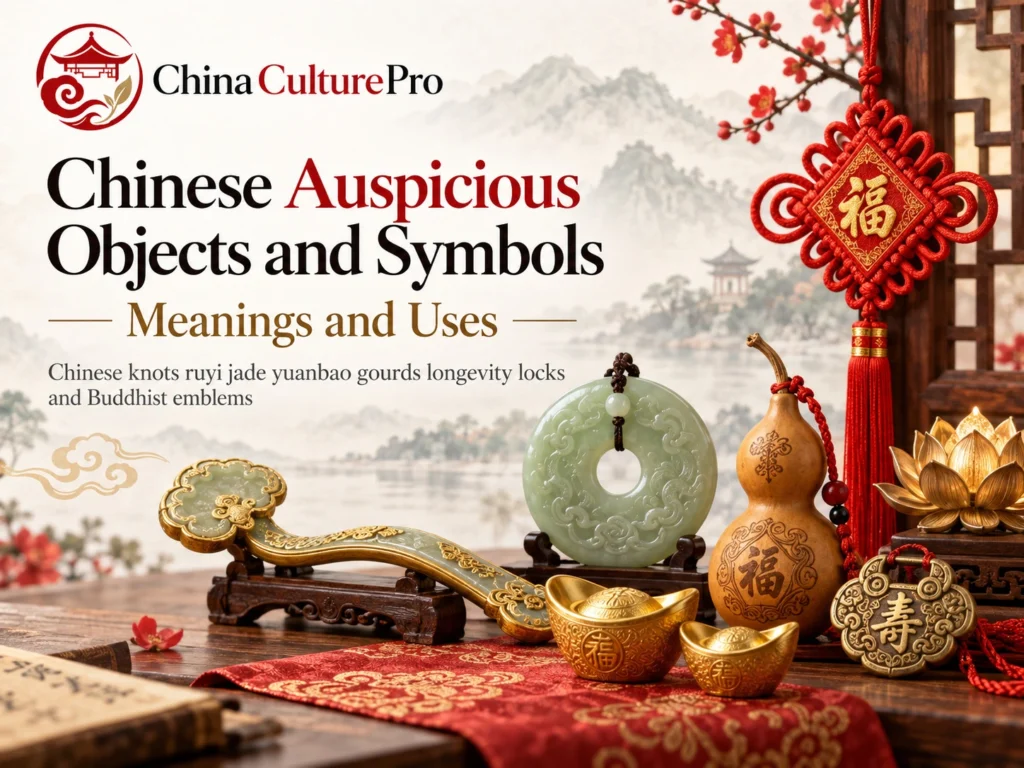
The material and the carving contribute different layers. A jade dragon adds the meanings of the dragon; a jade bat invokes blessing through the bat–fortune wordplay explained in Chinese bat symbolism; and a jade peach adds the longevity associations discussed in peach symbolism in Chinese culture. A jade ruyi similarly combines jade’s refinement with the object’s wish-fulfillment message.
The safest reading is therefore “jade material plus object form plus carved motif plus context.” The stone alone does not supply every meaning carried by the completed work.
Jade in Burial and Immortality Beliefs
Some elite burials used jade disks, plugs, mouth pieces, plaques, and—most famously in the Han dynasty—suits assembled from many jade pieces. These practices reflected beliefs that jade could help preserve the body, maintain integrity after death, or support a favorable passage into the afterlife. One surviving Han royal burial suit contains more than 2,000 pieces, illustrating the exceptional labor and status involved.[8]
Such objects do not establish a universal Chinese funeral custom. Jade suits belonged to a narrow elite context, and burial practices changed across regions and periods. Nor does their presence prove that jade actually prevented decay. The historically sound conclusion is that some communities attributed preservative, protective, or transcendent qualities to jade and expressed those beliefs through expensive funerary objects.
How Is Jade Worn, Given and Used Today?
Jade remains meaningful in contemporary life, but current practices are diverse rather than governed by one national etiquette.
- Personal jewelry: Bangles, pendants, rings, beads, and earrings combine adornment with individual or family meaning.
- Gifts between generations: A jade piece may express care, continuity, remembrance, or hopes for a younger person’s well-being.
- Milestones and relationships: Jade may be given for birthdays, weddings, births, graduations, or anniversaries, with the carved motif refining the message.
- Display and design: Carved figures, seals, vessels, and ruyi-shaped objects appear in interiors, collections, and contemporary cultural design.
- Family memory: An inherited object can acquire significance from its owner and story even when its original commercial or ritual meaning is unknown.
No fixed rule says that a person must begin wearing jade at a certain age or that one form is appropriate only for one gender. For a gift, the recipient, occasion, design, and documented material matter more than a universal formula.
Does Jade Bring Good Luck, Protection or Healing?
Jade can symbolize good wishes and protection, but symbolism should not be confused with demonstrated effect. Giving a pendant for safety or wearing a family bangle for reassurance can be culturally and emotionally meaningful without proving that the stone changes external events.
The saying that a broken jade piece has absorbed disaster for its wearer is best treated as folk belief. Breakage usually has a physical cause, and a damaged item should be checked for sharp edges and repaired or retired as appropriate.
Claims that jade heals organs, balances energy, detoxifies the body, or guarantees wealth are not established by jade’s historical prestige. Modern crystal-healing language may be personally meaningful to some users, but it should not be presented as medical advice or as the defining content of traditional Chinese jade culture.
How Should You Interpret a Jade Object in Context?
Use five steps rather than assigning a meaning from color alone:
- Identify the material claim: Note whether the object is labeled jade, nephrite, jadeite, feicui, or only “jade-like.”
- Establish date and setting: Separate an archaeological object, court work, personal ornament, burial item, and modern product.
- Identify the form: Ask whether it is a ritual object, bangle, pendant, seal, vessel, fitting, or sculpture.
- Read motifs and inscriptions: Animals, plants, characters, and rebus designs can add meanings that the material alone does not carry.
- Separate evidence from marketing: Give priority to provenance, museum records, inscriptions, and specialist identification over an unsourced product story.
This method interprets cultural meaning; it does not authenticate or value the stone.
Common Misreadings of Jade Symbolism
| Common misreading | More accurate interpretation |
|---|---|
| Jade means bright green jadeite | Jade includes nephrite and jadeite, both of which occur in multiple colors |
| Ancient China valued only green jade | White and pale nephrite held exceptional importance in many historical settings |
| Jade mainly symbolizes money and luck | Virtue, ritual, status, refinement, and skilled work are more central across the long tradition |
| Every jade object means the same thing | Material, form, motif, inscription, date, and use work together |
| The original meaning of every bi and cong is known | Their archaeological importance is clear, but some earliest functions remain debated |
| Jade has one official list of five virtues | Classical and later sources organize jade’s ethical qualities differently |
| A broken bangle proves that jade blocked disaster | This is a folk interpretation, not evidence of supernatural protection |
| Natural jade heals or changes feng shui automatically | Such claims are beliefs or marketing language, not established physical effects |
FAQs About Jade in Chinese Culture
Is Chinese Jade Nephrite or Jadeite?
It can be either. Nephrite formed the main material base of China’s early jade tradition, while jadeite became prominent much later, especially from the late eighteenth century onward. Modern gemological “jade” can include both.
Is Jade Always Green?
No. Nephrite and jadeite occur in white, gray, yellow, brown, black, and various greens; jadeite can also be lavender and orange-red. China’s historical appreciation of jade cannot be reduced to the meaning of green in Chinese culture.
What Does a Jade Bracelet Symbolize?
A jade bracelet may express affection, continuity, remembrance, blessing, or family connection. Its meaning depends on who gave it, who wore it, and why it was kept; there is no single message shared by every jade bangle.
Can Foreigners Wear or Give Jade?
Yes. Jade is not restricted by ethnicity. Choose a design appropriate to the recipient and occasion, describe its meaning accurately, and avoid promising healing or supernatural protection.
Sources
[1] Gemological Institute of America. Jade Description
[2] Gemological Institute of America. Jade History and Lore
[3] National Museum of Asian Art. Jades for Life and Death
[4] The Metropolitan Museum of Art. Annular Disk (Bi)
[5] The Metropolitan Museum of Art. Ritual Object (Cong)
[6] The Metropolitan Museum of Art. Ceremonial Blade
[7] Chinese Text Project. Book of Rites: Pin Yi
[8] The Metropolitan Museum of Art. Age of Empires: Chinese Art of the Qin and Han Dynasties
[9] The British Museum. Chinese Jade