
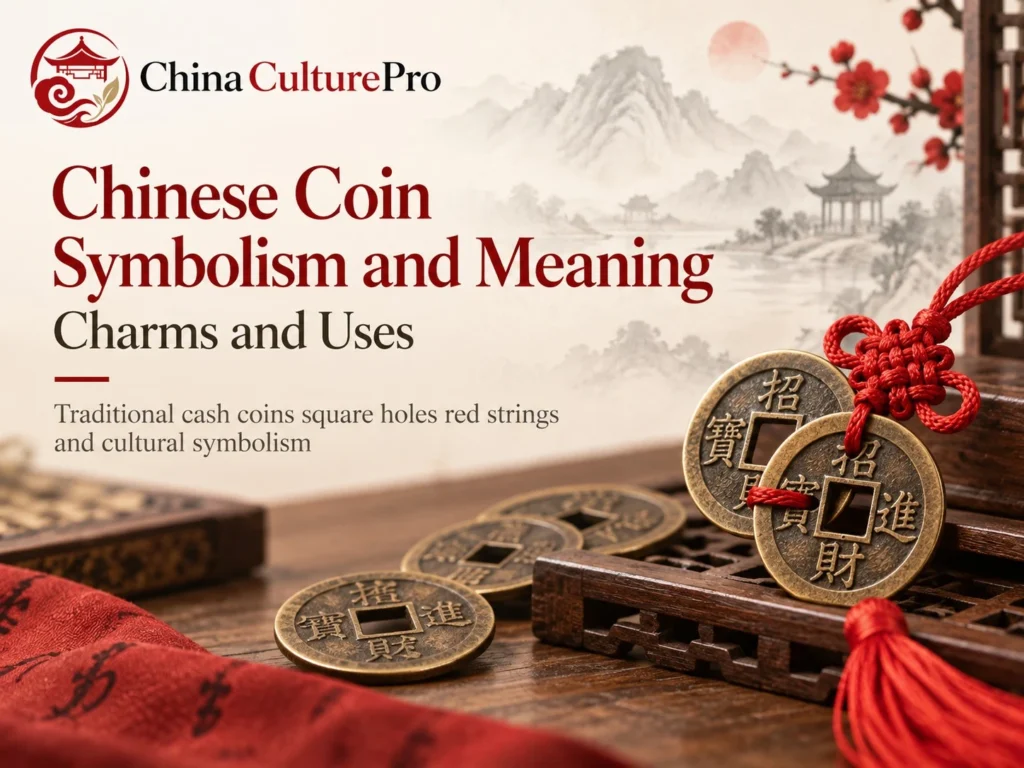

Quick Answer: What Do Chinese Coins Symbolize?
Traditional round cash coins with square holes (方孔钱, fāngkǒngqián) most often symbolize wealth, circulation, prosperity, and material security when used in Chinese art or auspicious decoration. Their exact meaning depends on whether the object was real money, a coin-shaped charm, a decorative motif, or a modern replica.
- Core symbolism: Wealth, exchange, prosperity, and a stable livelihood.
- Historical role: Most cash coins were official currency before their familiar shape became a decorative emblem.
- Folk extensions: Five Emperor Coins (五帝钱, Wǔdìqián) and red-cord arrangements are later customary combinations, not official ancient coin types.
- Context matters: A coin inscription may identify a reign and denomination rather than state a blessing.
These meanings express cultural wishes. Neither an old coin nor a particular arrangement has proven power to attract money, repel harm, or alter a person’s fortune.
An object sold as a “Chinese lucky coin” might be an authentic Qing cash coin, a non-circulating charm, a motif copied onto porcelain, or a newly cast souvenir. That distinction matters: the pieces can look similar while having different histories and uses. This guide places coins within the broader system of Chinese symbols and meanings, then shows how to identify the most likely interpretation without turning every square-holed disc into a feng shui object.
What Counts as a Chinese Coin Symbol?
Chinese coin imagery falls into four practical categories. Coin-shaped charms (花钱, huāqián) deserve special attention: “hua qian” is a numismatic label here, not the everyday phrase meaning “to spend money.” Scholarly work on Chinese charms documents inscriptions and images devoted to good fortune, protection, religion, and social wishes rather than monetary value.[3] The British Museum likewise catalogs square-holed Chinese objects as charms rather than coins when they were not issued for circulation.[4]
| Category | Original function | Key clue | Usual interpretation |
|---|---|---|---|
| Historical cash coin | Official currency | Reign title, currency legend, mint marks, regulated form | Money first; wealth symbolism may be added later |
| Hua qian | Non-circulating charm or token | Auspicious phrases, zodiac animals, deities, stories, or ritual imagery | Blessing, commemoration, protection, or another stated theme |
| Coin motif | Decoration | Painted, woven, carved, or molded coin shapes | Wealth, abundance, or continuous prosperity |
| Modern replica | Souvenir, jewelry, or marketed auspicious object | Recent manufacture, uniform finish, added cord or fittings | Modern decorative or folk meaning; not evidence of antiquity |
Why Are Traditional Chinese Coins Round with a Square Hole?
Practical Function
After the Qin unification, the round coin with a square central hole became the dominant form of Chinese cast currency and remained influential into the late Qing period.[1] The hole made coins easy to string for transport and accounting. It also allowed cast blanks to be held steady on a rod while their edges were finished. A surviving British Museum display string contains 1,000 genuine coins, illustrating the close relationship between cash coins and counted strings, although the value of a “string” was not perfectly fixed across every period and region.[2]
Most familiar cash coins were cast from copper alloys. Iron and other metals appeared in particular times and places, but they should not be treated as the universal norm. Practical production and handling explain much of the durable form; historians need not assume that the hole began as a purely cosmological design.
Symbolic Interpretation
Later tradition often reads the round exterior and square opening through the phrase “round heaven and square earth” (天圆地方, tiānyuán dìfāng). The same geometry can also suggest balance between complementary parts, while “round outside, square inside” became a moral metaphor for social flexibility joined to inner principle. These are meaningful cultural readings, but they are later interpretations rather than proof of one exclusive design motive. Nor does the phrase imply that every historical Chinese thinker held a simple, literal belief that the physical earth was square.
How Did Cash Coins Become Symbols of Wealth and Prosperity?
The symbolism begins with an ordinary fact: coins mediated exchange, stored value, paid taxes, and measured resources. A group of coins on a cord made accumulated wealth visible. Once new monetary systems replaced traditional cash, that recognizable silhouette remained available to artists and makers as shorthand for money, prosperity, and household security.
This is a functional symbol before it is a mystical one. A coin motif on a textile or New Year decoration does not claim to be spendable; it turns a familiar material object into a wish for adequate resources or thriving business. Repetition can strengthen the visual message, but it does not multiply luck by a calculable amount.
What Do the Characters on Chinese Coins Mean?
On genuine circulating coins, writing usually identifies monetary authority rather than delivering a random lucky slogan. From the Tang onward, a common naming pattern combined a reign or era title with a currency term such as “circulating treasure” (通宝, tōngbǎo), yuanbao, or zhongbao. The Shanghai Museum notes that Kaiyuan Tongbao helped establish this “treasure inscription” system for later dynasties.[1]
Kangxi Tongbao, for example, means currency issued under the Kangxi reign; it does not literally promise that its owner will become rich. Four-character legends are often read top–bottom–right–left, but clockwise arrangements and other exceptions exist. Qing reverses may carry Manchu mint information. A reliable reading therefore requires the coin’s date, dynasty, and layout—not an assumption that every inscription is an auspicious spell.
Cash Coins vs. Hua Qian: Were They Real Money?
Circulating Cash Coins
Historical cash coins were issued to function as money. Their designs, metal standards, and exchange values changed substantially across dynasties, and local shortages or reforms could produce variation. Wear, corrosion, and an old-looking surface are evidence to investigate, not automatic proof of age or cultural power.
Hua Qian and Other Coin-Shaped Charms
Hua qian imitate the useful form of money but were normally created as charms, presentation pieces, commemorative objects, game pieces, or carriers of auspicious and religious imagery. Their legends can concern longevity, marriage, children, examinations, zodiac animals, deities, or protection. That diversity is why translating every hua qian as “lucky money” loses important information.[3]
The distinction is functional, not merely visual. A charm can be historically valuable without ever having had a legal denomination, while a common circulating coin can later be reused in jewelry or a folk arrangement. The object’s first purpose and its later use should be described separately.
What Do Five Emperor Coins and Red-String Coins Mean?
Five Emperor Coins
Five Emperor Coins (五帝钱, Wǔdìqián) are a later grouping of historical coin types, not a single denomination issued by five rulers. The widely marketed “small” set combines Qing coins from the Shunzhi, Kangxi, Yongzheng, Qianlong, and Jiaqing reigns. A Baoji Bronze Ware Museum overview identifies this sequence and explains the folk beliefs attached to it.[5]
A less common “large” grouping selects representative issues from major dynastic periods, including Qin Banliang, Han Wuzhu, Tang Kaiyuan Tongbao, Songyuan Tongbao, and Ming Yongle Tongbao in the museum’s presentation.[6] Both are retrospective selections: authentic member coins were once money, but arranging them as one auspicious set is a later cultural practice. Calling the set an officially created ancient talisman would confuse those two histories.
Coins Tied with Red Cord
Cord has an obvious practical use: it joins loose coins into a wearable or hangable object. Red can add the festive and auspicious associations discussed in our guide to red in Chinese culture. Modern sets of three, five, six, or more coins are often sold with distinct placement rules, but there is no single nationwide code that fixes one meaning for every count.
These arrangements are best described as modern folk or commercial adaptations unless a specific, documented local practice says otherwise. The cord and number may express a wish for prosperity or safety, but they do not establish measurable “energy levels” or guaranteed results.
How Are Chinese Coins Used in Art, Jewelry, Gifts and Divination?
| Context | Common form | Best reading | Important limit |
|---|---|---|---|
| Decorative art | Painted, carved, or woven coin motifs | Wealth, abundance, household prosperity | A motif is not currency |
| Jewelry | Coin pendant, bracelet, belt or hat ornament | Adornment plus a personal wish | Check whether the piece is antique or a replica |
| Gifts and business | New Year gift, opening decoration, shop display | Prosperity and thriving trade | A wish, not a financial promise |
| Divination | Three coins used to generate lines | A randomizing method within a reading system | Not a special historical denomination |
In Yijing (易经, Yìjīng) divination, coin casting became a documented way to generate lines; research traces the three-coin method in textual sources and treats the coins as part of the procedure rather than a universally standardized “I Ching coin” issue.[7] Modern objects sold under that name are therefore tools or themed replicas, not proof that an ancient mint produced one official divination currency.
How Should You Interpret a Chinese Coin in Context?
- Classify the object: Decide whether it is currency, a hua qian, a motif, or a modern replica.
- Read both sides: Look for a reign title, currency legend, mint mark, auspicious phrase, figure, or animal.
- Check physical evidence: Consider material, casting style, weight, wear, and provenance; do not authenticate by color alone.
- Separate additions: Note later cords, knots, frames, beads, or other motifs that contribute their own meanings.
- Use the setting: Museum label, excavation, family jewelry, temple object, and souvenir shop each support different interpretations.
Round coins with square holes were also made elsewhere in East Asia, including Japan, Korea, and Vietnam. Shape alone cannot prove that an unidentified piece is Chinese.
Common Misreadings of Chinese Coin Symbolism
| Common claim | More accurate interpretation |
|---|---|
| Every round disc with a square hole is an ancient Chinese coin. | It may be currency, a charm, an East Asian coin, or a modern replica. |
| Cash coins were invented as wealth talismans. | Their primary role was monetary; auspicious symbolism developed around that function. |
| The shape proves a single “round heaven, square earth” origin. | The form had clear practical advantages; cosmology is a later cultural interpretation, not the only explanation. |
| Four characters always form a blessing. | Many legends identify a reign and currency type. |
| Hua qian were normal money. | They are coin-shaped non-circulating pieces with varied social, religious, or auspicious uses. |
| Five Emperor Coins were an official imperial set. | They combine separately issued coins in a later folk arrangement. |
| Three red-string coins have one ancient universal rule. | Meanings vary among later traditions and commercial presentations. |
| “I Ching coins” were a standard ancient denomination. | Ordinary coins can serve as casting tools; the retail label often describes modern themed sets. |
| Heavier patina means greater spiritual power. | Patina is a material condition, not a measure of cultural efficacy. |
| A coin necklace guarantees wealth or protection. | It can express a wish or identity, but it cannot guarantee an outcome. |
FAQs About Chinese Coin Symbolism
What Does the Round Shape and Square Hole Mean?
Practically, the hole allowed coins to be strung and helped hold cast blanks during finishing. Culturally, later viewers associated the geometry with “round heaven and square earth.” The symbolic reading is meaningful, but it should not replace the form’s practical history.
Are Chinese Lucky Coins Real Money?
Some are reused historical cash coins. Others are non-circulating hua qian, decorative motifs, or modern replicas. An inscription, material, manufacturing method, and reliable provenance are more useful than the square hole alone.
What Do Three Chinese Coins Tied with Red String Mean?
They usually form a modern auspicious ornament associated with prosperity or safety. Explanations of the number three differ among sellers and folk traditions, so there is no single ancient or nationwide “three-coin rule.”
Do Old Chinese Coins Bring Good Luck?
They can carry culturally meaningful wishes for prosperity or protection, especially when reused in a charm or family object. There is no evidence that age, patina, or arrangement gives a coin power to alter wealth, health, or fortune.
Can Foreigners Wear a Chinese Coin Necklace?
Generally, yes. First check whether the piece is a replica, an ordinary historical coin, or a charm with religious or political imagery. A trustworthy identification prevents an unknown inscription from being treated as a generic symbol of luck.
Sources
[1] Shanghai Museum. Chinese Numismatics Gallery
[2] British Museum. Coin; String of Cash
[3] Fang, Alex Chengyu, and François Thierry, eds. The Language and Iconography of Chinese Charms
[4] British Museum. Coin-Shaped Charm
[5] Baoji Bronze Ware Museum. 方圆之间——小五帝钱
[6] Baoji Bronze Ware Museum. 方圆之间——大五帝钱之秦半两
[7] Jung, Jaesang. The Forgotten Principle of Casting Coin in I-Ching Divination