
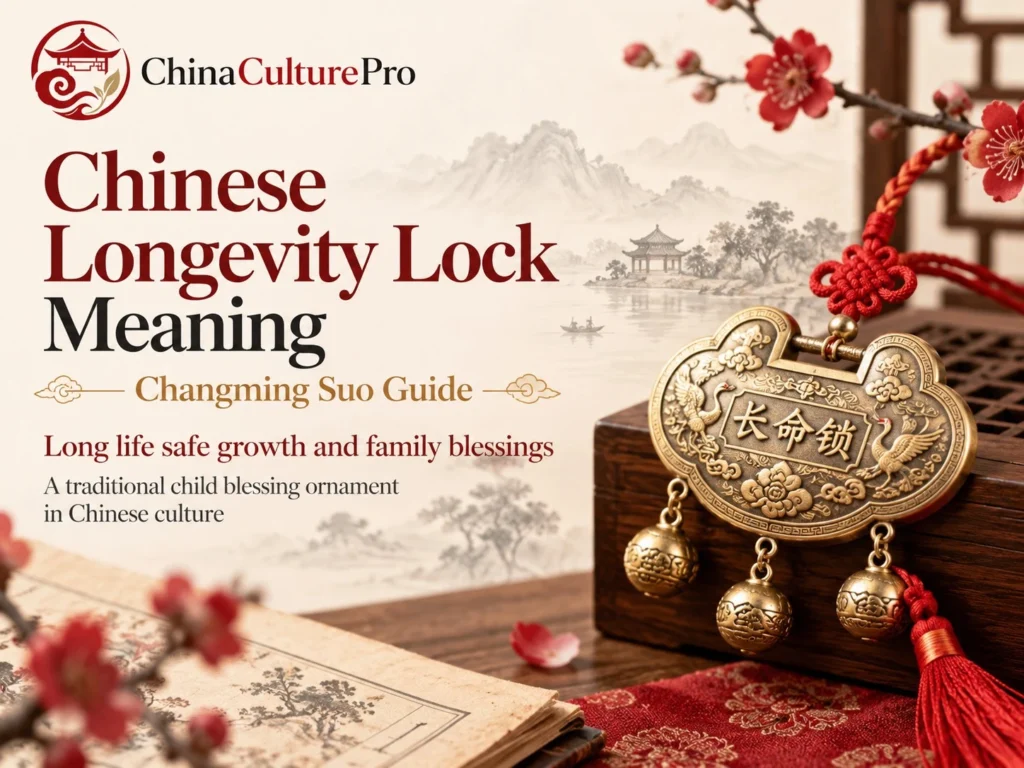

Quick Answer: What Does a Chinese Longevity Lock Mean?
A Chinese longevity lock (长命锁/長命鎖, chángmìng suǒ) is a lock-shaped ornament traditionally associated with children. It expresses a family’s wish that a child will remain safe, healthy, and “locked” to a long life. Common English names include longevity lock and long-life lock.
- Core meaning: long life, safe growth, and lasting family blessings
- Traditional wearer: an infant or young child
- Common occasions: a one-month celebration, the hundred-day milestone, or a first birthday, depending on local and family custom
- Typical features: a decorative lock-shaped pendant, often with inscriptions, auspicious motifs, bells, chains, or tassels
- Important boundary: it is a cultural blessing, not a medical or supernatural device
The symbolism does not mean that the object can prevent illness, avert accidents, or extend a child’s life. For infants, a necklace also creates real choking and strangulation risks and should not be treated as everyday protective equipment.
The longevity lock belongs to a larger tradition of giving visible form to family wishes. Like many Chinese symbols and meanings, it combines an ordinary object’s function with word, image, material, and ritual context. The lock shape supplies the central metaphor: what a household lock secures materially, the ornament is imagined to secure symbolically.
What Is a Chinese Longevity Lock?
The Ministry of Education dictionary in Taiwan defines changming suo as a lock-shaped ornament hung on a child’s chest, commonly made of silver or gold and engraved with phrases such as “May you live a hundred years” or “Long life and honored prosperity.”[1] Museum examples also include base-metal pieces and more elaborate necklace assemblies.
Most are not working locks. They retain the recognizable body of a door or chest lock but usually have no key, bolt, or opening mechanism. A complete piece may combine the central pendant with a neck ring, chain, bells, hanging leaves, beads, or tassels. Surviving examples range from plain door-lock forms to cloud and ruyi-shaped plaques. “Longevity lock” therefore names a ritual and decorative category, not one fixed design.
The modern label peace lock sometimes overlaps with longevity lock in jewelry listings. The two are not governed by an official taxonomy: “peace lock” emphasizes safety, while changming suo more clearly invokes a long life and the historical custom of adorning children.
Why Is It Shaped Like a Lock?
The shape turns the practical function of a lock into a family metaphor. A real lock closes, holds, and protects something valued. Applied to a child, the same action becomes a wish to “lock in” life, health, good fortune, and the possibility of growing safely into adulthood.
This metaphor was especially meaningful in societies where childhood illness and mortality were familiar realities. The ornament gave parents and grandparents a tangible way to express concern, hope, and responsibility. Its power was social and emotional: it marked a child as cherished and surrounded by family blessing.
The lock image should not be read literally. It does not seal a life force inside the body, and historical belief does not establish medical efficacy. The most accurate interpretation is a symbolic act of care expressed through the visual language of securing and preserving.
How Did the Longevity-Lock Tradition Develop?
The history is better understood as a convergence of child-protection customs than as one documented invention. A related tradition is the changming lü (长命缕/長命縷, chángmìng lǚ), or “long-life thread”: five-colored threads tied to a child’s wrist, arm, chest, cradle, or mosquito net during the Dragon Boat Festival. The dictionary also records the names baisuo (百索, bǎisuǒ, “hundred cords”) and bibing zeng (避兵缯/避兵繒).[2]
Because both the thread and the lock ornament were used to wish children safety and long life, later writers often describe the thread as a predecessor of the metal lock. That is a plausible cultural relationship, but the evidence does not support a perfectly continuous line in which one object simply changed material at a known date. Claims that a particular person, town, or year invented the longevity lock are likewise unproven.
What can be stated more firmly is that lock-shaped child ornaments were well established by the Ming and Qing periods. Museum records describe them as customary gifts worn by children, and late-Qing examples preserve door-lock, cloud, and ruyi forms.[3][4] Their materials, craftsmanship, and inscriptions varied by region, household means, and period.
Who Wore It and When Was It Given?
Traditionally, the wearer was an infant or young child. The gift marked the family’s hope that the child would pass safely through the vulnerable early years. Common modern explanations connect the ornament with three milestones:
| Occasion | Usual meaning | Cultural limit |
|---|---|---|
| One-month celebration | Welcoming the infant and offering an early blessing | Not observed identically by every family |
| Hundred-day milestone | Celebrating continued growth and wishing for safety | Timing and ceremony vary by region |
| First birthday | Marking a completed first year and wishing for a long future | There is no nationally required gift |
Grandparents and other close relatives are common givers, but no universal rule says that only the maternal grandmother—or any single relative—may present the lock. Some families kept the ornament for repeated ceremonial wear; others used it briefly and stored it as a keepsake. Local practice matters more than a supposed nationwide schedule.
Materials, Shapes, Inscriptions and Motifs
The design adds secondary wishes to the central “lock in long life” meaning.
| Feature | Examples | What it may add |
|---|---|---|
| Material | Silver, gold, copper alloy, jade | Status, family resources, craftsmanship, or personal taste |
| Shape | Door lock, cloud, ruyi head, plaque | Security, auspicious clouds, or wishes fulfilled |
| Inscription | 长命百岁; 长命富贵; 状元及第 | Long life; long life with honor and ease; success in the examinations |
| Motif | Bats, flowers, children, immortals, bells | Blessing wordplay, beauty, descendants, religious imagery, or sound and movement |
A National Museum of Taiwan History necklace, for example, has a cloud-shaped pendant inscribed 长命百岁 (chángmìng bǎisuì, “may you live a hundred years”) with bell- and petal-shaped drops.[5] Another ruyi-shaped piece bears 天仙送子 (“the heavenly immortal brings a child”), figures, leaves, bells, and surname-bearing chains.[3]
These details must be read as a composition. A bat adds the fu, or blessing, association; a ruyi outline adds a wish for affairs to go as desired. Neither motif replaces the object’s primary identity as a child-oriented longevity lock. Material also changes appearance and social context, not protective strength. Silver, gold, copper, and jade do not detoxify the body or extend life.
What Is a Hundred-Families Lock?
A hundred-families lock (百家锁/百家鎖, bǎijiā suǒ) is a special form of longevity lock associated with collective blessing. Accounts describe relatives or neighbors contributing money, material, or names so that the finished ornament represents support from many households. The logic resembles receiving “the blessings of a hundred families.”
“Hundred” is often collective rather than a museum inventory count. One documented ruyi-shaped example has five hanging chains engraved with different surnames and is cataloged as a baijia lock.[3] Customs varied, so an authentic historical example need not display exactly one hundred names or prove contributions from one hundred separate homes.
The term should not be used for every longevity lock. It identifies a communal subtype, whereas an ordinary piece may have been commissioned by one household. It is also distinct from a baijia yi (百家衣, bǎijiā yī), a “hundred-families garment” assembled from contributed cloth: the social blessing logic may overlap, but the objects do not.
How Does a Longevity Lock Differ From Related Symbols?
| Object or symbol | Primary setting | Main idea | Key difference |
|---|---|---|---|
| Longevity lock | Child life-cycle gift | Long life and safe growth | Lock-shaped wearable ornament |
| Peace lock | Modern or general jewelry | Safety and peace | Broader label; may overlap in retail use |
| Shou character | Writing and decoration | Longevity | A written character, not a child ritual ornament |
| Long-life thread | Dragon Boat Festival child custom | Health and protection | Five-colored cord rather than a metal lock |
| Western love lock | Modern couple ritual | Romantic permanence | Separate cultural history and audience |
The categories may meet in contemporary design—a lock pendant may carry the shou character or hang from red cord—but the added element does not erase the object’s original form. Red can reinforce celebration and blessing, as explained in the broader symbolism of red in Chinese culture; it is not mandatory and does not create a separate level of efficacy.
How Is the Longevity Lock Used Today?
Longevity locks remain popular as commemorative gifts for births, one-month celebrations, hundred-day events, and first birthdays. Modern pieces may simplify the historic silhouette, use contemporary chains, or present the pendant in a keepsake box rather than as an item for continuous wear. Adults may also wear a lock-inspired necklace as family jewelry, a memory object, or a Chinese-style design. That is a modern extension, not evidence that adult wear was the traditional norm.
Safety is more important than ceremonial display. The American Academy of Pediatrics does not recommend that infants wear jewelry: necklaces can strangle, while detachable beads or components can be swallowed or inhaled.[6] A longevity lock should never be treated as safety equipment. For a photo or brief ceremony, an adult should maintain direct supervision and remove the ornament immediately afterward. It should not remain on a baby during sleep or any unattended period. Storing the gift as a keepsake communicates the blessing without creating a wearable hazard.
How Should You Interpret a Longevity Lock in Context?
Use five checks:
- Identify the object. Is it a child ornament, an antique necklace, a modern pendant, or merely a lock-shaped decoration?
- Read every inscription. The words may emphasize longevity, peace, family prosperity, or scholarly success.
- Inspect the form and material. Door-lock, cloud, and ruyi shapes carry different secondary associations; material helps date and contextualize the object but does not determine “power.”
- Read the surrounding motifs. Surnames, bats, figures, flowers, bells, and hanging leaves can refine the message.
- Locate the social occasion. A birth gift, museum object, adult fashion piece, and commercial “feng shui cure” require different interpretations.
When evidence is limited, “lock-shaped auspicious child ornament” is more accurate than inventing a precise regional story or supernatural function.
Common Misreadings of the Chinese Longevity Lock
- It must open like a real lock: most examples are symbolic pendants, not functional locks.
- It must be silver: silver is common, but gold, copper alloy, jade, and other materials also appear.
- Every lock is a hundred-families lock: baijia suo is a collective-blessing subtype.
- It is the same as the shou character: one is a ritual ornament; the other is writing.
- It is a Daoist ritual implement: longevity locks belong broadly to family and folk custom, although individual motifs may be religious.
- Adults are forbidden to wear it: adult jewelry is a modern reinterpretation, not a cultural violation.
- Silver detoxifies or heals: no reliable evidence supports medical or life-extending effects.
- There is one required giver or date: gift timing and family roles vary.
- It needs a feng shui position: a wearable or keepsake object has no universally required placement.
FAQs About Chinese Longevity Locks
What Does Changming Suo Literally Mean?
Changming means “long life,” and suo means “lock.” The literal phrase is therefore “long-life lock” or “longevity lock.” Culturally, it describes the wish to secure a child’s life, health, and safe growth.
When Is a Longevity Lock Traditionally Given?
It may be given at a one-month celebration, a hundred-day milestone, or a first birthday. Customs differ by region and household, so none of these dates is universally required.
Must a Longevity Lock Be Made of Silver?
No. Silver is common in surviving examples and later custom, but gold, copper alloys, jade, and other materials also occur. Material affects craft, cost, and appearance—not the strength of the blessing.
Can Adults Wear a Chinese Longevity Lock?
Yes. Adult wear is best understood as contemporary jewelry inspired by a traditional child ornament. It may express family connection, remembrance, or a general wish for well-being, but it is not the historical default.
Does a Longevity Lock Actually Protect the Wearer?
No protective or life-extending effect has been demonstrated. The lock expresses care and hope. For infants, the physical jewelry can itself create choking and strangulation hazards, so cultural symbolism must never replace ordinary safety or medical care.
Sources
[1] Ministry of Education, Taiwan. 长命锁/長命鎖 — Revised Mandarin Chinese Dictionary
[2] Ministry of Education, Taiwan. 长命缕/長命縷 — Revised Mandarin Chinese Dictionary
[3] National Museum of Taiwan History. Ruyi-Shaped Longevity Lock with “The Heavenly Immortal Brings a Child” Motif
[4] National Museum of Taiwan History. Door-Lock-Shaped Longevity Lock with Figures
[5] National Museum of Taiwan History. “May You Live a Hundred Years” Longevity-Lock Necklace
[6] HealthyChildren.org, American Academy of Pediatrics. Teething Necklaces and Beads: A Caution for Parents