

Quick Answer: Who Was Luo Guanzhong?
Luo Guanzhong (罗贯中, Luó Guànzhōng) is a writer traditionally associated with historical romance and outlaw fiction. He probably lived in the fourteenth century, across the Yuan and Ming periods, but reliable details of his life are limited.[1]
- For the central work: Start with the historical novel about the collapse of the Han and rival political powers.
- For literary context: Pay attention to attribution, later editing and storytelling traditions.
- For an English edition: Decide whether you want the complete narrative or an explicitly abridged route.
An author’s name on a classical novel does not settle every question about how its surviving text was made.
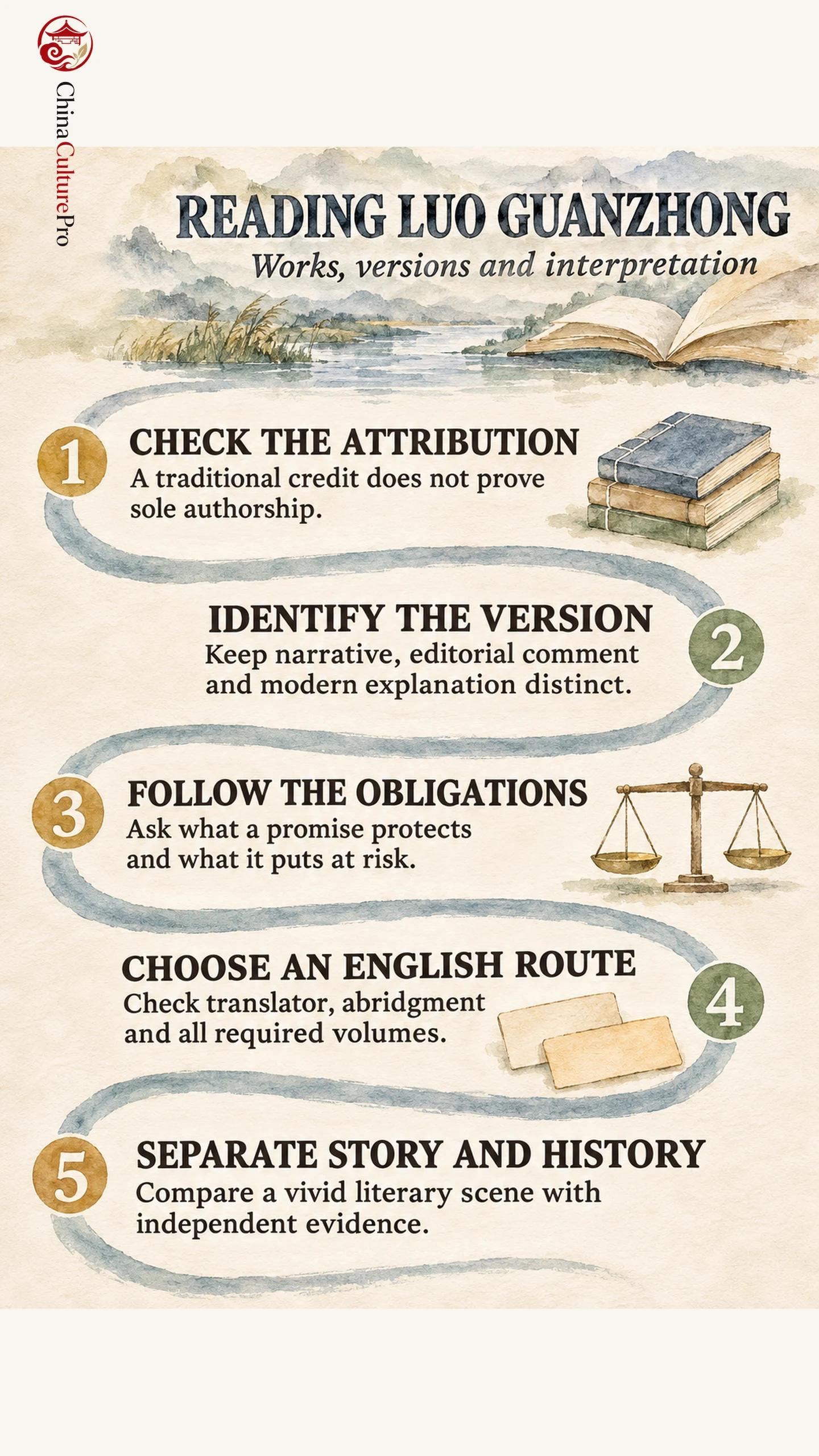
Reading Luo Guanzhong involves two related tasks: choosing a book and understanding what the author credit tells you. You can enjoy the narrative while keeping a few questions about editions in view. The aim is not to solve every scholarly debate before turning the first page.
Major Works and Degrees of Attribution
Treat the following as a guide to important associations, rather than a list of equally secure claims about sole authorship.
| Work | Reading context |
|---|---|
| Romance of the Three Kingdoms (三国演义, Sānguó Yǎnyì). | The principal starting point; its traditional attribution sits within a complicated history of composition and revision.[2] |
| Water Margin (水浒传, Shuǐhǔ Zhuàn). | Luo is associated with editing this outlaw narrative; that is different from establishing him as its sole author.[1] |
| Quelling the Demons’ Revolt (三遂平妖传, Sān Suì Píng Yāo Zhuàn). | A girl’s magic book produces rice and money in this comic supernatural narrative. Columbia’s English edition explicitly says “attributed to.”[7] |
For the main novel’s story and characters, use the Romance of the Three Kingdoms guide. The separate Water Margin guide provides a route into that work without collapsing the two novels into one authorial project.
The demons narrative also illustrates layered credits: a modern Chinese catalogue identifies Luo as compiler and Feng Menglong (冯梦龙, Féng Mènglóng) as the writer of additions. A book’s particular version matters when interpreting such a credit.[8]
Why the Edition Matters as Much as the Author’s Name
The earliest surviving printed edition of Three Kingdoms dates to 1522. The text familiar to many modern readers reflects the later editorial work of Mao Zonggang (毛宗岗, Máo Zōnggǎng), whose edition included changes to the narrative, prefatory guidance and commentary. Moss Roberts based his translation on that later text.[3]
This makes “what did Luo intend?” a harder question than it initially appears. A particular sentence, chapter arrangement or comment may belong to a long process of transmission. Before attaching it directly to a historical author, identify which edition you are reading.
A 2012 study in the Chinese University of Hong Kong’s Journal of Chinese Studies emphasizes the scarcity of biographical evidence and the difficulty of determining a final authorial hand. Its argument is one scholarly contribution to an unsettled question, not a reason to pretend the traditional attribution never existed.[2]
Keep three labels in your notes: narrative text, editorial comment and modern explanation. All may help you, but they do different work.
Reading Brotherhood and Competing Obligations
In the opening chapter, Liu Bei (刘备, Liú Bèi), Guan Yu (关羽, Guān Yǔ) and Zhang Fei (张飞, Zhāng Fēi) swear a bond of brotherhood that joins personal commitment to public service. Their pledge links helping people in distress with serving the state.[9]
That scene gives you a question to carry forward: what happens when obligations pull in different directions? In his foreword to Three Kingdoms and Chinese Culture, Roberts treats the novel as a study of conflicting values, including righteous obligation (义, yì), loyalty, family duties and brotherhood.[3]
Do not reduce a character to a permanent label after one impressive action. Note what a decision protects and what it puts at risk. A promise that looks straightforward when made may become difficult to honor under changed circumstances.
For historical background to Liu Bei, keep a separate note from your account of the novel’s characterization. This prevents a vivid literary scene from silently becoming your evidence for a historical event.
Choosing an English Starting Point
Moss Roberts’s Three Kingdoms is available in complete and abridged forms. Check the edition label as well as the translator’s name.
| English choice | What to check |
|---|---|
| Complete and unabridged translation. | The UC Press two-part edition uses ISBNs 9780520224780 and 9780520225039; obtain both parts for that edition.[5][10] |
| Abridged translation. | The 2020 UC Press edition, ISBN 9780520344556, offers a shorter route and identifies itself as abridged.[6] |
| A different attributed novel. | Patrick Hanan’s Quelling the Demons’ Revolt appeared from Columbia University Press in 2017; it offers comic and supernatural fiction rather than a shortened Three Kingdoms.[7] |
In the later abridged edition’s foreword, Roberts frames Three Kingdoms through the fall of an empire, reversing the more familiar story of imperial unification. Read with that large movement in mind as individual victories and defeats accumulate.[4]
The 2020 abridged edition includes a principal-character list and chronology, useful supports for following the narrative.[6] For a reading group, record chapter references alongside pages, and agree whether everyone is reading the same full or shortened text.
FAQs About Luo Guanzhong
Was the novel written in the Three Kingdoms period?
No. Its historical setting belongs to the end of the Han and the ensuing struggles. The author traditionally associated with it lived much later. Use the Three Kingdoms history guide to keep the historical period separate from the novel’s production.[1][5]
Does the 1522 printing give us the date of composition?
No. A surviving printed edition establishes a point in transmission, not necessarily when a work was first composed. The novel’s formation and earlier circulation remain subjects of scholarly investigation.[2]
Can I read the novel as a reliable account of every historical event?
Read it as historical fiction. For any particular event, distinguish the literary scene from independent records and later adaptations. The guide to history and legend offers a useful way to organize that comparison.
Sources
[1] Penguin Random House South Africa. Luo Guanzhong
[2] Li Ting Yuen, Journal of Chinese Studies. From Surrender to Departure: Dating and Version History, Part I
[3] Moss Roberts; Kimberly Besio and Constantine Tung. Three Kingdoms and Chinese Culture: Foreword and Introduction Sample
[4] Moss Roberts, University of California Press. Foreword to the Fifteenth Anniversary Abridged Edition
[5] University of California Press. Three Kingdoms: Complete and Unabridged Edition
[6] University of California Press. Three Kingdoms: Abridged Edition
[7] Columbia University Press. Quelling the Demons’ Revolt
[8] National Institute of Informatics, CiNii Books. San Sui Ping Yao Zhuan: Catalogue Record
[9] Three Kingdoms, via Wikisource. Chapter One: Opening and Brotherhood Pledge
[10] University of California Press. Three Kingdoms: Companion Part of the Complete Edition