

Quick Answer: What Should You Read by Wang Shifu?
Wang Shifu (王实甫, Wáng Shí Fǔ) is a Yuan-dynasty dramatist best approached through The Story of the Western Wing (西厢记, Xī Xiāng Jì), also known as Romance of the Western Chamber. Its lovers’ pursuit of a union brings desire into conflict with household authority and social expectations.
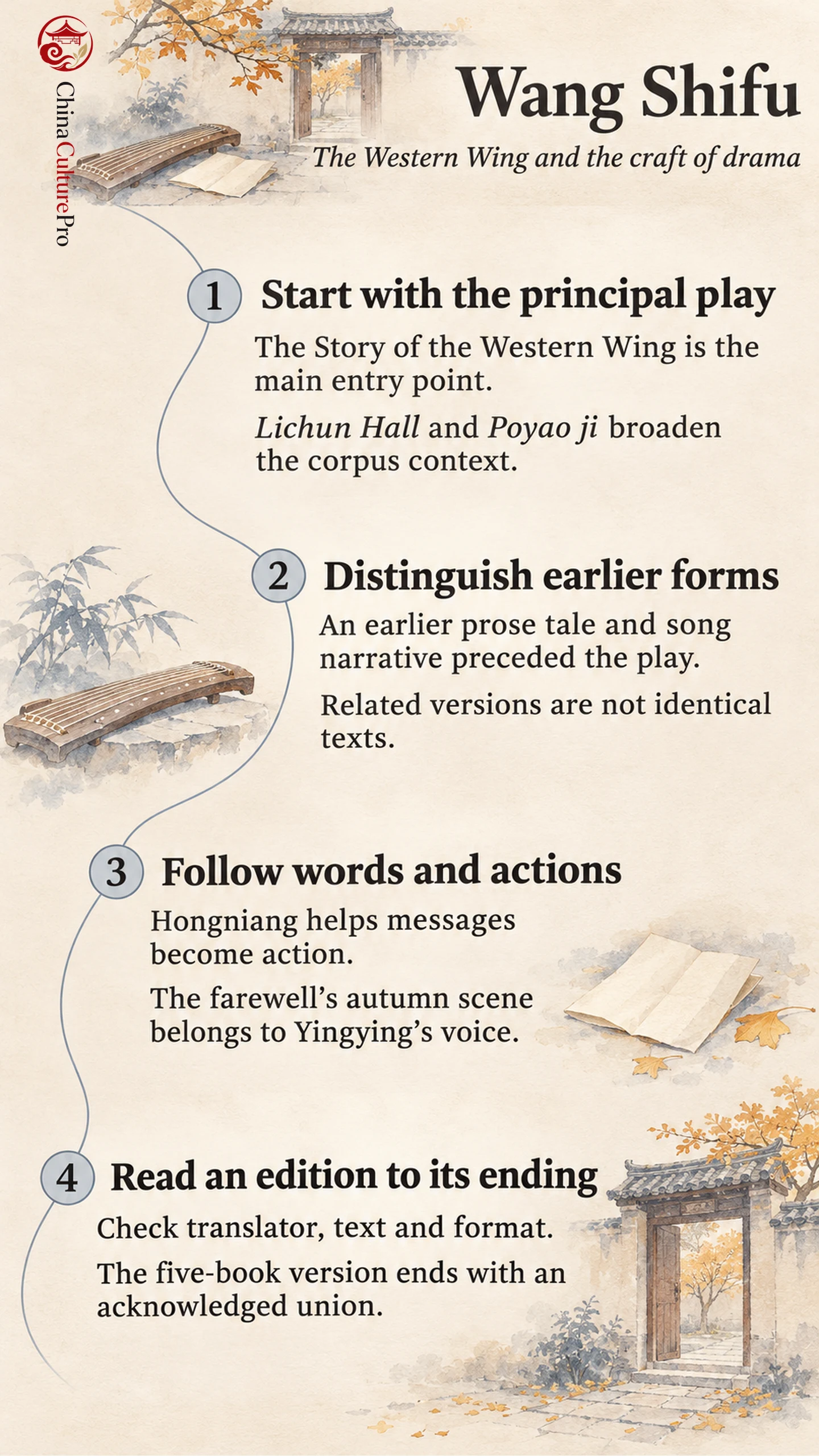
- For a first work: Start with the Western Wing, his principal surviving dramatic achievement.
- For the story: Follow the lovers and the maid who helps them communicate.
- For the language: Read the songs alongside the dialogue and stage directions.
An English edition with an introduction helps distinguish the dramatic text from its earlier sources and later adaptations.
A romance on stage depends on more than two people falling in love. Messages must reach their recipients, promises can be withdrawn, and someone must persuade a household to accept what has happened. Reading Wang Shifu through those actions brings his dramatic craft into view.
Place Wang Shifu and His Major Works
Wang Shifu was a Yuan dramatist whose biography remains uncertain. A Peking University lecture account identifies his surviving plays. His works provide a firmer starting point than a reconstructed personal life. [1]
His best-known play belongs to zaju (杂剧, Zá Jù), a dramatic tradition combining songs, speech and performance. [3] It sits within the larger history of Chinese opera and theatre, while retaining its own textual and formal character.
| Work | Place in a first reading |
|---|---|
| The Story of the Western Wing | Begin here for the romance, character conflicts and lyrical language. |
| Lichun Hall (丽春堂, Lì Chūn Táng) | Another surviving play listed in accounts of his work. |
| Poyao ji (破窑记, Pò Yáo Jì) | Another title traditionally associated with his surviving dramatic corpus. |
The university account lists all three; traditional attribution does not make every title’s textual history equally secure. [1]
Recognize the Story’s Earlier Forms
The Western Wing did not begin as an entirely new plot. An earlier prose narrative was The Story of Yingying (莺莺传, Yīng Yīng Zhuàn), by the Tang writer Yuan Zhen (元稹, Yuán Zhěn). Song-period storytelling adaptations followed, and Dong Jieyuan (董解元, Dǒng Jiě Yuán) developed a song-narrative version in the Jin period. Wang’s Yuan drama drew particularly on Dong’s version. [3]
Keep those forms distinct: an earlier tale, a performance-oriented song narrative and a later play are related works, not alternate English titles for a single unchanged text. Comparing them asks what an adaptation gives its characters to say and do.
Some Ming-period commentators attributed the work, or much of it, to Guan Hanqing (关汉卿, Guān Hàn Qīng). The encyclopedia instead follows modern attribution to Wang Shifu. Later continuations and revisions still need to be distinguished from his text. [3]
For a broader literary setting, the Chinese-literature guide places drama beside prose fiction, poetry and other textual traditions.
Read the Lovers through Hongniang and the Farewell
Keep three names in view as you begin:
- Cui Yingying (崔莺莺, Cuī Yīng Yīng): The young woman whose relationship meets household resistance.
- Zhang Sheng (张生, Zhāng Shēng): The student pursuing a union with her.
- Hongniang (红娘, Hóng Niáng): Yingying’s maid, whose practical intervention helps the lovers.
Follow the movement of messages and the power to accept or refuse them. Hongniang’s work makes communication possible, while Yingying’s mother controls conditions that the lovers cannot simply ignore. The Peking University discussion emphasizes how conflict and character-specific language develop these figures. [1]
In the fourth book’s interrogation scene, Hongniang turns the accusation back toward the mother’s broken promise. She combines an argument about keeping one’s word with the possible damage to household reputation. Her persuasion operates inside that social world, making her more than a convenient messenger. [4]
The same book then moves toward a farewell as Zhang leaves for the examinations. Yingying’s song spreads the parting across an autumn scene: blue sky, yellow flowers, west wind and migrating geese. Landscape becomes part of her voice at the moment of separation. [4]
Read the scene as drama. Notice who sings, who is being addressed, and what happens around the song. The lyrical passage gains force from its position between a newly acknowledged relationship and another departure.
Choose an Edition and Follow Its Ending
The Story of the Western Wing, edited and translated by Stephen H. West and Wilt L. Idema, provides a scholarly English route. The CiNii Books record identifies their roles and the University of California Press edition published in 1995. [6]
The publisher describes a complete translation of the earliest surviving version. Its introduction includes discussions of authorship, earlier materials and dramatic conventions, followed by the translated play. Those features help readers investigate how this text reached them. [2]
Check whether another book is a complete dramatic translation, a selection or a prose retelling. The same romance can appear in several formats. Keep the translator, editor and edition with the title; the guide to Chinese classic books offers further edition-selection questions.
Do continue past the famous farewell. In the fifth book’s ending, examination success, the resolution of a false report and acknowledged marriage bring the lovers together. The wish that lovers everywhere should become spouses closes a story whose resolution still involves rank, family and public recognition. [5]
That ending invites a useful question: how does the play reconcile a privately chosen attachment with the social conditions around it? Read the reunion beside Hongniang’s earlier persuasion and Yingying’s reluctance to part. [5]
For another dramatist’s treatment of love and literary form, continue with Tang Xianzu, keeping the two writers’ periods and plays distinct.
FAQs About Wang Shifu
Is The Story of the Western Wing a novel or a play?
Wang Shifu’s work is a play with songs and dialogue. Later adaptations and retellings may present its story in other forms.
Who are the central characters in Wang Shifu’s play?
The central lovers are Cui Yingying and Zhang Sheng. Hongniang, Yingying’s maid, plays a crucial role in helping them, while the mother’s authority creates obstacles.
Which English translation provides a scholarly introduction?
Stephen H. West and Wilt L. Idema’s The Story of the Western Wing includes an introduction discussing the work’s literary and textual context.
Does the play end with the lovers separating?
No. The five-book text ends with their acknowledged union. The farewell is an important dramatic episode rather than the final outcome.
Sources
[1] Peking University, Institute of Capital Development. Reading Yuan Drama: Wang Shifu’s Western Chamber
[2] University of California Press. The Story of the Western Wing
[3] Encyclopedia of China, Berkshire Publishing. Romance of the Western Chamber
[4] Wang Shifu, via Wikisource. The Western Chamber, Book Four
[5] Wang Shifu, via Wikisource. The Western Chamber, Book Five
[6] National Institute of Informatics, CiNii Books. The Story of the Western Wing: Bibliographic Record