

Quick Answer: How Should You Begin Reading Zhu Ziqing?
Zhu Ziqing (朱自清, Zhū Zìqīng; 1898–1948) was a modern Chinese essayist, poet, scholar and educator. Begin with four essays about a father’s care, a moonlit walk, the passage of time and seasonal renewal.
- For narrative: Start with the railway farewell and notice how the older narrator judges his younger self.
- For description: Follow the lotus-pond walk beyond its beautiful central passage.
- For range: Compare restless questions about time with a more hopeful scene of renewal.
These are prose essays. Their poetic imagery does not turn them into classical verse or make every narrator’s feeling a complete account of the author’s life.

Zhu’s best-known passages often circulate separately from their endings. Read the complete essays first. A small change in viewpoint—a remembered impatience, a sound the walker cannot share, a question repeated—can alter the meaning of an otherwise familiar scene.
Place Zhu Ziqing and Choose Four Essays
Zhu studied at Peking University and graduated in 1920. After teaching in several schools, he joined Tsinghua in 1925. His career brings together modern literary creation, teaching and scholarship; it cannot be reduced to a few schoolbook descriptions of scenery. [1] The modern Chinese literature guide places that work in a wider reading context.
| Starting essay | What to follow |
|---|---|
| The Sight of My Father’s Back (背影, Bèi Yǐng) | A remembered farewell reconsidered by an older narrator. [2] |
| Moonlight over the Lotus Pond (荷塘月色, Hé Táng Yuè Sè) | A night walk from unease through sensory pleasure and back home. [3] |
| Haste (匆匆, Cōng Cōng) | Repeated questions about days that cannot return. [4] |
| Spring (春, Chūn) | The movement from natural renewal toward human activity. [5] |
English titles vary. Use the Chinese title to identify the work, especially when an anthology calls the railway essay The View from the Rear or the night walk The Lotus Pond by Moonlight.
Read the Father’s Back through Two Perspectives
The farewell takes place during a family crisis: the grandmother has died, the father has lost his position and money is scarce. At the railway station, the younger narrator finds some of his father’s arrangements embarrassing or unnecessary. The older narrator explicitly questions that earlier sense of superiority. [2]
The father’s difficult crossing to buy oranges gives care a physical form. His weight, clothing and effort make the bodily cost of an ordinary act of care visible. The essay returns to his back in its closing recollection, prompted by a letter about his declining health. The father is still alive; the ending is not a death scene. [2]
Read the moments of irritation as carefully as the tears. Without the younger self’s impatience, the later recognition would lose much of its force. The essay asks the reader to inhabit both the original encounter and the act of remembering it.
For a broader comparison, see Chinese family traditions. Here, however, the most revealing evidence is the particular gesture and the narrator’s changed understanding, rather than a universal statement about all fathers and sons.
Follow the Lotus Pond Walk All the Way Home
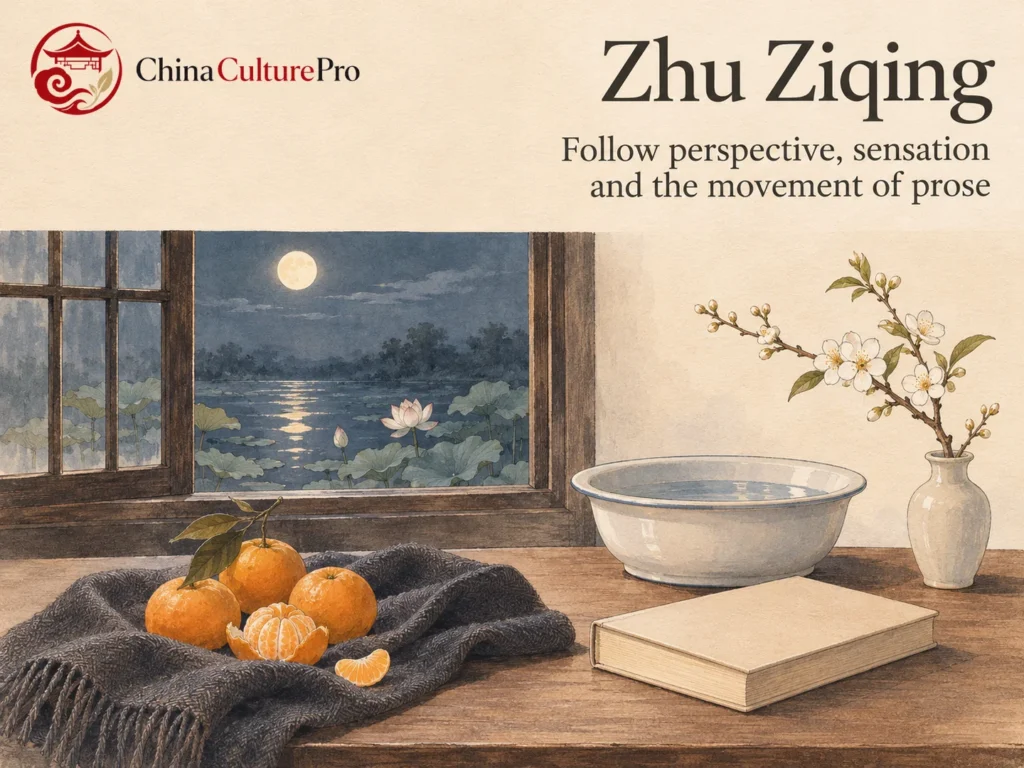
The night walk begins in unease. Solitude offers a temporary freedom from ordinary duties. Description then links different senses: lotus fragrance suggests distant singing, while the arrangement of light and shadow becomes musical. The scene is experienced through a mind making comparisons, not recorded as an inventory of plants. [3]
The movement changes when insects and frogs seem to possess a liveliness the walker cannot share. Recollections of lotus-gathering poetry lead toward thoughts of Jiangnan. He reaches his own door and returns to the sleeping household. The essay does not announce that all unease has disappeared. [3]
The Chinese literary allusions guide helps explain how an older poem can enter a modern scene. Mark the transition from what the narrator sees to what literature allows him to imagine. Distinguish the observed pond from the remembered literary scene before connecting them.
Compare Passing Time with Seasonal Renewal
Haste sets recurring natural events against human days that never come back. Time slips through washing, eating, watching sunlight and even lamenting its departure. The ending returns to a question rather than supplying a schedule or a practical solution. [4]
Its repetitions make the reader feel the attempt to catch something already passing. Read a paragraph aloud and notice how each ordinary action becomes another measure of loss. That effect is more specific than a general instruction to work harder.
Spring offers a different rhythm. Grass, blossom, wind and rain lead toward people moving outdoors and beginning their work. Its final comparisons progress through new life, youthful beauty and strength moving forward. Renewal becomes an invitation to participate, not only a view to admire. [5]
Compare where the essays leave their readers: one with a recurring question, the other with forward motion. The Chinese nature poetry guide offers adjacent examples of seasonal imagery, while the difference in genre remains useful: these scenes unfold within modern prose.
Find English Texts without Losing the Prose
The Chinese Essay, edited and translated by David Pollard, lists three Zhu selections: The View from the Rear, Traces of Wenzhou and The Lotus Pond by Moonlight. This provides a verified starting point for the railway and lotus-pond essays, alongside a further selection from his prose. [6]
When choosing a translation, compare paragraph movement as well as individual images. Does the older narrator’s self-criticism remain audible? Is the night walk’s change of mood preserved? Are repeated questions kept distinct from answers supplied by a note?
The Chinese classic books guide helps assess bilingual editions and annotation. Begin with one complete essay in two readings: first follow its movement, then return to the details that made that movement possible.
FAQs About Zhu Ziqing
Is the essay about his father a poem?
No. It is a prose essay built around recollection, a farewell scene and later reflection. Its emotional concentration and imagery do not make it a verse poem.
Does the lotus pond essay end with complete peace?
No such resolution is stated. The narrator experiences temporary freedom and beauty, then distance from the surrounding liveliness, thoughts of Jiangnan and a return home.
Are all four essays in the same English anthology?
Not in the verified contents of Pollard’s The Chinese Essay. Its Zhu section includes the railway farewell, the lotus-pond essay and Traces of Wenzhou. Check other editions separately for the time and seasonal essays.
Sources
[1] Tsinghua University. Zhu Ziqing: The Spirit of Tsinghua Is Practical Work
[2] Zhu Ziqing, via Wikisource. The Sight of My Father’s Back
[3] Zhu Ziqing, via Wikisource. Moonlight over the Lotus Pond
[4] Zhu Ziqing, via Wikisource. Haste
[5] Zhu Ziqing, via Wikisource. Spring
[6] Research Centre for Translation, Chinese University of Hong Kong. The Chinese Essay: Table of Contents