


Quick Answer: What Is Chinese Nature Poetry?
Chinese nature poetry makes landscapes, seasons and rural experience central to a poem’s attention. Two useful traditions are shanshui shi (山水诗, shānshuǐ shī), poetry of mountains and waters, and tianyuan shi (田园诗, tiányuán shī), poetry of fields and gardens.[1][2]
- Landscape: A journey, a view or a changing vantage point can become a way of thinking.
- Rural life: Fields and homes can bring work, neighbors and chosen withdrawal into the poem.
- Seasonal experience: Birds, flowers, weather and light take meaning from the particular scene.[3][4][5][6]
These are overlapping ways of reading, not a rule that every mountain poem expresses peace or every autumn poem expresses sadness.
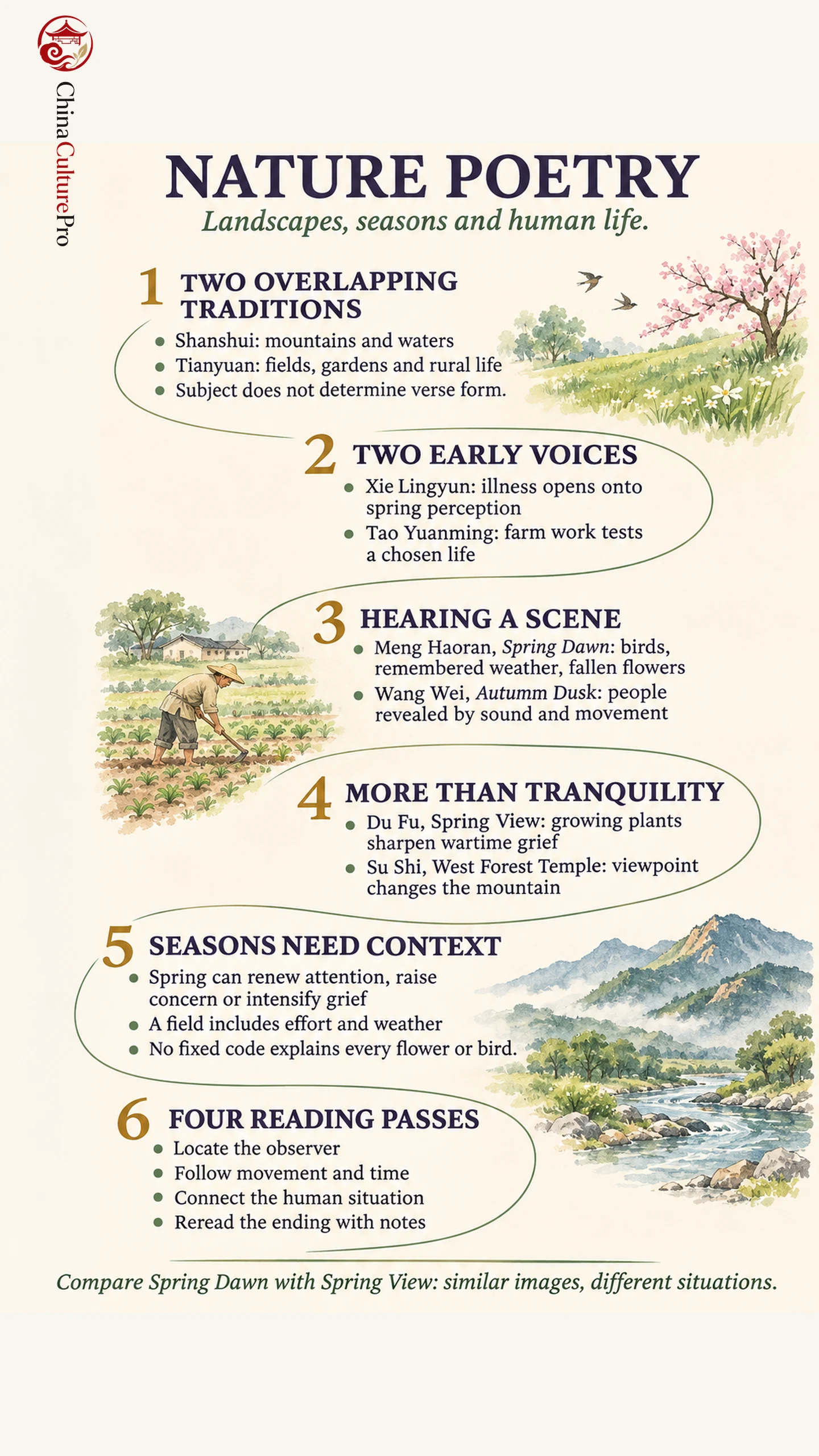
The most useful question is often what changes while the speaker looks or listens. A familiar scene may become strange after illness, a field may test someone’s commitment, or returning spring may sharpen grief. Begin with those relationships rather than a dictionary of symbols.
Landscape, Farmstead and a Long Poetic Tradition
Xie Lingyun (谢灵运, Xiè Língyùn) is a major early model for landscape poetry, while Tao Yuanming (陶渊明, Táo Yuānmíng) is closely associated with fields, gardens and rural life. Their importance concerns the sustained poetic treatment of these worlds, rather than a claim that earlier writing contained no natural imagery.[1][2][3]
Later writers, including Wang Wei (王维, Wáng Wéi) and Meng Haoran (孟浩然, Mèng Hàorán), developed a rich range of landscape and rural scenes. These traditions could overlap: mountains seen from a dwelling are not automatically a different emotional world from the dwelling’s garden. Nor did a mountain setting necessarily put a writer outside social or political life.[3]
Keep subject and verse form separate. “Nature poetry” describes an area of attention; it does not specify one line count or rhyme pattern. The broader Chinese poetry guide explains formal families, while regulated verse introduces one important set of structures.
Six Poems with Different Ways of Seeing
| Poem | Writer | A useful reading question |
|---|---|---|
| Climbing the Tower by the Pool (登池上楼, Dēng Chíshàng Lóu) | Xie Lingyun | What happens when a speaker laid low by illness notices spring? |
| Returning to Gardens and Fields (归园田居, Guī Yuán Tián Jū), no. 3 | Tao Yuanming | How does a difficult day’s farming give weight to a chosen life? |
| Spring Dawn (春晓, Chūn Xiǎo) | Meng Haoran | How do sounds connect the waking present with last night’s weather? |
| Mountain Dwelling at Autumn Dusk (山居秋暝, Shānjū Qiū Míng) | Wang Wei | How do sound and movement reveal people within apparent quiet? |
| Spring View (春望, Chūn Wàng) | Du Fu (杜甫, Dù Fǔ) | Why does spring growth intensify a wartime scene? |
| Inscribed on the Wall of West Forest Temple (题西林壁, Tí Xīlín Bì) | Su Shi (苏轼, Sū Shì) | What can changing viewpoints reveal and still leave unknown? |
Climbing the Tower by the Pool places spring grasses and changing birdsong after reflections on public service, withdrawal and illness. Its famous seasonal couplet belongs to a larger movement from confinement toward renewed perception, then toward thoughts of separation. Reading only the fresh grass would lose the speaker’s situation.[4]
The third farmstead poem gives rural choice a physical cost: weeds flourish among sparse beans, work stretches from dawn to a moonlit return, and dew wets the speaker’s clothes. Its ending values an intention kept intact. For the social world around those fields, read the Tao Yuanming profile.[5]
Spring Dawn contains just twenty Chinese characters: 春眠不覺曉,處處聞啼鳥。夜來風雨聲,花落知多少。 A speaker wakes to birds, recalls wind and rain, and wonders how many blossoms have fallen. The poem’s last question leaves the aftermath of that unseen night open to the reader’s imagination.[6]
In the autumn mountain poem, moonlight and spring water are joined by laundry women returning through bamboo and a fishing boat disturbing lotus plants. Quietness is experienced through signs of life, not by deleting the inhabitants. The Wang Wei profile explores that interplay further.[7]
Spring View begins with a broken country and enduring mountains and rivers. Vegetation grows thick in the city, while flowers and birds are caught in the speaker’s grief amid war and family separation. Nature’s continuing life makes human disorder more painful. The Du Fu profile supplies his wider poetic context.[8]
The temple-wall poem shifts the observer’s position: a mountain appears as a ridge or a peak, different from near, far, high and low. Its ending connects the failure to see the whole mountain with being inside it. The landscape supports a reflection on knowledge; the Su Shi profile places this short poem among his other work.[9]
Seasons, Sound and Human Presence
Spring does not supply one emotional instruction. In the tower poem it renews attention after illness; in Spring Dawn it brings both waking birds and concern for lost flowers; in Spring View it exposes a painful contrast with war. The same season can support discovery, tenderness or distress.[4][6][8]
Sound can also change what “empty” or “quiet” means. The autumn mountain scene includes voices and movement, while Spring Dawn begins with hearing before any account of looking. Ask what the speaker can actually perceive and what must be inferred.[6][7]
A cultivated field is equally different from a view of untouched wilderness. Its plants depend on effort and weather, and the poem can value a rural life without hiding its demands. The distinction keeps “natural” from becoming a synonym for effortless.[5]
Related subjects deserve their own context. Moon poetry follows one recurrent image, and farewell poetry shows how a landscape can organize distance between people. Neither requires every moon or river to carry a single meaning.
Read a Scene in Four Passes
Use the whole poem, ideally beside an annotated rendering. The English descriptions above are reading aids, not replacements for its arrangement of words.
- Locate the observer: Ask where the speaker is, what can be seen or heard and whether the scene is present, remembered or imagined.
- Follow movement and time: Notice changes of light, weather, season, distance and attention rather than listing objects alone.
- Connect the human situation: Look for labor, visitors, illness, separation or public disorder that changes the scene’s significance.
- Reread the ending with notes: Test how the final lines alter the opening, using an annotated edition for difficult words, allusions and historical context.
For a first comparison, read Spring Dawn beside Spring View. Both contain spring, flowers and birds, but their situations make those details work differently. Consult literary allusions when an inherited phrase needs explanation, then return to the poem’s own movement.
FAQs About Chinese Nature Poetry
Is Chinese nature poetry always about peaceful escape?
No. It can involve illness, labor, political ambition, war or separation as well as withdrawal and pleasure. The speaker’s situation determines how a landscape functions.[3][4][5][8]
Do seasons have one fixed meaning?
No. Seasonal associations matter, but individual poems reshape them. Spring can renew perception, raise concern for fallen blossoms or sharpen grief over human disorder.[4][6][8]
Are landscape poetry and farmstead poetry identical?
They are related traditions with different emphases: mountains and waters on one hand, fields, gardens and rural experience on the other. Many poems bring their subjects and concerns together.[1][2][3]
Which short poem is a useful first reading?
Meng Haoran’s Spring Dawn offers a compact starting point: four five-character lines move from waking and birdsong to remembered weather and a question about fallen flowers.[6]
Sources
[1] Key Concepts in Chinese Thought and Culture. Landscape poetry
[2] Key Concepts in Chinese Thought and Culture. Idyllic poetry
[3] Wendy Swartz, Rutgers University. Sites II: Oxford Handbook of Classical Chinese Literature
[4] Xie Lingyun, primary text via Wikisource. Climbing the Tower by the Pool
[5] Tao Yuanming, primary text via Wikisource. Returning to Gardens and Fields
[6] Meng Haoran, primary text via Wikisource. Spring Dawn
[7] Wang Wei, primary text via Wikisource. Mountain Dwelling at Autumn Dusk
[8] Du Fu, primary text via Wikisource. Spring View
[9] Su Shi, primary text via Wikisource. Inscribed on the Wall of West Forest Temple