


Quick Answer: Who Was Tao Yuanming?
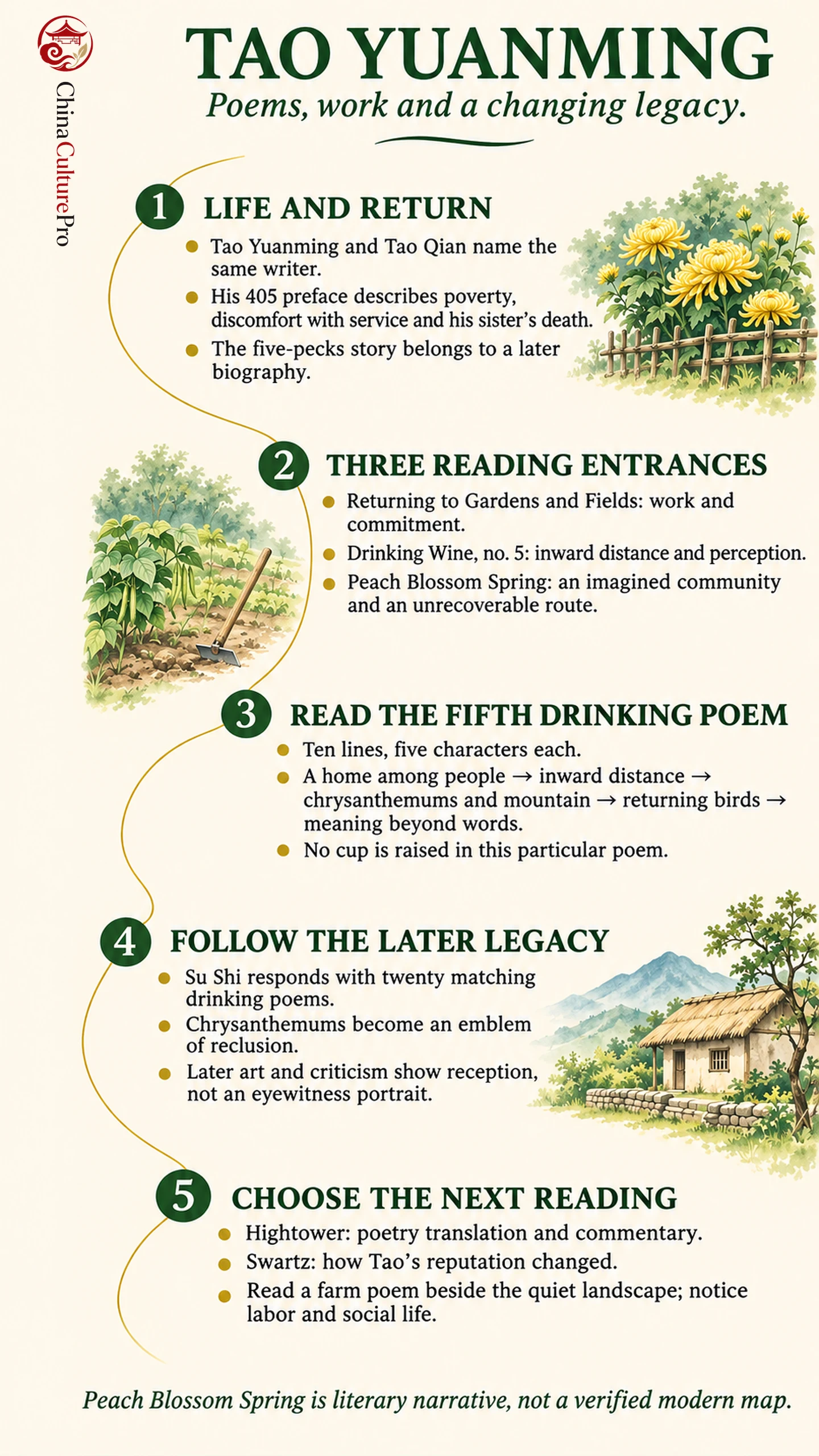
Tao Yuanming (陶渊明, Táo Yuānmíng), also known as Tao Qian (陶潜, Táo Qián), was a Chinese poet and prose writer remembered for rural life, withdrawal from office and reflection on how to live. His conventional dates are about 365–427; his birth year remains uncertain.[1][7]
- Life: Short periods of official service preceded a lasting return to farming and home.
- Writing: Fields, neighbors, birds, wine and ordinary work become subjects for ethical and philosophical reflection.
- Legacy: Later readers developed different images of him, from eccentric recluse to exemplary moral figure.[1][4][5][7]
Read the works alongside the biographical tradition. A poem’s voice and a later story about its author are different kinds of evidence.
Tao’s importance in Chinese literature lies partly in what he made worth attending to: a poor harvest, a visit, an evening view or the decision to stay home. His rural world offers pleasure and independence, but it also includes labor, material need and the passage of time.[4][5]
A Working Life and the Decision to Return
Tao came from the region of present-day Jiangxi and lived during the Eastern Jin (东晋, Dōng Jìn) and the political changes of the early fifth century. He held several short-lived posts before making farming and withdrawal central to his later life.[1]
The decisive return is associated with his departure from the county post at Pengze (彭泽, Péngzé) in 405. His Returning Home (归去来兮辞, Guīqù Láixī Cí) includes a preface explaining poverty, a household to support and the attraction of a post close enough to home. He soon felt that official work conflicted with his disposition. The death of his sister then provided the immediate occasion to leave, after more than eighty days in office.[2]
The later historical biography in Song shu (宋书, Sòngshū) tells a different, famous episode: he refuses to bow to a petty local figure for “five pecks of rice” and gives up his position. This is an important biographical tradition, but it should not replace the more complicated circumstances described in the preface.[3]
Withdrawal also did not mean a life without other people. The writings contain children, relatives, villagers, visitors and shared meals. Independence from official demands could coexist with ordinary social obligations and dependence on a harvest.[2][4]
Three Works to Begin With
Tao is strongly associated with tianyuan shi (田园诗, tiányuán shī), poetry of fields and gardens. Start with different kinds of text so that the word “pastoral” does not flatten his range.[1]
| Work | A useful starting point | What to notice |
|---|---|---|
| Returning to Gardens and Fields (归园田居, Guī Yuán Tián Jū) | The third poem’s bean field | Work, weeds, a late return and fidelity to a chosen life |
| Drinking Wine (饮酒, Yǐnjiǔ) | The fifth poem | Inward distance, chrysanthemums, evening birds and the limits of explanation |
| Peach Blossom Spring (桃花源记, Táohuā Yuán Jì) | The prose narrative, with its accompanying poem | An imagined community and the failure to find it again |
In the farm poem, beans grow beneath a mountain, but weeds are vigorous and the seedlings sparse. The speaker works from morning and carries a hoe home under the moon; evening dew wets his clothes. The close gives value to keeping his intention intact. Farming supplies a test of commitment rather than a decorative background. Other poems show village smoke, dogs, roosters and conversation about crops: a lived social landscape.[4]
Peach Blossom Spring uses another method. A fisherman discovers a settled, hospitable community whose ancestors escaped earlier upheaval. After he leaves, the marked route cannot be recovered. Its inviting fields and homes form an alternative social world, while the ending frustrates the wish to turn that world into an accessible destination. Read it as literary narrative, not verification of a hidden village on a present-day map.[6]
The broader nature poetry guide follows how landscape and rural work operate across writers; Tao’s poems are a major point of comparison.
Reading Drinking Wine, Number Five
The fifth poem contains ten five-character lines. It begins with a dwelling among people, yet without the disturbance of carriages and horses. A question follows: how is that possible? The answer makes distance a matter of the heart or mind, rather than geography alone.[5]
The central pair reads 採菊東籬下,悠然見南山: cǎi jú dōng lí xià, yōurán jiàn nán shān. A close English sense is “picking chrysanthemums beneath the eastern hedge, at ease I see the southern mountain.” The movement from a nearby task to a farther view matters more than making the line a slogan about escape.[5]
Evening air and returning birds extend that moment. The final pair says there is a true meaning here, but trying to articulate it ends in forgotten words. The poem has moved through a problem, an answer and a scene before reaching this hesitation. Its apparent simplicity therefore has an arrangement you can follow.[5]
Notice also what is absent: this particular poem does not describe a cup being raised. Its place within a drinking sequence gives context, but the title does not require every line to narrate intoxication. Reading it as nothing more than a drinking anecdote would miss its central question.[5]
The guide to Chinese poetry helps place five-character verse among other forms. Notes on literary allusions become useful when the seemingly plain language of other Tao poems invokes earlier texts.
How Later Readers Shaped His Legacy
Tao’s status grew through successive acts of interpretation. Later critics debated his withdrawal, personality and writing in changing moral and literary terms. The image of one timeless, perfectly consistent recluse can hide that history.[7]
Su Shi (苏轼, Sū Shì), for example, wrote a sequence matching Tao’s twenty drinking poems. Its introductory remarks explicitly frame the later poems as responses to Tao. This is a concrete form of influence: a later writer returns to an earlier poet’s sequence and uses it for his own reflection. The Su Shi profile supplies his separate context.[10]
Painting carried the associations further. Plucking Chrysanthemums, a painting dated 1658 and cataloged as a copy of an earlier work, connects chrysanthemums, wine and reclusion with Tao’s memory. It demonstrates a later cultural image, rather than supplying a contemporary likeness of the fifth-century poet.[8]
For English reading, James Robert Hightower’s The Poetry of T’ao Ch’ien offers translations and commentary on the poetry; a revised edition appears as The Poetry of Tao Qian. Wendy Swartz’s Reading Tao Yuanming: Shifting Paradigms of Historical Reception (427–1900) addresses the different question of how his reputation was formed. Choose the former to work through poems and the latter to study their later reception. Our Chinese classics reading guide explains how edition choices affect that experience.[7][9]
FAQs About Tao Yuanming
Are Tao Yuanming and Tao Qian the same writer?
Yes. These are two names associated with the same poet. Older English books may use T’ao Yuan-ming or T’ao Ch’ien, so those spellings can help when searching library catalogs.[1]
Why did Tao Yuanming leave office?
His 405 preface describes financial pressures, discomfort with service and his sister’s death as the occasion for departure. The historical biography preserves the famous refusal-to-bow story. Reading both avoids reducing the decision to one anecdote.[2][3]
Is Peach Blossom Spring a real place?
The work presents an imagined community through a fisherman’s discovery and a route that cannot be found again. The narrative does not establish a unique, historically verified modern location.[6]
Is every poem about drinking literally about alcohol?
No. Drinking provides a recurring setting and sequence title, but individual poems can center on values, solitude, aging or perception. The fifth drinking poem, for example, develops its thought through habitation, flowers, mountains and returning birds.[5]
Sources
[1] Chinese University of Hong Kong, Renditions. Tao Qian
[2] Tao Yuanming, primary text via Wikisource. Returning Home, with preface
[3] Shen Yue, primary historical text via Wikisource. Song shu, volume 93: Tao Qian
[4] Tao Yuanming, primary text via Wikisource. Returning to Gardens and Fields
[5] Tao Yuanming, primary text via Wikisource. Drinking Wine: twenty poems, number five
[6] Tao Yuanming, primary text via Wikisource. Peach Blossom Spring
[7] Wendy Swartz, Rutgers University. Reading Tao Yuanming: Shifting Paradigms of Historical Reception, 427–1900
[8] The Metropolitan Museum of Art. Plucking Chrysanthemums, after Zhang Feng
[9] Quirin Press, James Robert Hightower. The Poetry of Tao Qian: revised edition
[10] Su Shi, primary text via Wikisource. Matching Tao’s twenty Drinking Wine poems