


Quick Answer: How Do Shi, Ci and Qu Differ?
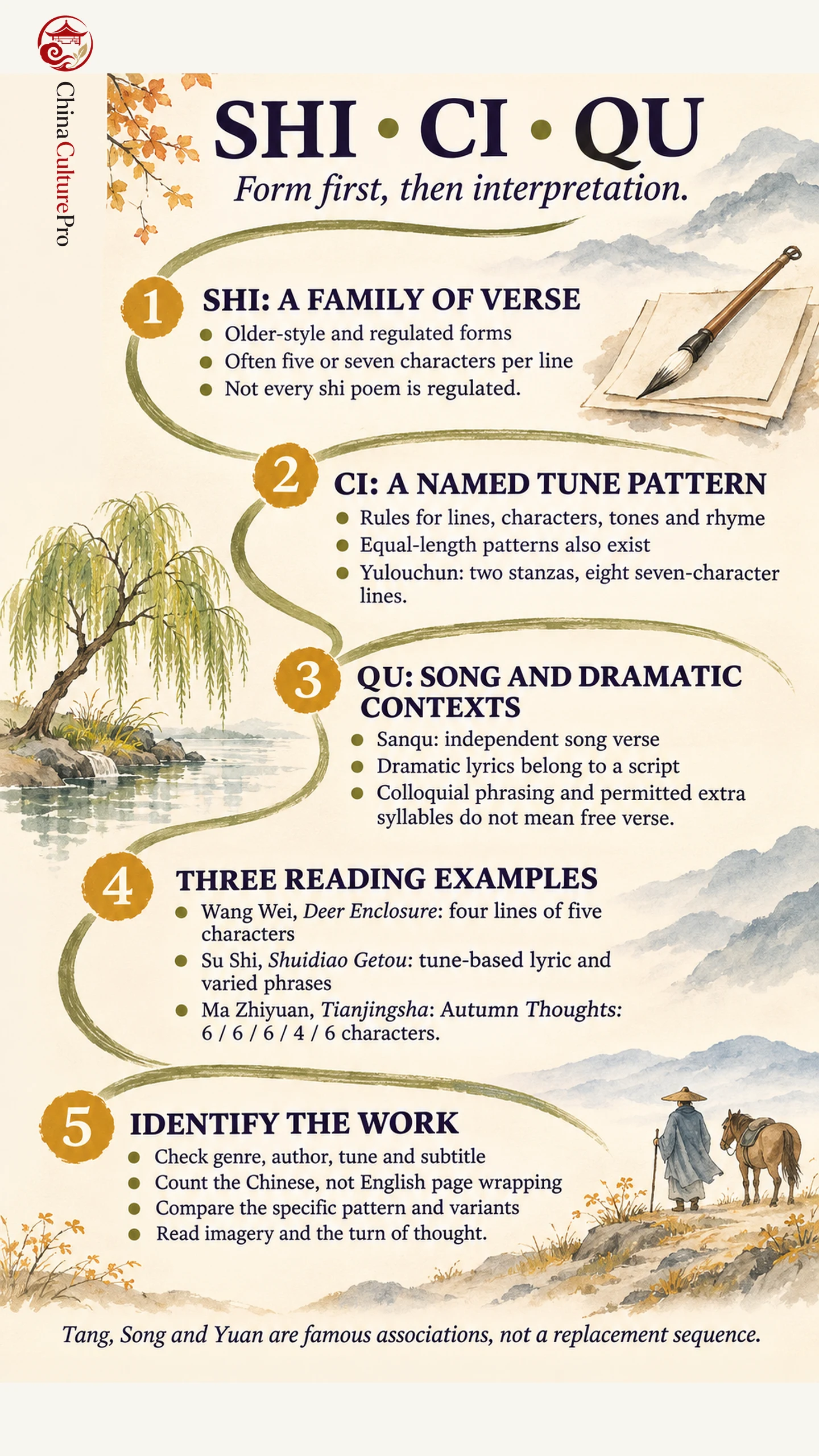
Shi poetry (诗, shī), ci lyrics (词, cí) and qu songs (曲, qǔ) are related traditions with different ways of organizing verse. The useful distinction concerns formal conventions and musical background, rather than three separate sets of subjects.
- Shi: A broad verse family, including older-style and regulated forms, often with five or seven Chinese characters per line.
- Ci: Lyrics organized by named tune patterns that govern such features as line lengths, tones and rhyme.
- Qu: Tune-based verse associated with independent songs and drama, often allowing more colloquial expression.[1][2][3]
These are starting categories. An English translation’s line breaks, or a poem’s topic, cannot establish its Chinese form.
The same moon, journey or farewell can appear in several poetic forms. To compare them, first separate the text’s structure from what it describes. Our wider Chinese poetry guide places these traditions beside other forms, including poetic rhapsodies and the southern anthology tradition.
Three Forms Compared
Shi is itself a family rather than one template. Three terms make that internal distinction clearer:
| Term | Meaning |
|---|---|
| gushi (古诗, gǔshī) | Older-style shi verse, without the full rules of recent-style regulated poetry. |
| jintishi (近体诗, jìntǐshī) | Recent-style shi verse governed by formal rules for line length, tones and rhyme. |
| sanqu (散曲, sǎnqǔ) | Independent qu song verse, distinct from lyrics embedded in a dramatic script. |
Within recent-style poetry, lüshi (律诗, lǜshī) normally has eight lines, while jueju (绝句, juéjù) has four. The latter label also includes older-style examples; four lines alone do not prove compliance with regulated tonal rules. The regulated verse guide explains those distinctions.[1]
| Feature | Shi | Ci | Qu |
|---|---|---|---|
| Structural starting point | A specific verse subtype, with stricter or freer rules | A named tune pattern, called a cipai (词牌, cípái) | A named song pattern in an independent song or dramatic context |
| Line lengths | Often five or seven characters; other lengths exist | Frequently mixed lengths, but equal-length patterns exist | Determined by the pattern, with permitted additions in some contexts |
| Formal flexibility | Depends on whether the work is older-style or regulated | Specific patterns have requirements and recognized variants | May admit chenzi (衬字, chènzì), extra syllables beyond a pattern’s basic count |
| Language and subjects | Varied, from landscape to politics | Varied, including longing, reflection and public concerns | Often more colloquial, without being restricted to comedy |
Extra syllables do not turn qu into unrestricted free verse. A song still has a pattern and a performance context; additions serve phrasing and expression within that tradition.[2][3][4]
Why Music and Period Labels Need Care
“Shi cannot be sung” is too absolute. The shi tradition includes yuefu (乐府, yuèfǔ), or Music Bureau poetry, with important connections to song. The distinction is better expressed through the conventions of each genre than through a permanent boundary between spoken and sung words.[1]
For ci, a tune name establishes a formal framework; it is not simply a descriptive title. The surviving written pattern also should not be confused with a complete, recoverable historical performance. Learn more about that distinction in the Song ci guide.[2]
Nor can visual line length settle the question. Yulouchun (玉楼春, Yùlóu Chūn), a ci tune, has a well-attested 56-character pattern divided into two stanzas of four seven-character lines each. Its equal-length lines make it a useful counterexample to the claim that all ci must be uneven.[5]
The familiar sequence “Tang poetry, Song lyrics, Yuan songs” names celebrated associations, rather than dates when one form abolished another. Shi continued during the Song period; shi, ci and qu were all written in later imperial times. Qu’s prominence in the Yuan period likewise does not make every Yuan poem qu. The Tang poetry guide follows one major period without treating it as the whole shi tradition.[1][3]
Three Works to Read Side by Side
Wang Wei (王维, Wáng Wéi) offers a compact shi example in Deer Enclosure (鹿柴, Lù Zhài). Its four five-character lines move from a mountain without visible people to heard voices, then to returning light on moss. Count twenty characters without punctuation, but also notice how sound and light alter the scene. A short poem is more than its dimensions; the Wang Wei profile develops its landscape context.[6]
Su Shi (苏轼, Sū Shì) writes under the ci tune Shuidiao Getou (水调歌头, Shuǐdiào Gētóu) in the lyric opening with a question about the bright moon. Long and short phrases carry the speaker from imagined celestial travel to human separation and a wish for shared moonlight. The tune name identifies its pattern; the opening words identify this particular lyric. Read the Su Shi profile or moon poetry guide for its broader setting.[7]
Ma Zhiyuan (马致远, Mǎ Zhìyuǎn) supplies a qu example under Tianjingsha (天净沙, Tiānjìngshā), with the subtitle “Autumn Thoughts.” It is a xiaoling (小令, xiǎolìng), here meaning a single short sanqu song. This label also occurs in ci, so it needs a genre context.[4][8]
The received text has five phrases with 6, 6, 6, 4 and 6 characters: twenty-eight in all. Vines, trees, evening crows, a bridge, water, homes, an old road, west wind and a thin horse accumulate before sunset and the distant, sorrowful traveler bring the scene into focus. Its short length still supports a deliberate progression from objects to the traveler’s emotional situation.[8]
A Practical Way to Identify a Poem
Use the Chinese text and an annotated edition together. Modern page wrapping and English verse layout can conceal the original arrangement.
- Check the edition label: Look for the genre, author, tune name and any subtitle in an annotated source.
- Count the original lines: Count Chinese characters without punctuation, keeping musical phrases separate from page wrapping.
- Compare the right pattern: For a tune-based lyric, consult that tune’s pattern and variants; for shi, identify its specific subtype.
- Read beyond the label: Follow the speaker, imagery and turn of thought, using notes to test references and translation choices.
Once you know the form, compare how a subject changes across texts. A farewell poem may compress a parting into four lines or develop it through a longer lyric. Notes on literary allusions help distinguish an inherited reference from the speaker’s immediate situation. For a guided English route across genres, Zong-qi Cai’s How to Read Chinese Poetry combines Chinese texts, translations, romanization and explanatory reading strategies.[1]
FAQs About Shi, Ci and Qu
Did ci replace shi and qu replace ci?
No. Their best-known periods overlap with the continued use of other forms. Later writers still composed in all three traditions, so a dynasty label alone cannot identify a poem’s genre.[1]
Are all short four-line poems regulated verse?
No. Jueju names four-line verse, but the category includes older-style and regulated examples. Identifying a regulated example requires checking more than its line count.[1]
Can a ci have equal-length lines?
Yes. The 56-character Yulouchun pattern has eight seven-character lines arranged in two stanzas. Mixed line lengths are common in ci, but they are not a universal test.[5]
Does a tune name identify one unique poem?
No. Many writers can compose to the same tune. Record the author and opening words, as well as any subtitle, to identify a specific work.[2][7]
Sources
[1] Columbia University Press. How to Read Chinese Poetry: A Guided Anthology
[2] Key Concepts in Chinese Thought and Culture. Ci: lyric
[3] Key Concepts in Chinese Thought and Culture. Qu
[4] Key Concepts in Chinese Thought and Culture. Xiaoling
[5] Chinese primary pattern handbook via Wikisource. Yu ding ci pu, volume 12: Yulouchun
[6] Wang Wei, primary text via Wikisource. Deer Enclosure
[7] Su Shi, primary text via Wikisource. Shuidiao Getou: When did the bright moon appear?
[8] Ma Zhiyuan, primary text via Wikisource. Tianjingsha: Autumn Thoughts