

Quick Answer: What Are Chinese Parallel Couplets?
Chinese duilian (对联, duìlián) are paired, associated lines composed to work together through corresponding wording, structure, sound and meaning. They may be displayed as calligraphy on doorways or hanging scrolls, but their literary craft extends beyond decoration.[1][2]
- Read across the pair: The relationship between the lines matters as much as either line alone.
- Look for correspondence: Equal character counts, matched phrases, related meanings and tonal contrast are central features.
- Identify the occasion: A festive doorway pair, a memorial inscription and a couplet within a poem have different contexts.
A Chinese parallel couplet does not need the end rhyme associated with some English verse couplets. Tonal correspondence is a different matter.[3][6]
Two lines can place moonlight beside flowing water or answer the greenness of spring grass with the red of blossoms. The effect depends on relationships: similar structures can make a contrast sharper or allow two scenes to complete one thought. The Chinese poetry guide provides the wider literary setting; this introduction shows what to notice in a pair of lines.
How a Couplet Holds Together
The first line is called shanglian (上联, shànglián), and the answering line xialian (下联, xiàlián). Their names identify a sequence, even when the two are displayed beside one another rather than one above the other.[2][3]
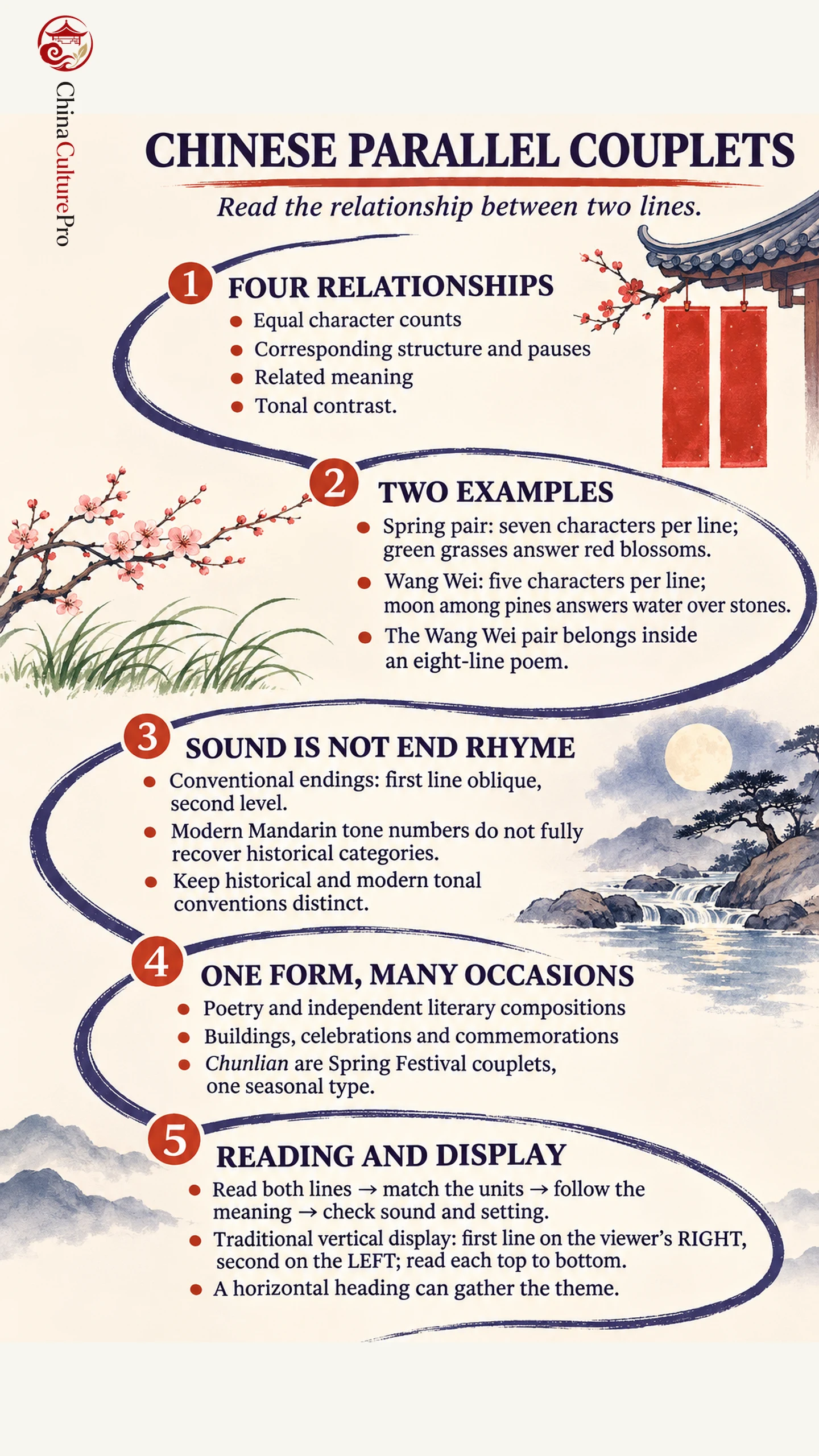
Four relationships provide a useful first reading:
| Relationship | What to compare |
|---|---|
| Length | Corresponding lines have equal character counts; longer pairs may contain several matching clauses. |
| Structure and rhythm | Compare phrase boundaries, pauses and the grammatical work of corresponding words. |
| Meaning | The lines should relate to a shared subject, through development, complement or contrast. |
| Sound | Conventional composition balances tonal categories at important corresponding positions, including the endings. |
These features cooperate. A noun placed against another noun can connect two images; matched pauses let the reader hear the relationship. Equal length alone would not make two unrelated statements a successful parallel couplet.[2][3]
Traditional prosody distinguishes ping (平, píng), the level category, from ze (仄, zè), the oblique group. The latter includes the historical entering category, ru (入, rù), as well as other non-level categories. Modern Mandarin’s first and second tones are a useful introductory clue to level tones, but some characters now pronounced that way belonged to the historical entering category. Modern tone numbers alone cannot reliably reconstruct an old pattern.[4]
In conventional independent couplets, the first line ends oblique and the second level. Contemporary composition may follow a historical or modern tonal system; the Couplet Society’s rules distinguish these approaches and say they should not be mixed within one pair. A full tonal audit requires more than checking the final words.[3]
Two Examples of Parallel Craft
A spring pair reproduced by the National Library of China provides a seven-character example. In simplified characters, it reads:[2]
又是一年芳草绿;依然十里杏花红。
Modern Mandarin pronunciation is Yòu shì yī nián fāng cǎo lǜ; yī rán shí lǐ xìng huā hóng. An English sense-gloss written for this guide is: Another year, the fragrant grasses are green; still, across ten li, the apricot blossoms are red.
Each line has seven characters. Grass answers blossoms, and green answers red; the images share a spring setting while introducing different colors. The first line emphasizes the returning year, the second an extended view. Read their combination rather than assuming that the second must simply repeat the first. The endings also supply an accessible modern Mandarin contrast: lǜ has a fourth tone, hóng a second.[2]
A second example comes from Wang Wei (王维, Wáng Wéi) and Autumn Dusk at a Mountain Dwelling (山居秋暝, Shānjū Qiūmíng):[5]
明月松间照,清泉石上流。
Míng yuè sōng jiān zhào, qīng quán shí shàng liú. An English sense-gloss is: The bright moon shines among pines; clear spring water flows over stones.
The two five-character lines align a luminous subject, a spatial setting and an action. Moon and water differ, as do shining and flowing, but their structures invite comparison. The pair belongs inside an eight-line poem whose surrounding lines include rain, returning people and a boat. Extracting it for display does not change the fact that its original setting is a poem. The Wang Wei guide reads that fuller scene.[5]
Poetry, Spring Couplets and Other Occasions
Parallel lines occur within classical poems as well as in independent compositions. In poetry, a couplet participates in a larger sequence; its meaning can depend on what comes before and afterward. The regulated verse guide explains the place of paired lines within stricter poetic structures.
Independent couplets can identify a setting, express a view, celebrate an occasion or commemorate a person. Their visual form can bring literary language into architecture and social life. A line chosen for a study, for example, has a different job from a pair addressed to a wedding or a memorial occasion.[1][2]
Chunlian (春联, chūnlián), or Spring Festival couplets, are a seasonal form within that wider tradition. Their language commonly welcomes the new year and expresses good wishes. Red doorway displays are especially familiar, but festive red paper should not become the definition of every duilian. Follow the New Year couplets guide for the seasonal custom and New Year decorations for other objects seen alongside it.[6]
Reading and Displaying a Couplet
Use four steps when approaching an unfamiliar pair:
- Read both lines: Identify the first and second lines before interpreting either on its own.
- Match the units: Count characters and compare corresponding phrases, grammatical roles and pauses.
- Follow the meaning: Ask how the second line develops, contrasts with or completes the first.
- Check sound and setting: Use the appropriate tonal convention and confirm the occasion and display direction.
In a conventional vertical doorway display, read each line from top to bottom, beginning with the line on the viewer’s right. The answering line is on the left. A hengpi (横批, héngpī), a horizontal heading above the pair, can state or gather its theme. Check the actual wording and layout when encountering a modern design rather than assuming that every horizontal heading uses the same reading direction.[1][6]
Calligraphy adds another layer: the brushwork, script, spacing and relationship with the doorway or wall shape the encounter. The calligraphy guide explains that visual dimension, while the characters guide supplies background for recognizing the writing.
Modern Mandarin pinyin (拼音, pīnyīn) can help pronounce a transcription; the pinyin guide explains its notation. It does not reproduce every historical tonal distinction. For close reading, keep the original text, the paired structure and a clear account of the occasion together.
FAQs About Chinese Parallel Couplets
Must the two lines rhyme?
No. Matching end rhyme is not a general requirement of duilian. Conventional tonal opposition and other correspondences are distinct from using the same rhyme sound.[3]
Are all Chinese couplets seven characters long?
No. Seven-character pairs are common, but shorter and longer forms exist. The examples here use seven and five characters per line, and longer independent couplets may contain several clauses.[2][4][5]
Which line goes on the right?
In a traditional vertical display, the first line goes on the viewer’s right, the second on the left. Read each from top to bottom, then consider how the pair works together.[1][6]
Are all duilian Spring Festival decorations?
No. Spring couplets are one seasonal type. The wider form includes literary compositions and writing for buildings, celebrations and commemorative occasions.[2][6]
Sources
[1] University of Hong Kong, University Museum and Art Gallery. Duilian: Chinese couplet
[2] National Library of China and China Couplet Society. Appreciating couplets
[3] China Couplet Society. General rules for couplets
[4] Nanjing University, interview with Cheng Zhangcan. Couplet craft and tonal distinctions
[5] Wang Wei, Chinese primary text via Wikisource. Autumn Dusk at a Mountain Dwelling
[6] Li Wei and Tong King Lee, Global Chinese. Language play in and with Chinese