


Quick Answer: How Do Idioms and Proverbs Differ?
In a common learner distinction, chengyu (成语, chéngyǔ) are established fixed expressions, often four characters long and shaped by literary or historical allusion; yanyu (谚语, yànyǔ) are proverbs expressing observations or lessons from experience. The English word “idiom” is broader than chengyu, and the categories do not always divide neatly.[1][2][5]
- Form is a clue: Four characters suggest a familiar pattern, but longer chengyu exist.
- Function matters: A phrase can characterize a situation, while a proverb commonly offers a more general judgment or lesson.
- Context decides usage: Check established wording, current meaning, grammar and tone before using either.
Counting characters alone cannot reliably classify an expression or explain how it works in a sentence.
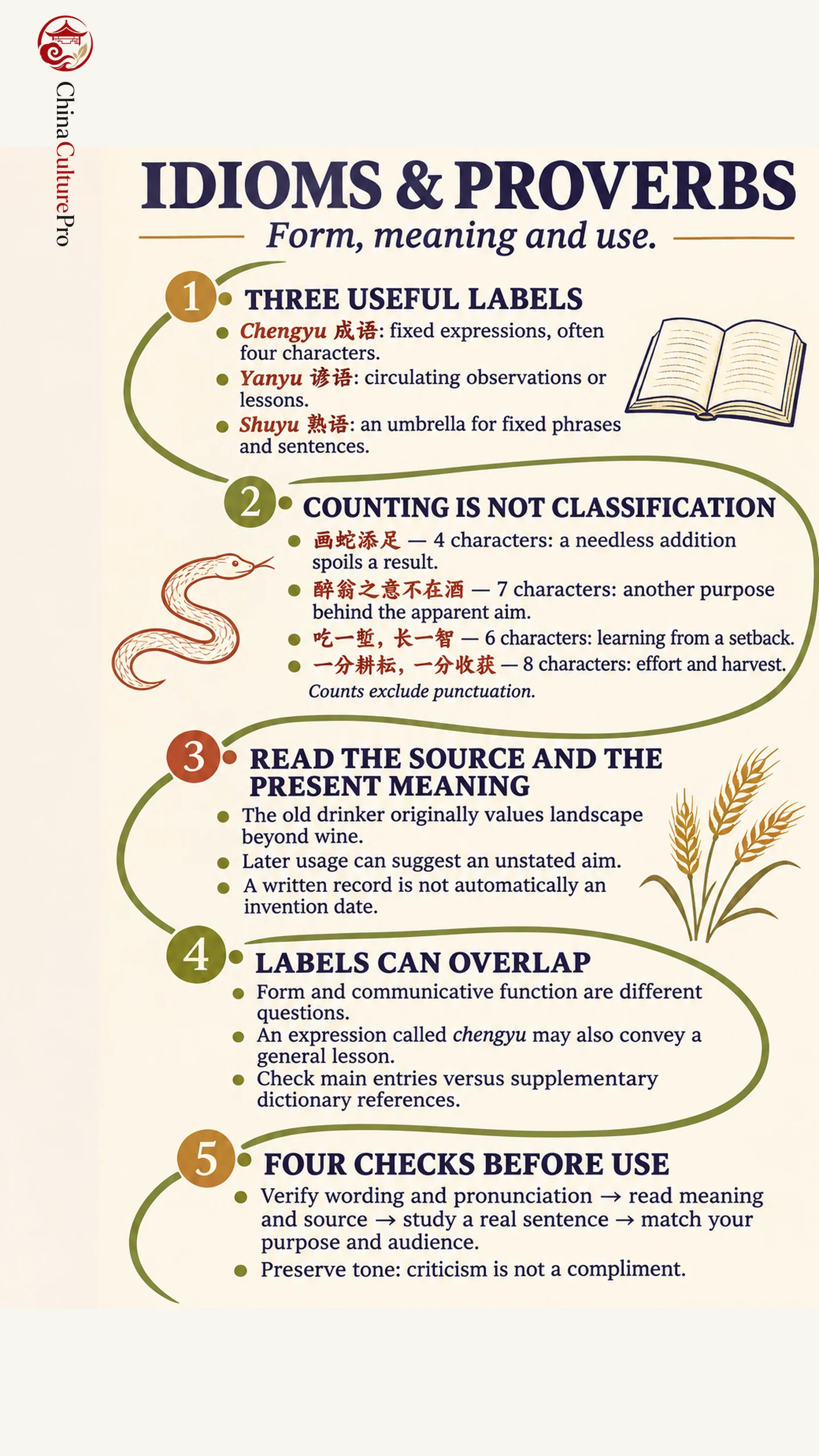
English lists often group Chinese idioms, proverbs, sayings and quotations together. That can be convenient for browsing, but it obscures important differences. A compact expression about a needless addition does not do exactly the same job as advice about learning from a setback. Use the chengyu guide and Chinese proverbs guide for fuller collections; the comparison here explains how to read their labels.
The Main Differences at a Glance
Three working definitions help establish the vocabulary:
- chengyu: A conventional fixed expression, often four characters long, with established wording and a meaning shaped by usage or allusion.[1]
- yanyu: A circulating proverb that expresses a general observation, judgment or lesson from experience.[2]
- shuyu (熟语, shúyǔ): An umbrella term for established fixed phrases or sentences, including idioms and proverbs.[3]
These definitions distinguish useful tendencies rather than impose one universal taxonomy. In particular, “idiom” in an English explanation may describe a broader functional category than a Chinese dictionary’s chengyu heading.[5]
| Feature | Chengyu: a common tendency | Yanyu: a common tendency |
|---|---|---|
| Form | Compact, often four characters, with established wording | A concise saying or sentence, sometimes in balanced parts |
| Meaning | A conventional meaning, frequently supported by an allusion | An observation, judgment or lesson about experience |
| Sources | Literary passages, stories, historical traditions or established usage | Circulating sayings, including forms recorded in written sources |
| Use | Characterizes a person, action or situation within a larger statement | Offers a general lesson or comment that may stand on its own |
These are tendencies, not an absolute grammar test. Check how the particular expression is used, rather than forcing every saying into one column.[1][2]
Four Examples That Test the Distinction
| Expression | Form and meaning | What it demonstrates |
|---|---|---|
| Draw a snake and add feet (画蛇添足, huà shé tiān zú) | Four characters; an unnecessary addition makes something worse | A familiar chengyu works through an image and an established critical meaning.[6] |
| The old drinker’s intention is not in the wine (醉翁之意不在酒, zuì wēng zhī yì bù zài jiǔ) | Seven characters; the apparent purpose conceals another aim | A dictionary-listed chengyu need not have four characters.[7] |
| Learn wisdom from a setback (吃一堑,长一智, chī yī qiàn, zhǎng yī zhì) | Six characters, excluding punctuation; a setback provides a lesson | A proverb-like observation connects experience with learning.[8] |
| Effort and harvest (一分耕耘,一分收获, yī fēn gēng yún, yī fēn shōu huò) | Eight characters, excluding punctuation; results require effort | Balanced clauses can express practical advice through an agricultural image.[9] |
The first expression belongs to a story about a drawing contest: a person finishes a snake, then adds feet and loses the prize. Its established meaning criticizes needless embellishment that spoils a result. In an editing discussion, it could describe an extra sentence that weakens an already clear ending. It does not simply mean that something is detailed or creative. The Chinese fables guide follows related uses of stories as arguments.[6]
The second comes from Ouyang Xiu (欧阳修, Ōuyáng Xiū) and his Record of the Old Drinker’s Pavilion (醉翁亭记, Zuìwēng Tíng Jì). In the original passage, the drinker’s interest lies in the surrounding landscape rather than wine alone. Later idiomatic usage can suggest an unstated purpose. That distinction prevents the modern sense of ulterior motive from being carelessly projected back onto every aspect of the original scene.[7]
The third is suitable when reflecting on a mistake and what it teaches. The fourth encourages effort through the relationship between cultivation and harvest. Both need attention to the situation: neither guarantees that suffering automatically produces wisdom or that every effort receives an equal reward. Used as advice, they express a viewpoint rather than an empirically exceptionless rule.[8][9]
The English labels and explanations above are sense-glosses for this guide, not claims that an English proverb has an identical Chinese history or tone.
Sources, Labels and Overlapping Categories
An expression can be classified by its form, its source or its communicative function. Those questions need not yield mutually exclusive answers. Linguistic research has pointed out that some expressions conventionally called chengyu can function as proverbs, while other fixed expressions do different grammatical jobs. Treat overlap as something to investigate, not proof that the labels are useless.[5]
Dictionary organization also matters. The Ministry of Education’s Revised Mandarin Chinese Dictionary explains that its proverb-entry conventions cover several kinds of fixed sayings, including maxims. Finding an expression in the reference material of an idiom dictionary does not by itself prove that it belongs to the dictionary’s main chengyu category. Check whether you are reading a main entry, a supplementary reference or an editorial explanation.[4]
A recorded source is another kind of evidence. A classical text may preserve an early form, a story may later be compressed into a shorter expression, or a saying may circulate before the surviving example that a dictionary cites. Do not automatically turn “recorded in this book” into “invented by this author on this date.” The literary allusions guide develops the relationship between a phrase and an earlier passage.
Choosing and Using an Expression
Use four checks before putting an unfamiliar expression into speech or writing:
- Check the complete form: Copy the established wording and verify pronunciation, including any recorded variant.
- Read meaning and context: Distinguish the literal image, the current meaning and any earlier source passage.
- Study a real sentence: Notice the expression’s grammatical position and whether it praises, criticizes, jokes or offers advice.
- Match your purpose: Choose the expression for the situation and reader, then use plain wording if its tone or meaning is uncertain.
The snake expression illustrates why the third check matters: an intended compliment about elaborate work could become criticism of a needless addition. Likewise, offering a lesson about setbacks immediately after someone’s disappointment can sound dismissive if they wanted acknowledgment rather than advice. These are contextual judgments; familiarity with the saying does not remove the need to consider its audience.
Modern Mandarin pinyin (拼音, pīnyīn) helps with pronunciation, while the Chinese characters guide explains the writing system. The pinyin guide distinguishes spelling from English letter values.
FAQs About Chinese Idioms and Proverbs
Are all chengyu four characters long?
No. Four characters are a common pattern, but the seven-character expression about the old drinker and the wine is a dictionary-listed counterexample.[1][7]
Can a chengyu also function as a proverb?
Yes. Classification by conventional form and classification by communicative function can overlap. A fixed expression may also convey a general lesson, depending on the expression and its use.[5]
Are Chinese proverbs always ancient quotations?
No. Proverbs are circulating sayings about experience, and a written record does not automatically identify an inventor. An attributed literary quotation and a traditional proverb should not be assumed to be the same category.[2][4][5]
Should I translate a saying word for word?
Literal wording can reveal an image, but it may miss the established meaning or tone. Explain the sense and context before choosing an English comparison.[6][7]
Sources
[1] Academy of Chinese Studies. Chengyu: Chinese idiom
[2] Taiwan Ministry of Education, Revised Mandarin Chinese Dictionary. Yanyu
[3] Taiwan Ministry of Education, Revised Mandarin Chinese Dictionary. Shuyu
[4] Taiwan Ministry of Education. Proverb entry conventions
[5] Lei Chunyi, Círculo de Lingüística Aplicada a la Comunicación. New taxonomic proposal for Chinese phraseology
[6] Taiwan Ministry of Education, Dictionary of Chinese Idioms. Drawing a snake and adding feet
[7] Taiwan Ministry of Education, Dictionary of Chinese Idioms. The old drinker’s intention is not in the wine
[8] Taiwan Ministry of Education, Revised Mandarin Chinese Dictionary. Learning wisdom from a setback
[9] Taiwan Ministry of Education, Revised Mandarin Chinese Dictionary. Effort and harvest