


Quick Answer: Who Was Du Fu?
Du Fu (杜甫, Dù Fǔ; 712–770), also written Tu Fu in English, was a major poet of the Tang (唐, Táng) dynasty. His work connects public upheaval with family anxiety, bodily experience and the close observation of ordinary life.[1]
- Read for range: War and displacement matter, but so do welcome rain, friendship and the practical details of making a home.
- Notice the construction: Paired lines, compressed language and changes in scale help turn an occasion into a poem.
- Use an annotated edition: Historical context and notes can clarify an allusion without resolving every interpretive question.
His poems offer powerful encounters with history through a particular voice; they are not an unfiltered chronicle of everything that happened.
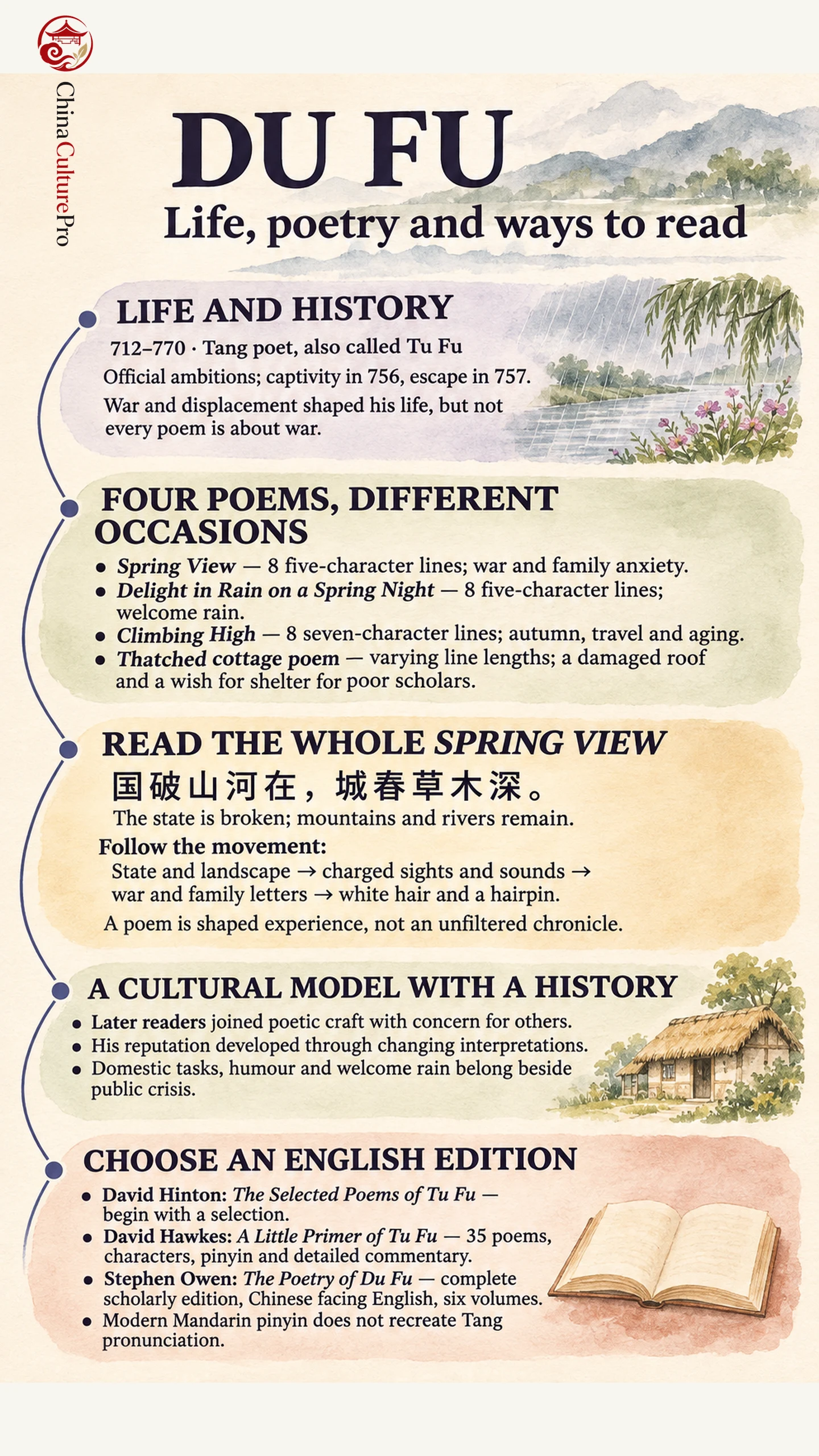
A ruined capital and a thinning head of hair can belong to the same poem. That movement between a public world and an individual body is one useful way into Du Fu. Begin with a few contrasting works, then examine how their details are arranged. The broader Chinese poetry guide places him among other writers and forms.
The Life Behind the Wartime Poems
Du Fu was born in Henan in 712. His early hopes of an official career met disappointment in the civil service examinations, although he eventually obtained appointments. He lived through the An Lushan Rebellion of 755–763, a conflict that disrupted the Tang dynasty and shaped the circumstances of his writing.[1]
His position was often precarious. Rebels took him prisoner in 756; he escaped and rejoined the Tang court the following year. He served as an official without attaining the senior positions he had hoped for. Travel, insecurity and separation from family help explain why private details in his poems can carry the pressure of much larger events.[2]
Later life also involved attempts to establish a household, including a home in Chengdu. Poems about fruit trees, household supplies and repairing a water system show that his attention extended to the material business of living. Reading only battlefield or refugee poems obscures this part of his range.[3]
Li Bai (李白, Lǐ Bái) was a contemporary with whom he is often paired. The comparison can illuminate different poetic choices, but “Du Fu records reality while Li Bai imagines” is too rigid: a carefully shaped personal scene is already more than a report. The Li Bai guide offers contrasting poems to read alongside these.
Four Poems That Show Du Fu’s Range
The following works provide four different entries. English titles vary, so use the Chinese title to identify the poem across editions.
| Poem | Reading interest |
|---|---|
| Spring View (春望, Chūn Wàng) | An eight-line, five-character poem in which a damaged public world meets longing for family and physical signs of distress.[4] |
| Delight in Rain on a Spring Night (春夜喜雨, Chūnyè Xǐ Yǔ) | Eight five-character lines welcome rain that nourishes living things. Notice the movement from quiet nighttime moisture to anticipated morning flowers.[5] |
| Climbing High (登高, Dēng Gāo) | Eight seven-character lines connect autumn landscape, the river’s continuing movement, prolonged travel and an aging, ill speaker.[6] |
| Song of the Thatched Cottage Broken by Autumn Wind (茅屋为秋风所破歌, Máowū Wéi Qiūfēng Suǒ Pò Gē) | A longer poem with varying line lengths moves from damage to a roof and a wet household toward a wish for shelter for impoverished scholars.[7] |
Compare the two poems about rain. In one, it arrives at the right moment and nourishes the world; in the cottage poem, it enters a damaged home and prolongs suffering. Weather has no single fixed emotional meaning across Du Fu’s work. The setting and the speaker’s circumstances determine what it does in each poem.[5][7]
Reading Spring View Beyond Its Famous Opening
Read this poem against the rebel-occupied Tang capital, Chang’an (长安, Cháng’ān). Its spring growth is part of a city scene marked by political disaster.[12]
The opening couplet, shown here in simplified characters, reads:[4]
国破山河在,城春草木深。
An English sense-gloss written for this guide is: The state is broken, while mountains and rivers remain; spring has reached the city, where grasses and trees grow thick. Each line has five characters. The seasonal growth does not simply promise recovery: nature persists amid a damaged human order.
Read on rather than treating the opening as a self-contained proverb. Flowers, tears, birds and a startled heart bring feeling into the scene. The compressed wording leaves interpretive space around who seems to act and who feels: English translations may assign those relationships differently. A smooth English sentence necessarily makes choices that the Chinese can leave less explicit.[4]
The next pair of lines links continuing warfare with the extraordinary value of a letter from home. Public conflict becomes the problem of knowing whether loved ones are safe. The final pair reduces the scale again: the speaker scratches at thinning white hair, scarcely able to hold a hairpin. The poem ends with a bodily gesture, not a declaration about the fate of the dynasty.[4]
The complete movement matters: state and landscape, emotionally charged sights and sounds, war and family news, then an aging body. Those shifts help explain why the poem’s historical significance cannot be separated from its construction. The details are selected and placed; they do not arrive as a neutral list of facts.
This is lüshi (律诗, lǜshī), an eight-line regulated form. Du Fu also uses seven-character regulated lines, as Climbing High shows. Our guide to regulated verse explains line length, tonal organization and parallel structures. His mastery of this form does not mean every poem he wrote followed it.[4][6]
Why Du Fu Became a Cultural Model
Du Fu’s later reputation joined poetic achievement with the image of a writer deeply concerned about other people’s suffering. This reputation has a history: readers from the Song dynasty (宋, Sòng) through the Qing dynasty (清, Qīng) interpreted him in changing ways. Calling him an important cultural model describes a long process of reception, not an objective ranking that every reader must accept.[11]
The cottage poem helps make the ethical dimension concrete. After the speaker’s own household suffers, he imagines a vast shelter protecting impoverished scholars, even at the cost of his own comfort. The original expression identifies a particular group; the emotional widening of concern is powerful without turning the passage into a modern housing-policy statement.[7]
His influence also involves what poetry can attend to: illness, domestic tasks, awkward circumstances and changing perspectives as well as grand events. The same poet can be concerned with public duty and household repairs. Reading these works together keeps moral seriousness from becoming a label that erases humour, practical detail or formal invention.[3]
For further reading, nature poetry develops the interaction between setting and feeling, while literary allusions explain how earlier texts enter a later poem. Both help make influence visible at the level of language rather than only through reputation.
Choosing an English Edition
Three books serve different reading needs:
- A selection to begin reading: The Selected Poems of Tu Fu, translated by David Hinton, provides a single-poet selection in English.[9]
- Detailed help with construction: David Hawkes’s A Little Primer of Tu Fu presents thirty-five poems with Chinese, pinyin (拼音, pīnyīn) transliteration, character-by-character translation and commentary on form, background and individual lines.[8]
- A complete scholarly resource: The Poetry of Du Fu, translated by Stephen Owen, is a six-volume edition published in 2016. It places Chinese and English on facing pages and supplies textual and explanatory notes. The critical text draws on early editions and other witnesses rather than merely reproducing one later editor’s wording.[3][10]
Pinyin helps connect characters with modern Mandarin readings; it is not a reconstruction of Tang pronunciation. Use the pinyin guide if the tone marks are unfamiliar. Then compare one poem in two editions: a difference in English wording can reflect a textual variant, an interpretation or a translator’s approach to poetic expression.
If your main interest is historical context, begin with a short annotated selection rather than assuming that more pages will automatically make a poem clearer. If you want to examine an unresolved phrase, the scholarly edition provides a different tool. The Tang poetry guide opens the wider literary setting after that first close reading.
FAQs About Du Fu
Are Du Fu and Tu Fu the same writer?
Yes. They are English romanizations associated with 杜甫. Older and newer editions may use different spellings while discussing the same poet.[1]
Was all Du Fu’s poetry about war?
No. His subjects include the pleasures and difficulties of daily life, weather and household concerns. The rain poem in this guide provides a useful contrast with the wartime capital.[3][5]
Is Du Fu’s poetry a reliable history book?
It is valuable historical evidence when read with context and other sources, but a poetic speaker, selected images and literary construction require interpretation. The poems should not be treated as transparent records of every event or feeling.[11]
Which English edition is best for close reading?
Hawkes’s primer is designed to show how a small set of poems works at the level of characters and lines. Owen’s complete edition serves readers needing broader coverage and textual notes. The better choice depends on the question you are trying to answer.[8][10]
Sources
[1] Chinese University of Hong Kong, Renditions. Du Fu
[2] Asia for Educators, Columbia University. Selected poems by Du Fu
[3] Harvard Gazette, Stephen Owen interview. Translating nine pounds of poetry
[4] Du Fu, Chinese primary text via Wikisource. Spring View
[5] Du Fu, Chinese primary text via Wikisource. Delight in Rain on a Spring Night
[6] Du Fu, Chinese primary text via Wikisource. Climbing High
[7] Du Fu, Chinese primary text via Wikisource. Song of the Thatched Cottage Broken by Autumn Wind
[8] Chinese University of Hong Kong Press. A Little Primer of Tu Fu
[9] New Directions. The Selected Poems of Tu Fu
[10] The Library of Chinese Humanities, Harvard University. The Poetry of Du Fu
[11] Brill, Ji Hao. The Reception of Du Fu (712–770) and His Poetry in Imperial China
[12] Asia for Educators, Columbia University, Paul Rouzer. Great Tang Poets: Du Fu