


Quick Answer: Where Should You Start with Zheng Guangzu?
Zheng Guangzu (郑光祖, Zhèng Guāngzǔ) was a Yuan dramatist. Start with his divided-soul romance, then compare a proud scholar’s humiliation with a maid’s resourceful management of a courtship.
- For love and identity: Watch the separation between a woman’s bedridden body and travelling soul.
- For social ambition: Track who offers a wine cup, who receives it and who must wait.
- For comedy: Listen to the maid as carefully as the lovers.
Read these works as performance texts. Their historical names and supernatural devices belong to dramatic constructions, rather than documentary biography or accounts of how bodies work.
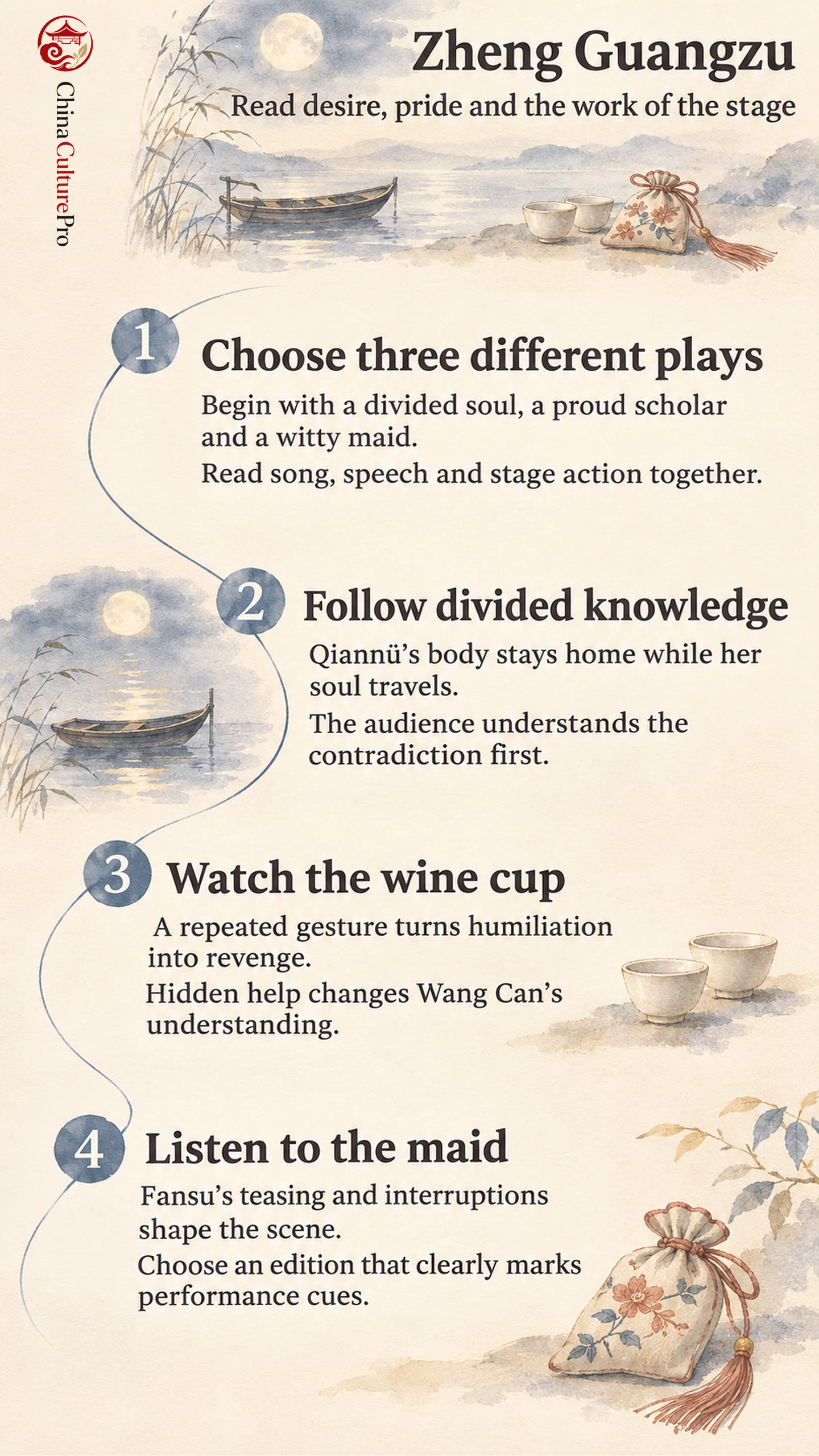
A summary can tell you that lovers reunite or a talented man finds recognition. Reading Zheng Guangzu becomes more rewarding when you ask how the audience reaches that ending: through divided knowledge, repeated gestures and a quick-witted speaker who can turn an apparent detour into the next scene.
Place Zheng Guangzu and Choose Three Plays
Zheng came from Xiangling in the Pingyang region and used the courtesy name Dehui. His exact birth and death years are uncertain. He is conventionally grouped with Guan Hanqing, Ma Zhiyuan and Bai Pu as four major Yuan dramatists. [1]
His zaju (杂剧, zájù) are plays combining song, speech and stage action. In the texts below, the printed cues separating those modes guide the reader through performance, not material to skip on the way to the plot. The Chinese literature guide places drama beside poetry and narrative traditions.
| Play | What to follow first |
|---|---|
| Qiannü’s Soul Leaves Her Body (倩女离魂, Qiàn Nǚ Lí Hún) | The audience knows two versions of one woman occupy different places. [2] |
| Wang Can Ascends the Tower (王粲登楼, Wáng Càn Dēng Lóu) | Repeated hospitality gestures reveal pride and dependence. [3] |
| Wind and Moon in the Hanlin Academy (翰林风月, Hàn Lín Fēng Yuè) | The maid’s initiative turns romantic hesitation into action. [4] |
These short English titles are reading labels; editions may translate the longer Chinese titles differently. Keep the Chinese title with your notes when comparing editions.
Follow the Two Qiannüs through Separation and Reunion
After her mother obstructs a promised marriage, Qiannü’s body remains ill at home while her soul follows Wang Wenju as he travels toward the examinations. The soul joins him, but the body later receives news that seems to describe a different wife. The audience understands the contradiction before the household does. [2]
This split makes longing visible through two roles. At the final homecoming, suspicion gives way to a stage direction joining soul and body. Wang’s official success and the mother’s acceptance accompany the reunion: the ending joins the lovers’ desire to family consent and official achievement. [2]
Instead of treating every supernatural moment as a symbolic code, keep a simple record of who knows what. Mark the difference between information available to the audience, information carried in a letter and the explanation a character invents. That difference helps you hear both the anxiety and the comedy of mistaken conclusions.
For comparison, read the guide to Wang Shifu and ask how another Yuan romance handles obstacles to a union. Compare the actual endings before assuming all scholar-and-beauty stories make the same argument about love.
Watch the Wine Cup Change Meaning in Wang Can
The play’s Cai Yong repeatedly withholds a cup from the talented but proud Wang Can while favouring Cao Zhi. Later, after gaining office, Wang repeats the humiliating pattern against Cai. The same gesture changes hands; having acquired power does not automatically make Wang more generous. [3]
The ending discloses that Cai secretly supplied help through Cao and advanced Wang’s prospects. Recognition requires Wang to revise his understanding of earlier events. The revelation also prepares a family reunion and marriage, binding professional advancement to obligations he had misread. [3]
Notice the value of repetition here. A second performance of an action can recall the first without a narrator explaining the parallel. Read the two exchanges aloud with pauses before the cup is passed. Then ask whether you hear revenge, comic exposure or a lesson imposed by an older patron. Those responses need not cancel one another.
The character’s name offers an additional reason to read cautiously: a play using an ancient writer is still a constructed drama. A resemblance between a title and a historical literary work does not establish that every office, encounter or conversation happened.
Read the Maid’s Performance and Choose an English Edition
In the Hanlin romance, the maid Fansu urges her mistress Xiaoman away from study and into the garden. There they overhear Bai Minzhong playing music. Fansu alternates teasing, alarm and concern about punishment; Xiaoman secretly leaves an embroidered sachet, which Bai reads as a message of attachment. [4]
The scene gives the maid more to do than deliver information. Her sung descriptions, interruptions and threatened withdrawals prolong the encounter. Listen for the gap between the mistress’s stated reserve and her wish to stay. What looks like hesitation in a summary becomes changing pressure in performance. [4]
For an English route into this theatre, Monks, Bandits, Lovers, and Immortals: Eleven Early Chinese Plays is edited and translated by Stephen H. West and Wilt L. Idema. Its introductions and explanation of conventions help readers distinguish speech, song and stage directions. [5]
Before choosing any translation, inspect one scene rather than judging by the plot description alone. Can you identify who speaks, where singing begins and which actions the text requires? Use the Chinese classic books guide for edition questions. A later comparison with Tang Xianzu can extend your reading of desire and dramatic invention across periods without collapsing their different works into one story.
FAQs About Zheng Guangzu
When did Zheng Guangzu live?
He was active in the Yuan period. His exact birth and death years are uncertain, so precise dates in brief online biographies should be treated cautiously.
Is Qiannü’s Soul Leaves Her Body a ghost story?
It is a supernatural romance in which a living woman’s soul travels while her body remains at home. Calling it simply a ghost story can obscure that central distinction.
Are these plays reliable biographies of their named characters?
No. They use characters, historical names and literary conventions to construct drama. Verify a historical claim separately instead of treating dialogue as a record of an actual conversation.
Sources
[1] Ministry of Education, Revised Mandarin Chinese Dictionary. Zheng Guangzu
[2] Zheng Guangzu, via Wikisource. Qiannü’s Soul Leaves Her Body
[3] Zheng Guangzu, via Wikisource. Wang Can Ascends the Tower
[4] Zheng Guangzu, via Wikisource. Wind and Moon in the Hanlin Academy
[5] Hackett Publishing. Monks, Bandits, Lovers, and Immortals: Eleven Early Chinese Plays