

Quick Answer: Where Should You Start with Zhang Jiuling?
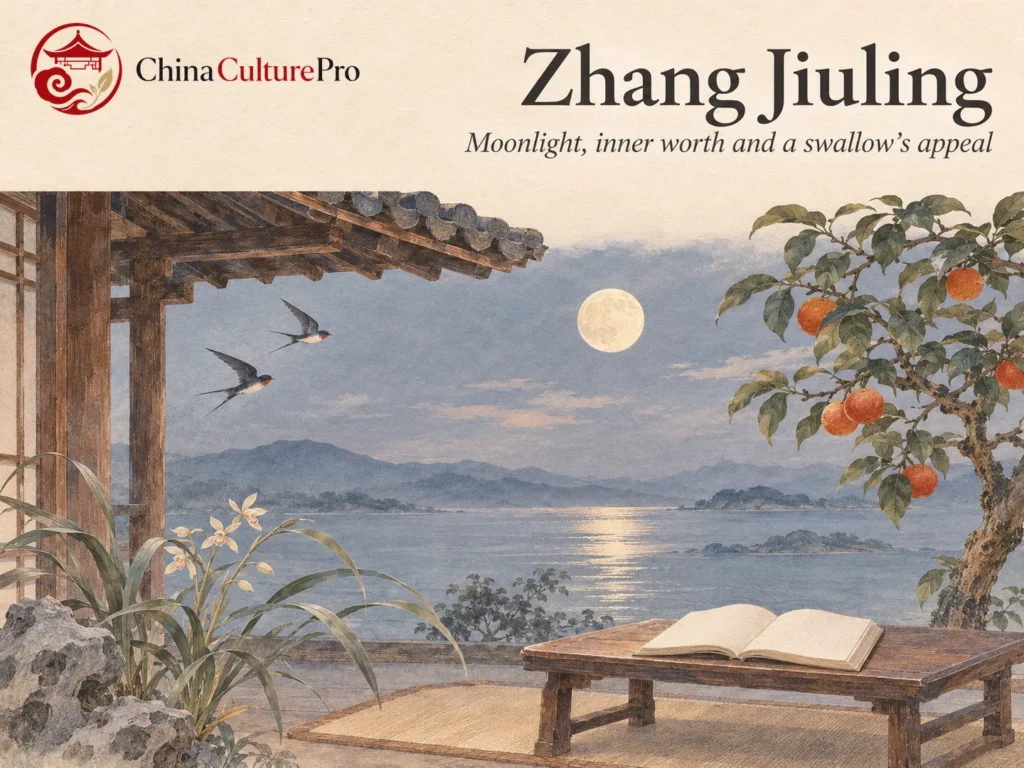
Zhang Jiuling (张九龄, Zhāng Jiǔlíng; 678–740) was a Tang poet and chancellor remembered for his upright reputation. Start with his moon poem, then compare two reflections using plants and a poem voiced through a vulnerable swallow.
- For longing: Follow what the speaker does through a night of moonlight.
- For character: Compare inner worth with the wish to be recognized or useful.
- For interpretation: Begin with the actual plant or bird scene before applying a political explanation.
His public career matters, but it does not turn every image into a securely identified person or every poem into a precisely dated event.

Shared moonlight cannot be carried to an absent person. A fragrant plant can possess value without being picked. A small bird can enter an elegant house and still need protection. Zhang’s poems develop these tensions through scenes that reward reading beyond the famous line.
Place Zhang Jiuling and Choose Four Poems
A native of Qujiang, Zhang served under Emperor Xuanzong and became chancellor. His collected writing is known as Qujiang Ji (曲江集, Qǔ Jiāng Jí). [1] The Tang dynasty guide supplies the broader setting; these four poems introduce different ways of speaking within it.
| Poem | First reading task |
|---|---|
| Gazing at the Moon, Thinking of One Far Away (望月怀远, Wàng Yuè Huái Yuǎn) | Follow shared light, wakefulness and the wish for reunion. [2] |
| Ganyu: Orchid and Osmanthus (感遇·兰叶春葳蕤, Gǎn Yù Lán Yè Chūn Wēi Ruí) | Ask whether value depends on being chosen. [3] |
| Ganyu: Red Oranges (感遇·江南有丹橘, Gǎn Yù Jiāng Nán Yǒu Dān Jú) | Separate the tree’s worth from its blocked usefulness. [3] |
| Returning Swallows (归燕诗, Guī Yàn Shī) | Hear a small visitor’s appeal against suspicion. [4] |
The two plant-poem labels identify members of a twelve-poem sequence by their opening images. An anthology may select only some of the sequence, so use the opening words as well as its numbering.
Follow the Moon Poem from Shared Light to Dreamed Reunion
The opening joins a rising moon over the sea with people separated across a great distance. Shared time does not remove the separation: the poem immediately turns toward the long night and the longing that keeps the speaker awake. [2]
Then the scene becomes bodily. The candle is extinguished, moonlight fills the space, and the speaker puts on clothing and feels the gathering dew. These actions give the longing duration; they are not simply a decorative list of things seen at night. [2]
At the end, moonlight cannot be gathered into the hands and sent as a gift. Returning to bed opens the possibility of a meeting in dreams. The poem finishes with a wished-for encounter, rather than reporting an actual reunion. [2]
Read the sequence of actions aloud before isolating the opening couplet. The text does not specify a festival date or name the absent person, so a later association with Mid-Autumn need not fix the original occasion. The Chinese moon poetry guide offers comparisons with other ways poets connect shared light and distance.
Compare the Two Plant Poems for Worth and Recognition
The first poem pairs spring orchid growth with autumn osmanthus blossom. Their vitality belongs to their own seasons. A secluded observer may delight in their fragrance, but the ending asks why the plants should seek someone to pick them. Worth does not begin with that act of recognition. [3]
The red orange tree remains green through winter. The poem presents an inward steadfastness, then asks why something fit for honoured guests is obstructed by distance. Its final comparison with peach and plum trees challenges selective recognition. Here usefulness is desired but frustrated, a different emphasis from the first poem’s independence. [3]
Read the imagery’s immediate qualities before assigning a moral meaning. The guides to orchid symbolism and osmanthus symbolism give broader contexts, while the poem’s argument determines which associations matter here.
These reflections invite comparison with public life, but the sequence’s exact chronology is debated. A moral reading does not require presenting every poem as a documented response to one specific dismissal. [5] The Chinese nature poetry guide helps extend this habit of reading the scene before the explanation.
Hear the Swallow’s Appeal before Choosing an Edition
Also transmitted under a title meaning On Swallows, the bird poem places a modest seasonal visitor within an elegant architectural setting. Paired movement through decorated doors and halls does not make the speaker powerful. Its final address asks predatory birds not to suspect a wish to compete. [4]
Listen to the change from description to appeal. The ending exposes a relationship between the bird seeking room to live and the stronger creatures capable of misreading it. An allegorical reading can recognize anxiety and unequal power without treating the lines as a recorded conversation between named officials. [4]
For form, compare this eight-line poem with the moon poem and the old-style plant reflections. The regulated verse guide explains why equal line counts alone do not exhaust the formal questions of tone, rhyme and paired structure.
Peter Harris’s Three Hundred Tang Poems includes Zhang Jiuling among its authors, arranges poems by poet and supplies short explanatory notes. It is an anthology, not the writer’s complete collected works. [6] When choosing another edition, compare its handling of the moonlight gift, the plant’s need for recognition and the swallow’s final appeal. The Chinese classic books guide helps assess translations and annotations; keep the Chinese title and opening line beside your notes so changing English titles do not obscure the text you mean.
FAQs About Zhang Jiuling
Is the moon poem specifically about the Mid-Autumn Festival?
The poem is often read with moon-viewing traditions, but its lines do not identify that festival date. Its central situation is separation under shared moonlight.
Are the Ganyu poems one poem or a sequence?
They form a twelve-poem sequence. Anthologies often choose only a few, so check the opening lines when identifying an individual piece.
Do the birds and plants have fixed meanings in every poem?
No. Their qualities can support moral or political interpretation, but each poem builds its own relationships. Read the particular scene before applying a symbolic label.
Sources
[1] Ministry of Education, Revised Mandarin Chinese Dictionary. Zhang Jiuling
[2] Zhang Jiuling, via Wikisource. Gazing at the Moon, Thinking of One Far Away
[3] Zhang Jiuling, via Wikisource. Twelve Ganyu Poems: Orchid and Osmanthus; Red Oranges
[4] Zhang Jiuling, via Wikisource. On Swallows, Complete Tang Poems Volume Forty-Eight
[5] Ding Han, National Chung Cheng University. From Sorrow to Sorrow without Excess: Comparing the Ganyu Poems of Chen Zi’ang and Zhang Jiuling
[6] Everyman’s Library, Penguin Random House. Three Hundred Tang Poems, Peter Harris