

Quick Answer: Where Should You Start with Yu Xuanji?
Yu Xuanji (鱼玄机, Yú Xuánjī) was a late Tang poet whose surviving work ranges from longing and disappointment to literary recognition and visits within a religious world. Read several complete poems before allowing a dramatic story about her life to determine their meaning.
- For emotional movement: Follow a lament through to its less passive ending.
- For recognition: Compare the worth of a flower with the visibility of a graduate’s name.
- For observation: Notice how an unsuccessful visit becomes a poem through objects and changing light.
The poems, historical accounts and later labels are different kinds of evidence. None should silently stand in for the others.
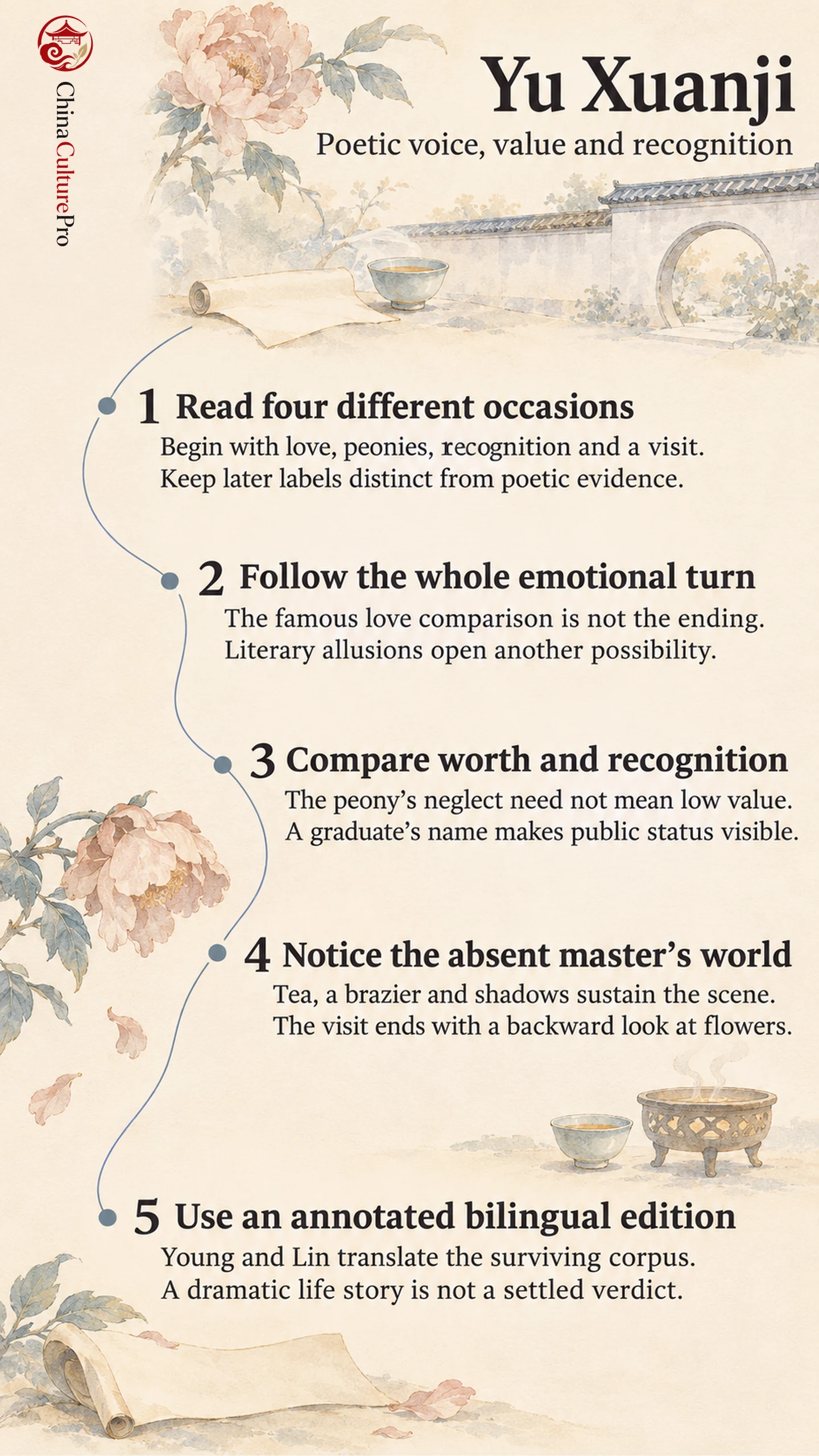
An expensive peony attracts no buyer; a gifted observer envies names on an examination list; a visitor looks back toward flowers outside a wall. These scenes offer three different ways to encounter Yu Xuanji’s literary intelligence, beyond an isolated quotation about love.
Place Yu Xuanji and Choose Four Poems
Yu belongs to the late Tang literary world and is associated with life as a Daoist priestess. Her social identity remains a subject of interpretation: scholar Jinhua Jia challenges the later label “courtesan,” emphasizing religious context and the poet’s agency. [1] That disagreement matters when choosing a biography or edition.
These English titles are descriptive aids. The Chinese identifies the particular text; longer titles may be shortened differently in translations.
| Poem | A useful reading focus |
|---|---|
| To a Neighbouring Woman (赠邻女, Zèng Lín Nǚ) | Emotional distress gives way to a more active ending. [3] |
| Selling Fading Peonies (卖残牡丹, Mài Cán Mǔ Dān) | Value is asserted before others recognize it. [4] |
| Visiting Chongzhen Temple’s South Tower and Seeing the New Graduates’ Names (游崇真观南楼睹新及第题名处, Yóu Chóng Zhēn Guàn Nán Lóu Dǔ Xīn Jí Dì Tí Míng Chù) | Literary ability meets the visibility of public recognition. [5] |
| Visiting Master Zhao and Not Finding the Master (访赵炼师不遇, Fǎng Zhào Liàn Shī Bù Yù) | Everyday objects give an absent person’s surroundings a presence. [6] |
Use the Tang poetry guide for the larger literary setting. These poems reward attention to their endings as much as to their familiar themes.
Read To a Neighbouring Woman beyond Its Famous Couplet
The eight-line poem begins with a woman shielding herself with a sleeve and feeling too troubled to attend to her appearance. Its famous comparison makes a devoted lover harder to obtain than a priceless treasure. Tears follow, but the ending invokes literary male figures and asks why the speaker should remain fixed on one disappointment. [3]
That turn matters. A reading based only on the central comparison misses the change from lament toward an imagined alternative. The poem allows pain and a claim to choice to occupy the same short space. [3]
Read the literary names as part of that movement before treating them as a list of actual men in Yu’s life. An annotated edition should explain their inherited associations. The Chinese literary allusions guide provides a useful introduction to how a name can do more than identify a historical person.
Compare the Peony’s Value with the Graduate’s Name
Selling Fading Peonies makes neglect sound like a consequence of exceptional worth: its price is imagined as too high for buyers, and the fragrance too intense even for butterflies. The flower belongs in an elevated setting rather than roadside dust. By the time it reaches the imperial garden, those who might have bought it regret their lost opportunity. [4]
The poem reverses the judgment implied by an unsold flower. Its imagery invites a reading about unrecognized value, without requiring the scene to document a particular transaction involving the author. Compare other Chinese nature poetry by asking when a plant remains an observed object and when it begins to argue a human case. [4]
The Chongzhen Temple quatrain makes the question of recognition more explicit. Bright spring surroundings and admired writing lead to a speaker resenting the silk robe that conceals poetic ability, then looking up enviously at graduates’ names. [5]
Here the obstacle is not a failure to possess talent. It is the gap between talent and the public form in which achievement becomes visible. That distinction is more precise than inventing a failed examination attempt for the poet. The text gives us a pointed comparison, rather than a complete educational biography. [5]
Visit the Absent Master through Everyday Objects
The visit to Master Zhao begins with absence: the person sought is away, leaving a servant at home. A warm brazier, herbs being prepared and tea in a neighbouring courtyard suggest ongoing activity. Dim lamplight and a slanting shadow then shape the scene, before the visitor turns back toward a few flowers beyond the wall. [6]
The poem does not end with a meeting. Objects and surroundings become the encounter’s substance, allowing an unsuccessful social visit to produce an attentive record of presence and absence. It is a useful counterweight to reading every poem solely as romantic confession. [6]
Notice how the final look changes the direction of attention. The visitor cannot recover the absent host, but can still register something outside the original purpose of the journey. Read that as a poetic arrangement, without turning the herbs or tea into advice about religious or medical practice.
Choose an English Edition without Turning Poetry into Biography
The Clouds Float North: The Complete Poems of Yu Xuanji, translated by David Young and Jiann I. Lin and published in 1998, is a bilingual Chinese-English edition presenting forty-nine surviving poems. It includes landscapes and occasional poems as well as writing about relationships. [7] Its compact corpus makes comparison across themes practical.
Use its introduction and annotations alongside the individual texts. Young’s introductory account stresses how little is securely known and questions the historical accuracy of the dramatically detailed story of crime and execution. That caution does not establish an alternative verdict; it limits what a reader can confidently reconstruct. [2]
The same discipline applies to romantic stories. A poem’s directness is not permission to assign every voice, recipient or image to a certain event in the author’s life. Biography can inform a reading while leaving room for occasion, convention and imaginative invention.
For comparisons, read Xue Tao and Wen Tingyun as writers with their own situations and methods. When choosing Chinese classic books, favour notes that distinguish textual evidence from an attractive story.
FAQs About Yu Xuanji
Which Yu Xuanji poem is a compact first reading?
The four-line poem about seeing new graduates’ names is a focused starting point. It makes the tension between literary ability and public recognition especially clear.
Did Yu Xuanji write only about love?
No. Her surviving poems also include landscapes, visits, religious surroundings, social exchange and reflection on literary recognition.
Does The Clouds Float North include every poem she ever wrote?
It presents a surviving corpus. “Complete” should not be read as a guarantee that everything she wrote in her lifetime has survived.
Sources
[1] Jinhua Jia, Tulsa Studies in Women’s Literature. Unsold Peony: The Life and Poetry of Daoist Priestess-Poet Yu Xuanji of Tang China
[2] David Young, University of Virginia Chinese Text Initiative. Introduction to Yu Xuanji
[3] Yu Xuanji, via Wikisource. To a Neighbouring Woman
[4] Yu Xuanji, via Wikisource. Selling Fading Peonies
[5] Yu Xuanji, via Wikisource. Visiting Chongzhen Temple’s South Tower and Seeing the New Graduates’ Names
[6] Yu Xuanji, via Wikisource. Visiting Master Zhao and Not Finding the Master
[7] Wesleyan University Press. The Clouds Float North: The Complete Poems of Yu Xuanji