

Quick Answer: Where Should You Start with Xue Tao?
Xue Tao (薛涛, Xuē Tāo) was a Tang poet associated with Chengdu’s literary world. Her work offers poems of separation, social exchange and close observation. Begin with a farewell or a short spring sequence, then explore how objects and landscapes carry different kinds of meaning.
- For a first reading: Try the short poem addressed to a departing friend.
- For a sequence: Follow the changing images of spring longing.
- For context: Check attribution questions and the paper tradition linked to her name.
A literary scene can be vivid without supplying a reliable episode from the poet’s life. That distinction matters especially when reading familiar stories about her.
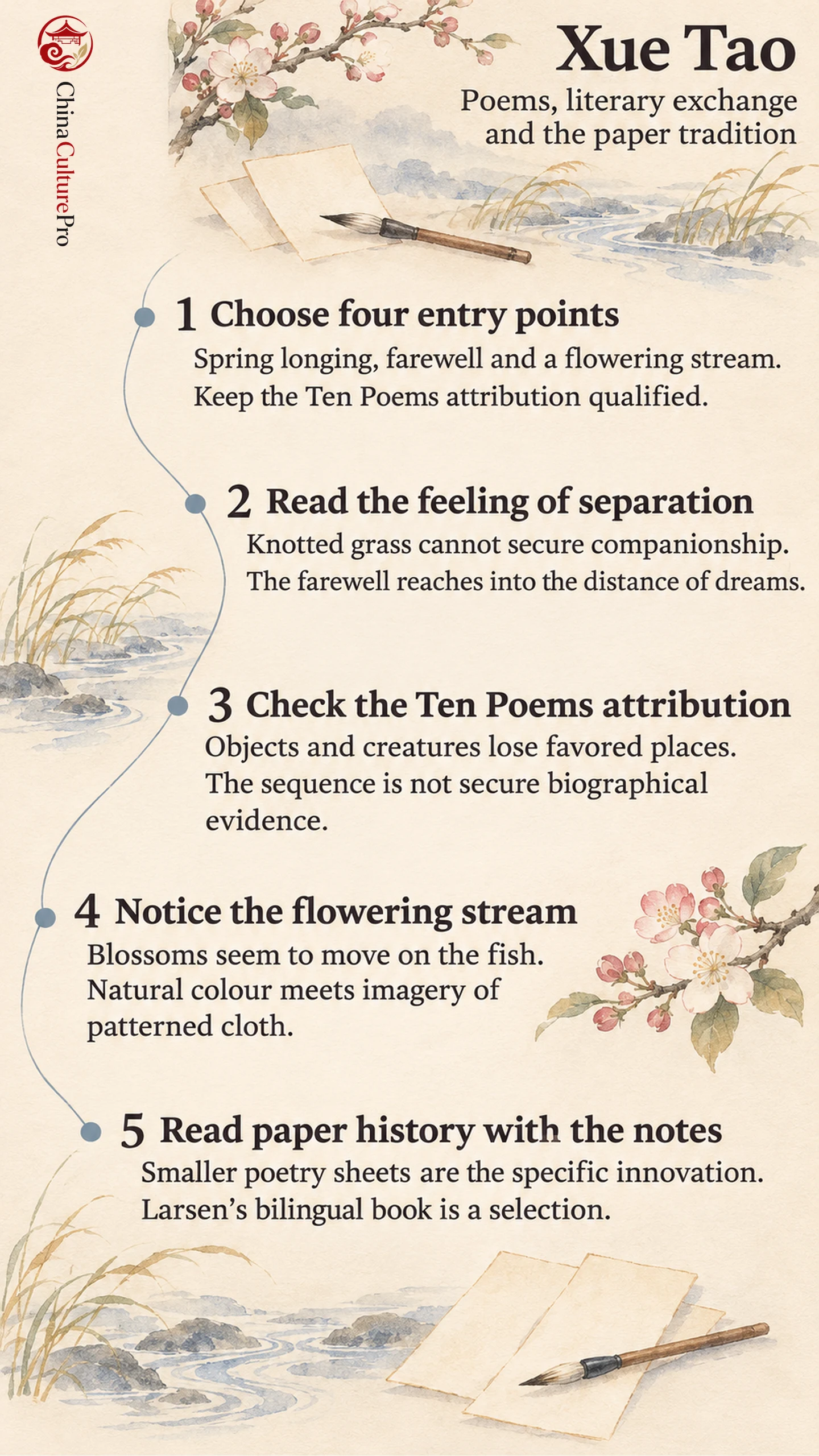
A cold landscape, knotted grass and blossoms seemingly carried by fish offer very different ways into Xue Tao’s poetry. Reading their particular arrangements reveals a wider range than a single label such as “love poet.”
Locate Xue Tao and Choose Four Entry Points
Xue worked as an entertainer and official hostess, bringing her into contact with powerful and accomplished men in the literary culture of her time. Poetry formed part of those relationships, rather than remaining solely a private activity. [1] Read her within Tang poetry with attention to the audience and occasion suggested by each text.
| Work or sequence | A useful reading focus |
|---|---|
| Gazing at Spring (春望词四首, Chūn Wàng Cí Sì Shǒu) | Four quatrains connect flowers, knotted grass and longing. [3] |
| Seeing a Friend Off (送友人, Sòng Yǒu Rén) | A cold landscape gives distance an emotional presence. [4] |
| Ten Poems of Separation (十离诗, Shí Lí Shī) | Disputed attribution; objects lose favor. [5] |
| Crabapple Brook (海棠溪, Hǎi Táng Xī) | Flowers seem to appear on fish. [5] |
The sequence and individual poems offer different reading units. Choose one complete unit first, identify its images, and notice where its ending changes the question you began with.
Read Separation in Spring and Farewell
Gazing at Spring moves through four five-character quatrains. Flowers open and fall without shared pleasure or grief; grass is knotted to express attachment, but tying the plant cannot create the hoped-for companionship. The sequence makes natural recurrence and unfulfilled companionship press against each other. [3]
Read the four together before treating one image as a general symbol. The return of flowers does not bring the awaited meeting into reach. [3]
Seeing a Friend Off begins with reeds, nighttime frost, cold moonlight and pale mountains. Its ending questions whether separation begins only with this evening, extending the distance into the realm of dreams. The four seven-character lines make the landscape and the feeling of parting difficult to separate. [4]
Notice what remains unstated: the friend is not named, and the poem supplies no complete account of the relationship. You can explore the force of the cold scene without inventing that story. Compare other Chinese friendship and farewell poems by asking how each makes an absence felt. [4]
Approach Ten Poems of Separation with Its Attribution in View
A dog is excluded after biting a household member; a worn brush loses its place in a hand. Objects and creatures suggest dependence on favor. [5]
The attribution is disputed. A received collection preserves five-poem and ten-poem versions with differing accounts. [5] In a 2025 lecture, textual scholar Chen Shangjun argued that the ten-poem sequence belonged to a secretary surnamed Xue in Yuan Zhen’s staff in eastern Zhejiang, rather than to Xue Tao. [6]
This affects how the poems should be used. A reader can study the pattern of losing a valued position while keeping the author credit qualified. Reconstructing a particular punishment in Xue Tao’s life from those objects would require evidence beyond the sequence itself.
When using an edition, look for its attribution note before connecting the text to biography. That small check helps keep an appealing narrative from doing the work of a documented historical account.
Notice the Reflections in Crabapple Brook
Crabapple Brook spreads spring colour across water, making flowers seem to appear on fish. Later lines compare natural colour with patterned, dyed cloth. [5]
Start with that visual surprise before deciding on a hidden personal message. The Chinese nature poetry guide offers comparisons for how poets turn close observation into an organized scene.
Connect Poetry Paper with an Annotated English Selection
Xue Tao paper (薛涛笺, Xuē Tāo Jiān) belongs to her literary afterlife as well as to the history of writing materials. A study of early accounts distinguishes her preference for smaller sheets from the invention of the fancy paper itself: she asked manufacturers to produce an existing kind of paper in a more convenient format for poems. [2]
The distinction gives her contribution a concrete scale. It concerns the material object used for a short poem and its exchange, rather than the invention of paper or printing. Later accounts of her personally making special paper should be read alongside the earlier evidence. [2]
For English reading, Jeanne Larsen’s Brocade River Poems, published by Princeton University Press in 1987, is a bilingual selection with an introductory essay and notes explaining allusions and cultural context. It presents about two-thirds of the surviving poems, rather than the entire surviving body of work. [1]
Use an edition’s notes to identify the situation and allusions before returning to the poem’s own arrangement. For comparison of selection, translation and annotation, consult the Chinese classic books guide.
FAQs About Xue Tao
Which Xue Tao poem should I read first?
Begin with Seeing a Friend Off. Its four lines offer a compact example of landscape organized around the feeling of separation.
Did Xue Tao invent paper?
Her association concerns poetry stationery, especially a smaller format for an existing fine paper. It should not be expanded into a claim that she invented paper or printing.
Is Brocade River Poems a complete collection of her surviving poetry?
No. Jeanne Larsen’s bilingual book is a selection covering about two-thirds of the surviving poems, with an introduction and explanatory notes.
Sources
[1] Princeton University Press. Brocade River Poems: Selected Works of the Tang Dynasty Courtesan Xue Tao
[2] T. H. Barrett, Journal of the Royal Asiatic Society. The Woman Who Invented Notepaper: Towards a Comparative Historiography of Paper and Print
[3] Xue Tao, via Wikisource. Complete Tang Poems, Volume 803: Gazing at Spring
[4] Xue Tao, via Wikisource. Seeing a Friend Off
[5] Siku Quanshu poetry collection, via Wikisource. Poems of Xue Tao and Li Ye: Selected Passages
[6] Chen Shangjun, lecture transcript reviewed by the speaker, The Paper. Ten Perspectives on Tang Poetry Texts and Documents