

Quick Answer: Why Read Yan Jidao?
Yan Jidao (晏几道, Yàn Jīdào) was a Northern Song poet of ci (词, cí), or song lyrics, whose remembered pleasures often return as longing. [6] Begin with one lyric of recollection and another of reunion, then try a festival poem to hear a different kind of absence.
- For remembered love: Start with the lyric opening after a dream.
- For reunion: Read the poem in which lamplight cannot quite dispel doubt.
- For a broader view: Compare a festive gathering with the feeling of being away from home.
Read these as crafted lyrics, keeping the speaker’s situation distinct from a documented episode in the author’s life.
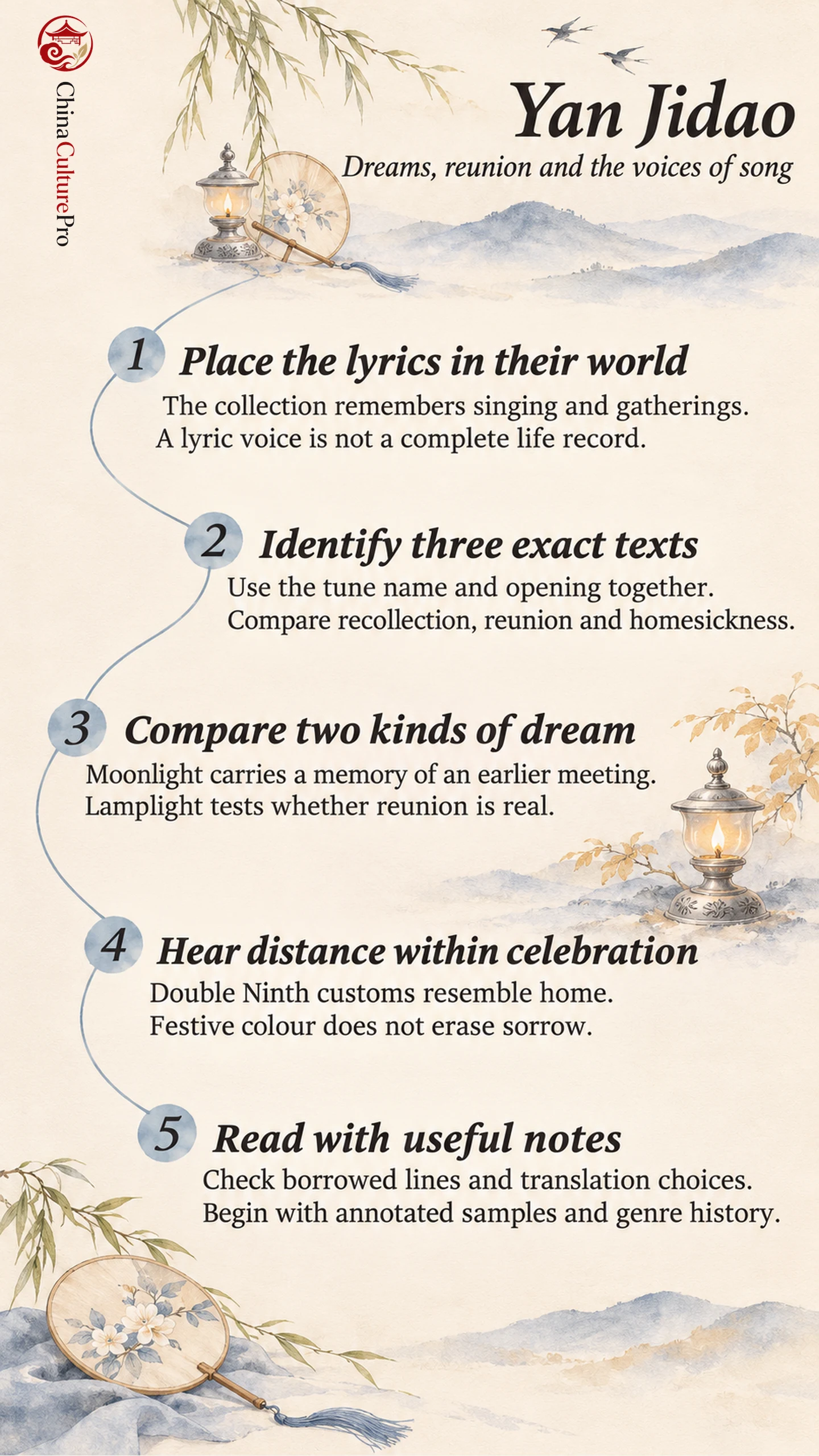
Dreams do different work in Yan Jidao’s poetry. Sometimes waking restores loneliness; elsewhere an actual meeting seems almost too unlikely to trust. Following those changes gives a sharper introduction than describing every lyric simply as nostalgic.
Place Yan Jidao in the World of Song Lyrics
Yan Jidao was a son of the poet and statesman Yan Shu (晏殊, Yàn Shū). Raised in a wealthy household, he experienced declining fortunes after his father’s death. His surviving collection is Xiaoshan Ci (小山词, Xiǎo Shān Cí), often rendered Little Mountain Lyrics. Exact dates for his life vary between accounts. [1]
His form was ci: lyrics written to established tunes governing line lengths and rhythm. Tune names identify patterns shared by many texts, not necessarily a poem’s subject. [2]
His own account of the collection recalls passing freshly written lyrics to singers at friends’ gatherings. It also says that the texts represented experiences shared with companions, alongside his own feelings. [3] The Song ci poetry guide gives a wider introduction to this relationship between literary text and performance.
Start with Three Contrasting Lyrics
The English labels below describe the selected poems. Use the Chinese opening as well as the tune name to locate the exact text in an anthology.
| Lyric, identified by tune and opening | What to notice |
|---|---|
| Linjiangxian: After the Dream (临江仙·梦后楼台高锁, Lín Jiāng Xiān · Mèng Hòu Lóu Tái Gāo Suǒ) | Solitude in the present opens into a memory of a first meeting. [2] |
| Zhegutian: The Reunion (鹧鸪天·彩袖殷勤捧玉钟, Zhè Gū Tiān · Cǎi Xiù Yīn Qín Pěng Yù Zhōng) | Repeated dreams make a reunion difficult to believe. [3] |
| Ruanlanggui: Double Ninth Away from Home (阮郎归·天边金掌露成霜, Ruǎn Láng Guī · Tiān Biān Jīn Zhǎng Lù Chéng Shuāng) | Familiar festivities sharpen the feeling of distance from home. [4] |
Keep a simple question beside each text: where is the speaker emotionally at the beginning, and what has changed by the ending? That gives you a way to compare their movement without forcing them into one continuous love story.
Follow the Turns between Memory and Reunion
In After the Dream, locked buildings and lowered curtains frame a solitary present. Falling petals surround one person while swallows fly in pairs. The second stanza recalls Xiaoping, her clothing and the music of her instrument; the ending lets the moon connect that earlier meeting with the present. [2]
Performance could carry that feeling beyond its first occasion. Translation also involves choices: the clothing’s heart motif may describe decoration or a collar’s shape. [2]
The Reunion reverses the relation between dream and waking. Its first stanza remembers a remembered night of drinking, song and dance. After separation, meetings have repeatedly occurred in dreams; now the speaker holds up a lamp and still fears that reunion may be another dream. The lyric’s distinctive tension lies in joy struggling to become believable. [3]
Compare the endings before choosing a general theme. One preserves a vanished encounter through moonlight; the other tests a present encounter against remembered dreams. Neither movement is captured fully by calling the poems sad.
Read Festival Joy against Homesickness
The Ruanlanggui lyric evokes the Double Ninth Festival (重阳节, Chóng Yáng Jié), the ninth day of the ninth lunar month. Coloured cups, performers’ sleeves and yellow chrysanthemums create a festive scene. Its resemblance to home does not make the speaker feel settled: the ending hopes that drinking and singing might replace sorrow. [4]
Watch that hope carefully. The wish to exchange sadness for intoxication does not establish that sadness has disappeared. The poem makes a gathering emotionally divided, with outward celebration and inward estrangement present together. [4]
Its opening metal-palm image also needs a note. It recalls an imperial device associated with collecting dew in the Han capital, serving as a capital-city allusion here. It is not evidence that the speaker has visited a surviving Han monument. [4]
The useful comparison with the love lyrics is the gap between what surrounds the speaker and what the speaker can recover. In one case there is remembered companionship; in another, familiar customs without the security of home.
Choose Notes That Explain Performance and Allusion
Yan Jidao also adapted earlier poetic language. Research on Xiaoshan Ci treats such borrowing as a means of refinement and innovation, rather than evidence that a familiar phrase has simply been repeated without purpose. [5] An annotated edition should help you see what a borrowed line does in its new setting.
For a first English encounter, the two Stanford editions listed below provide complete sample lyrics, Chinese texts, translations and explanatory notes. Compare their translations with the Chinese, particularly where a translator supplies a speaker or perspective that the original leaves less explicit. [2]
For broader context, Stephen Owen’s Just a Song: Chinese Lyrics from the Eleventh and Early Twelfth Centuries, published in 2019, examines the genre’s development from performance into literature. Its scope extends beyond one poet; it is not a translation of Yan Jidao’s complete collection. [7]
Use the Chinese literary allusions guide when a named object or inherited scene interrupts your reading. When choosing among Chinese classic books, prioritize an edition that identifies exact openings and explains its translation choices.
FAQs About Yan Jidao
How was Yan Jidao related to Yan Shu?
Yan Jidao was Yan Shu’s son. Both are important Song lyric poets, but they are separate authors with different collections and life circumstances.
Is Linjiangxian the title of only one poem?
No. It is a tune name used for many lyrics. Add the opening words when identifying a particular text.
Which lyric contains the silver-lamp reunion scene?
It appears in the Zhegutian lyric beginning with coloured sleeves offering a cup. It should not be confused with the Linjiangxian lyric opening after a dream.
Sources
[1] Chinese University of Hong Kong, Renditions. Yan Jidao
[2] Stanford Global Medieval Sourcebook, Qian Jia. To the tune The Immortal by the River: When I wake up from the dream
[3] Yan Jidao, via Wikisource. Little Mountain Lyrics, Siku Quanshu edition: Selected Passages
[4] Stanford Global Medieval Sourcebook, Qian Jia. To the tune Ruan Returns: The dew on the metal palm at the edge of the sky has turned into frost
[5] Ching-fen Cho, National Central University Journal of Humanities. An Analysis of Yan Jidao’s Borrowing of Poetic Lines in his Xiaoshan ci
[6] Taiwan Ministry of Education. Dictionary entry: Yan Jidao
[7] Harvard University Asia Center. Just a Song: Publisher Description