


Quick Answer: What Makes Yan Shu Worth Reading?
Yan Shu (晏殊, Yàn Shū) was a Northern Song poet of ci (词, cí), or song lyrics. His work can make seasonal return feel inseparable from loss, yet it also includes quiet autumn perception and lively spring play. Read several contrasting pieces before assigning his poetry one mood.
- For a first lyric: Begin with the new song, the wine cup and the returning swallows.
- For separation: Follow a speaker looking along distant roads without knowing where to send a letter.
- For variety: Compare an autumn room with a girl’s delight in winning a spring game.
Tune names identify lyric patterns; add the opening words to locate the exact poem. A speaker’s situation does not automatically supply the author’s biography.
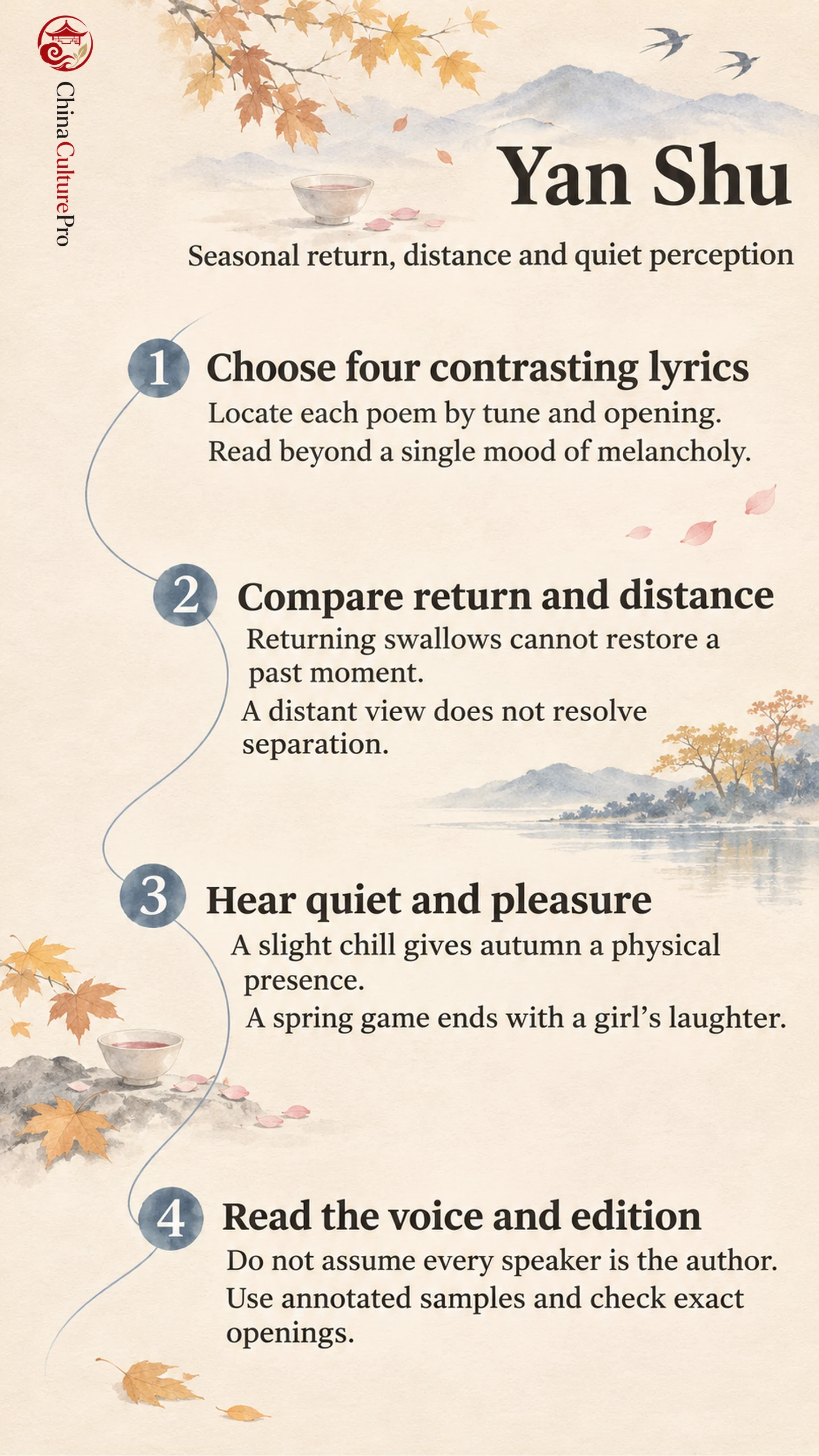
Returning swallows do not mean the same thing in every Yan Shu lyric. They can sharpen awareness of time passing, depart in pairs while a person remains alone, or simply help establish a season. Their position in a complete poem matters more than a fixed symbolic definition.
Place Yan Shu and Choose Four Entry Lyrics
Yan Shu lived from 991 to 1055 and came from the Linchuan region of present-day Jiangxi. An accomplished official as well as a writer, he rose to the position of Grand Councillor. [1] His lyric collection is Zhu Yu Ci (珠玉词, Zhū Yù Cí), meaning Pearl and Jade Lyrics. [6]
These four texts offer different emotional settings. The English labels are descriptive aids; the Chinese opening identifies each particular lyric.
| Lyric and opening | Main reading focus |
|---|---|
| Huanxisha: A New Song and a Cup of Wine (浣溪沙·一曲新词酒一杯, Huàn Xī Shā · Yī Qǔ Xīn Cí Jiǔ Yī Bēi) | The contrast between falling blossoms and returning swallows. [2] |
| Dielianhua: Chrysanthemums by the Railing (蝶恋花·槛菊愁烟兰泣露, Dié Liàn Huā · Jiàn Jú Chóu Yān Lán Qì Lù) | A widening view that cannot resolve separation. [3] |
| Qingpingle: Fine Autumn Wind (清平乐·金风细细, Qīng Píng Yuè · Jīn Fēng Xì Xì) | Small sensations of an autumn day and night. [4] |
| Pozhenzi: Spring Scene (破阵子·燕子来时新社, Pò Zhèn Zǐ · Yàn Zǐ Lái Shí Xīn Shè) | A seasonal scene ending in the pleasure of a game. [5] |
The Song ci poetry guide explains the broader form. For this selection, start by tracing the change between each poem’s opening and ending rather than trying to reconstruct a lost melody.
Compare Returning Spring with Unreachable Distance
In A New Song and a Cup of Wine, the new performance meets familiar surroundings: last year’s weather and an old terrace. The setting sun prompts a question about return. Falling blossoms and apparently familiar swallows then place irreversible loss beside seasonal renewal, before the ending returns to a person walking alone. [2]
The parallel arrangement gives the two natural images equal weight. Seasonal renewal does not undo the passing moment; their coexistence makes the closing solitude harder to dismiss. Read all six lines together before lifting the celebrated contrast out as a general maxim. [2]
Chrysanthemums by the Railing takes another route. Mist and dew give flowers a human sadness, paired swallows depart, and moonlight enters the room without understanding separation. After the night’s west wind, the speaker climbs alone and looks along distant roads. The wish to send a letter ends in uncertainty about the recipient’s location. [3]
The movement outward expands the field of vision without closing the emotional distance. That is a useful distinction from treating the tower scene simply as an image of ambition. Compare other Chinese friendship and farewell poems by asking whether a distant view offers connection or makes its absence more apparent.
Hear Quiet Autumn and the Pleasure of Spring Play
Fine Autumn Wind begins with gently moving air and falling leaves. Wine and a deep sleep by a small window give way to fading flowers, sunset on the railing and the slight chill felt by a silver screen. The ending registers a change of season through an intimate physical sensation. [4]
Read how little explanation the poem supplies. It does not require a named absent lover or an account of bereavement to make its quiet scene affecting. You can notice waning colour and cooling air without converting every detail into a code for despair. [4]
Spring Scene shifts from swallows, pear blossoms, pond moss, orioles and drifting catkins to an encounter with a smiling girl. Her pleasure is linked to winning a grass contest; a good dream the night before seems retrospectively to anticipate that success. The poem ends with laughter visible on her face. [5]
That ending gives this lyric a distinct place in a first selection. Reading it beside the solitary garden walk keeps “elegance” from becoming shorthand for unchanging sadness. The Chinese nature poetry guide offers further comparisons for scenery that supports different human occasions.
Read the Voice Carefully and Find an English Route
Yan’s official career is documented, but the person speaking in a lyric need not be a transparent portrait of that official. The received collection’s editors even challenged a claim that his work avoided women’s voices. [6] Ask what the individual poem establishes before supplying the speaker’s gender, relationship or life event.
For an accessible English beginning, the Stanford edition of the Huanxisha lyric provides the Chinese text, a complete translation and an introduction. It also explains that translations may make choices about a speaker’s perspective where the Chinese is less explicit. [2] Compare those choices with what you can observe directly in the images and sequence.
A Silver Treasury of Chinese Lyrics, edited by Alice W. Cheang and published in 2003, offers a wider anthology route. Its contents include a Yan Shu section with Huanxisha, Treading the Sedge and Willow by the Hillside Pavilion. It is a multi-author selection, not a complete English translation of his collection. [7] Check exact openings when comparing editions; an English tune label alone may not identify the text.
His son Yan Jidao (晏几道, Yàn Jīdào) is a separate poet. [6] When choosing Chinese classic books, an author index and clear notes are useful safeguards against mixing their lyrics or confusing a shared tune name with shared authorship.
FAQs About Yan Shu
Was Yan Shu the same poet as Yan Jidao?
No. Yan Shu was Yan Jidao’s father. They were distinct Song lyric poets with separate collections.
Does Pozhenzi: Spring Scene describe a battle?
No. Despite the military wording of the tune name, this lyric depicts spring scenery and a girl pleased with winning a grass game. The tune name does not determine its subject.
Which Yan Shu lyric is a good first reading?
Try the Huanxisha lyric beginning with a new song and a cup of wine. Its six lines make the relationship between seasonal return and personal solitude especially clear.
Sources
[1] Chinese University of Hong Kong, Renditions. Yan Shu
[2] Stanford Global Medieval Sourcebook, Qian Jia, Nina Du and Runqi Zhang. Sands of the Washing Stream: A single new song, a single cup of wine
[3] Yan Shu, via Wikisource. Dielianhua: Chrysanthemums by the Railing
[4] Yan Shu, via Wikisource. Qingpingle: Fine Autumn Wind
[5] Yan Shu, in Yuxuan Lidai Shiyu, via Wikisource. Pozhenzi: Spring Scene
[6] Siku Quanshu editors, via Wikisource. Pearl and Jade Lyrics: Collection Preface and Selected Text
[7] Chinese University of Hong Kong, Research Centre for Translation. A Silver Treasury of Chinese Lyrics, edited by Alice W. Cheang