

Quick Answer: Where Should You Start with Yan Lianke?
Yan Lianke (阎连科, Yán Liánkē) writes fiction in which rural communities, ambition and power meet startling narrative inventions. Choose a first novel by the kind of story you want to follow: a family catastrophe, an expansive satire, a famine camp or one extraordinary night.
- For a family focus: Begin with the village novel built around a blood-selling disaster.
- For elaborate satire: Try the community drawn into a spectacular tourism scheme.
- For a compressed setting: Choose the story of a town caught in a night of dreamwalking.
These books engage with social and historical realities through invented narrators, settings and events. Their literary form matters as much as their subject.
A dead child can narrate a village’s tragedy; a summer snowstorm can lead to an impossible business plan. Such premises make Yan Lianke’s work distinctive, but the useful reading question comes next: what does the invention reveal about how people seek security, profit or authority?
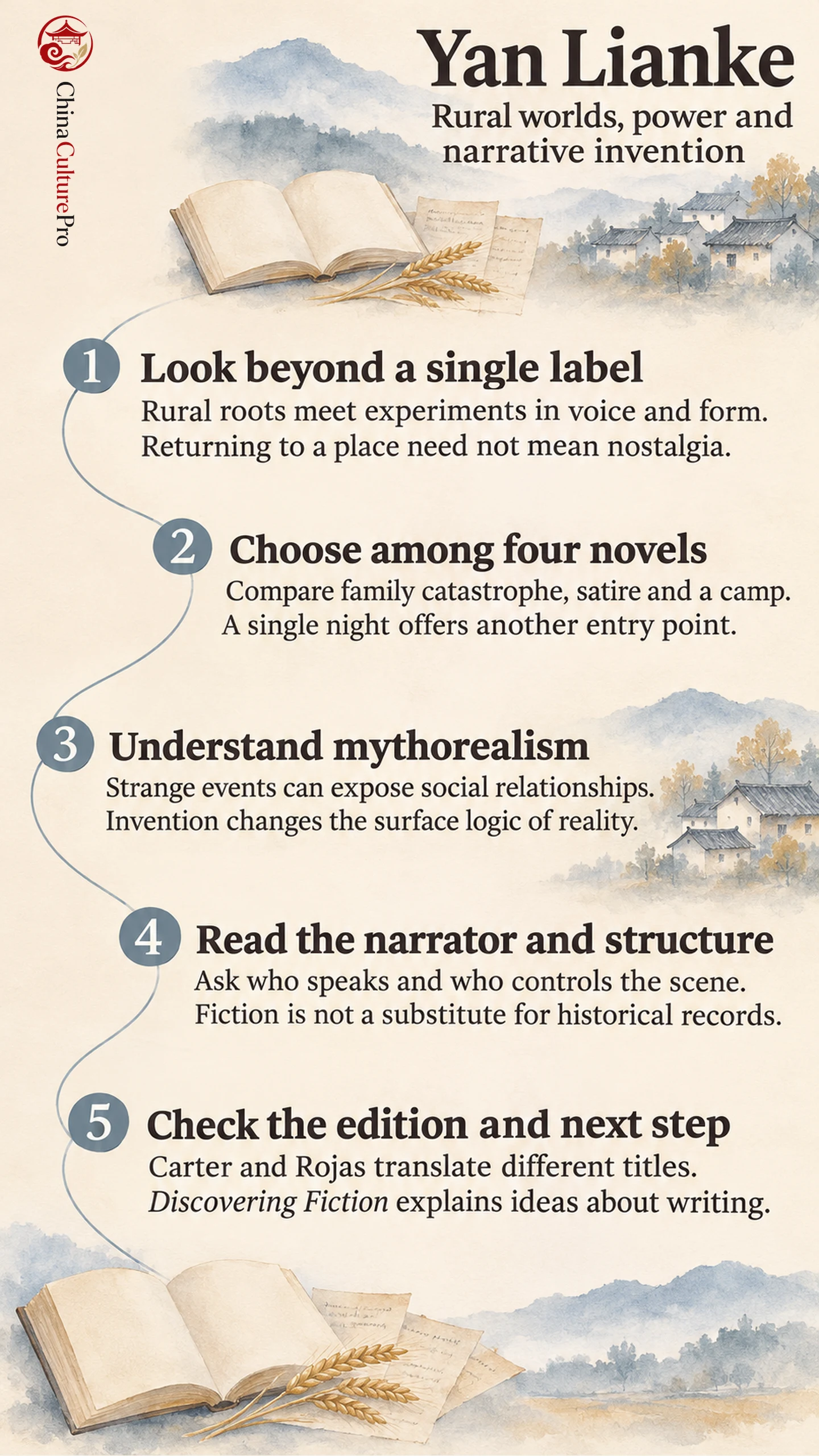
Locate Yan Lianke beyond a Single Label
Born in Henan in 1958 to a rural family, Yan entered the army as a young man and developed a literary career that moved beyond its early military setting. Recognition has included the Lu Xun and Lao She literary prizes and the Franz Kafka Prize. [1] His place in modern Chinese literature rests on particular experiments in voice and structure as well as social criticism.
Rural settings should not automatically be read as homesickness. In a 2026 interview, Yan described his long desire to leave the countryside while continuing to plant stories in familiar terrain. [7] That tension helps frame a recurring question: what happens when escape from deprivation becomes a new pursuit of advantage?
Choose a Novel by Its Narrative Premise
These four books offer different entry points. The descriptions identify their starting situations without turning them into one interchangeable account of rural life.
| Novel | Narrative starting point | Read it for |
|---|---|---|
| Dream of Ding Village (丁庄梦, Dīng Zhuāng Mèng) | A blood-selling disaster fractures a Henan village and one family. | Complicity, loss and the voice of a dead child. [2] |
| Lenin’s Kisses (受活, Shòu Huó) | A mostly disabled community is recruited into a performance scheme meant to fund a Lenin tourist attraction. | The collision of development, spectacle and power. [3] |
| The Four Books (四书, Sì Shū) | Intellectuals in a famine-era labour camp face rewards for informing and impossible production demands. | How coercion changes relationships and testimony. [4] |
| The Day the Sun Died (日熄, Rì Xī) | A boy and his funeral-business family face a town’s night of widespread dreamwalking. | Suppressed desires released over one night. [5] |
The camp novel is set during the Great Leap Forward (大跃进, Dà Yuè Jìn). Its four interwoven narratives distinguish it from a single chronological account. [4] Choose by the form you want to explore, rather than assuming that the darkest subject necessarily makes the best introduction.
Understand What Mythorealism Changes
Mythorealism (神实主义, Shén Shí Zhǔ Yì) is Yan’s term for a writing approach that seeks underlying realities through imaginings, myths, allegory and transformations grounded in everyday life. It challenges the expectation that a convincing novel must reproduce ordinary surface causality. [6]
That gives you a practical reading question. When an event seems impossible, ask what relationship it makes newly visible: who gains control, whose experience is excluded, and what desire keeps a scheme moving? The invention should be read in relation to the social world it alters.
In Lenin’s Kisses, unseasonal snow destroys livelihoods before an official’s plan puts villagers’ abilities on public display to raise money. The proposal to buy Lenin’s preserved body belongs to the novel’s satire, not to a documented tourism project. [3] Notice how the promise of collective prosperity also advances the official’s career.
The term is therefore more useful as a question about literary method than as a label guaranteeing one meaning for every strange event. Nor does it make Yan’s work a complete explanation of Chinese society.
Read Form alongside Historical Context
Dream of Ding Village opens with an already-dead child’s account. He died from a poisoned tomato, in retaliation for his father’s blood-selling business, rather than from the village’s disease. Family complicity is built into the narrative voice. [2]
That distinction changes how the opening works. The child can disclose a family history that a straightforward survivor’s account would organize differently. Grandpa’s dreams, meanwhile, fill the village world with blood imagery. [2] Read those images as part of the novel’s construction, rather than as clinical explanations.
In an excerpt from The Four Books, the camp’s young supervisor burns some confiscated books while setting others aside under the pretext of future fuel. Questions about grain production are put to the prisoners as books pass through his hands. Cultural possession, intimidation and agricultural demands occupy the same scene. [8]
These examples suggest a useful habit: record who speaks and what that speaker can control. Historical background helps you understand the pressures, but a fictional scene does not establish how often an event occurred or stand in for a historical archive.
Find the English Edition and a Useful Next Step
Cindy Carter translated Dream of Ding Village. Carlos Rojas translated Lenin’s Kisses, The Four Books and The Day the Sun Died. [2][3][4][5] Check the translator as well as the title when locating an edition; a later paperback date need not be the date of either the original novel or its first English translation.
For Yan’s ideas about writing, Discovering Fiction (发现小说, Fā Xiàn Xiǎo Shuō), translated by Rojas and published in English in 2022, is literary criticism rather than another novel. Its discussions of realism and causality provide a route from a specific book into his approach to constructing fiction. [6]
Publication history also requires care. In 2026 Yan discussed how censorship and self-censorship had shaped his choices, while several recent Chinese-language works had appeared in Hong Kong and Taiwan. [7] This history should not replace discussion of the writing or become a blanket claim about every edition’s legal status.
After one novel, use the broader Chinese literature guide to compare forms. Reading Mo Yan or Yu Hua alongside Yan is most rewarding when you compare their specific narrative choices rather than grouping all three under one national style.
FAQs About Yan Lianke
Which Yan Lianke novel is a manageable first choice?
The Day the Sun Died offers a concentrated premise, with one night’s events followed through a boy and his family. Choose Dream of Ding Village instead if you prefer an entry centred on family responsibility and loss.
Is The Four Books an edition of the Confucian classics?
No. It is Yan Lianke’s novel about intellectuals in a famine-era labour camp. Its title and structure invoke literary and religious traditions, but it is a distinct work of fiction.
Are Yan Lianke’s novels straightforward historical records?
No. They transform social and historical material through invented voices, allegory and unusual structures. Use historical scholarship alongside them when you need factual reconstruction.
Sources
[1] Hong Kong University of Science and Technology. Yan Lianke: Honorary Degree Citation, 2017
[2] Grove Atlantic. Dream of Ding Village: Description and Excerpt
[3] Grove Atlantic. Lenin’s Kisses
[4] Grove Atlantic. The Four Books
[5] Grove Atlantic. The Day the Sun Died
[6] Yan Lianke and Carlos Rojas, Duke University Press. Discovering Fiction: Publisher Page and Translator’s Introduction
[7] Yan Lianke, interviewed by Jeremy Tiang, The Paris Review. The Art of Fiction No. 269, Summer 2026
[8] Cite Publishing, Rye Field. The Four Books: Chinese Edition and Excerpt