


Quick Answer: Where Should You Start with Zhu Shuzhen?
Zhu Shuzhen (朱淑真, Zhū Shūzhēn) is a Song poet whose surviving work ranges beyond romantic sorrow. Begin with four short works: a protest over scattered blossoms, a spring lyric, a poem about women writing and a summer lake outing.
- For imagery: Compare how flowers, birds and spring weather answer—or fail to answer—the speaker.
- For voice: Read the poem of self-reproof aloud and test its apparent agreement with social expectations.
- For editions: Check which wording a translator uses in the lake-outing lyric.
Her life remains poorly documented. Treat a poem’s speaker as a literary voice before using it to reconstruct a marriage or love affair.
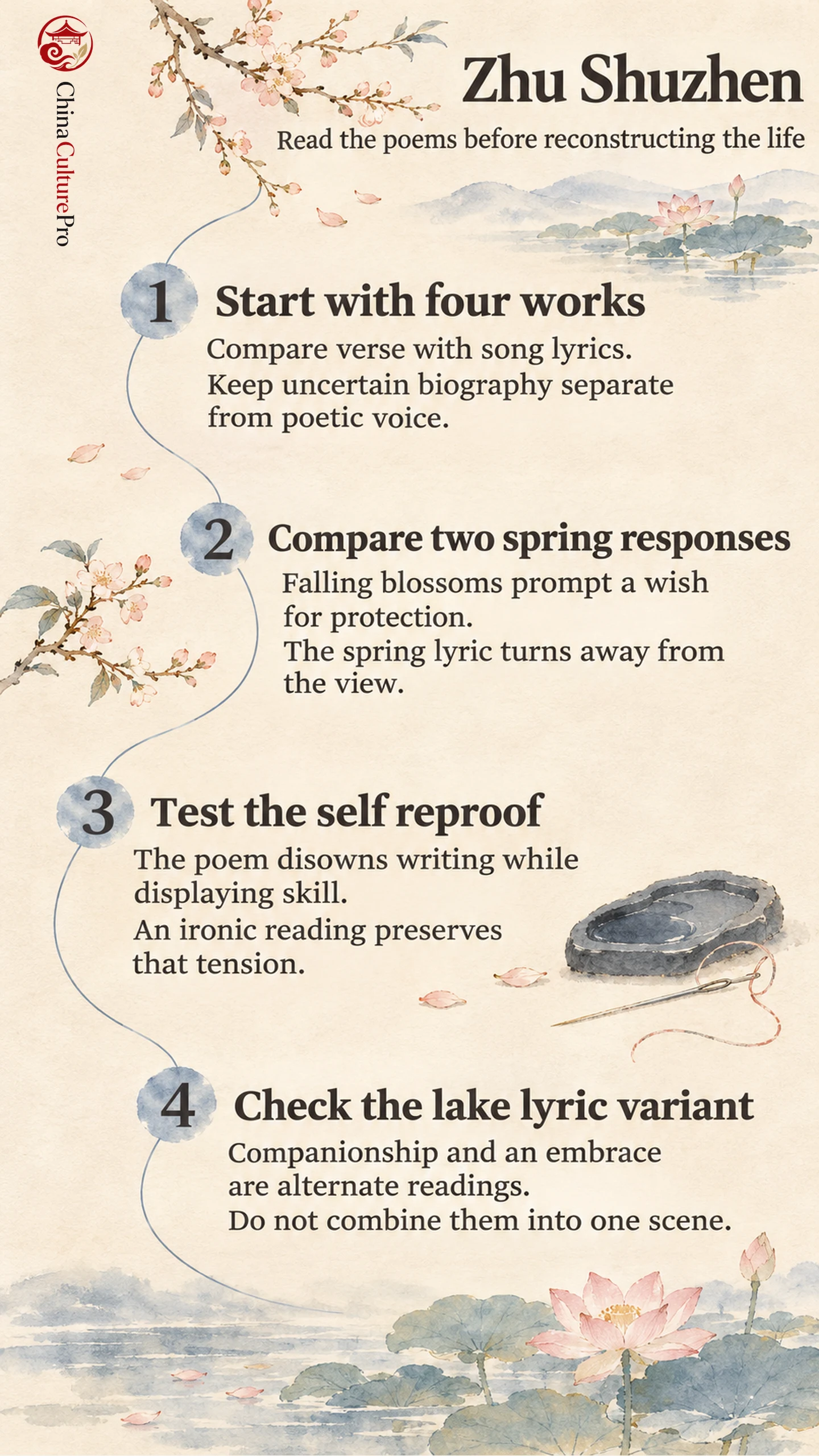
The collection’s association with heartbreak can make every blossom seem like a clue to one unhappy life. A more rewarding beginning is to notice what each poem does differently: ask for protection, refuse a view, challenge an expectation or remember pleasure.
Meet the Poet through Four Starting Works
Zhu’s poetry is transmitted in collections associated with the title Duanchang Ji (断肠集, Duàn Cháng Jí), commonly rendered as a collection of heartbreak. Even basic biographical details are disputed. The surviving poems offer a much firmer starting point than a seamless story of her private life. [1]
Her work includes shi (诗, shī), verse in established poetic forms, and ci (词, cí), lyrics written to tune patterns. The comparison of shi, ci and qu explains the broader formal differences.
| Starting work | Form and useful question |
|---|---|
| Falling Flowers (落花, Luò Huā) | A four-line poem: why wish for a power that could protect blossoms? [2] |
| Ye Jin Men: Spring Is Half Gone (谒金门·春半, Yè Jīn Mén Chūn Bàn) | A song lyric: why does fine weather deepen separation? [3] |
| Self Reproof (自责, Zì Zé) | A four-line poem: does its apparent self-criticism sound convincing? [6] |
| Qing Ping Yue: A Summer Lake Outing (清平乐·夏日游湖, Qīng Píng Yuè Xià Rì Yóu Hú) | A song lyric: how does temporary pleasure become reluctance after parting? [4] |
These English labels identify the selected texts; editions may translate their titles differently. The tune names in the two lyrics identify patterns, so keep the opening Chinese words beside them when comparing translations. The Song ci poetry guide provides that formal context.
Compare the Flowers with the Unresponsive Spring
Falling Flowers begins with blossoms on joined branches. Wind and rain seem jealous of their flowering and hasten their destruction. The speaker wishes that the deity of spring could remain in charge and prevent petals from scattering over green moss. The final wish imagines protection that the actual scene does not provide. [2]
Its force comes from the mismatch between flourishing and the speed of destruction. Read the final wish as a response to that unfairness. You need not identify an actual lover or parent for the protest to be intelligible. For related conventions, see Chinese literary allusions.
In the spring lyric, the speaker has leaned along all the railings, yet heaven pays no attention to sorrow. Warmth and gentle weather belong more happily to birds. Fallen flowers fill the courtyard, but the curtain stays lowered; the closing grass stretches the feeling outward into distance. [3]
Compare the speakers’ actions. One appeals for protection; the other withdraws from the view. Both connect emotion with the season, but they do not express the same response to loss. Keeping that difference visible prevents a general label such as melancholy from replacing the reading.
Hear the Argument inside Self Reproof
The poem apparently accepts that a woman deserves blame for literary activity. It contrasts wearing through an iron inkstone with breaking a gold needle through embroidery: writing is declared outside the speaker’s business, while needlework earns approval. [6]
Yet the declaration comes in a carefully constructed poem. The speaker performs the very activity being disowned. That contradiction allows an ironic reading: the socially approved judgment may sound less persuasive when its author demonstrates the skill it dismisses.
Try reading it twice, first as sincere self-correction and then as a bitter imitation of someone else’s rebuke. Which account better explains the disproportionate contrast between the two tools? The comparison makes room for tension without claiming direct access to the poet’s private intention.
The wider guide to women in Chinese history supplies social context. For another poetic voice, compare Li Qingzhao, while allowing each writer’s poems to establish their own concerns.
Read the Lake Outing with Its Textual Variants
The lake lyric moves through mist, lotus flowers, handholding and a brief shower. Its pleasure is temporary: after separation, the speaker returns with little interest in approaching the dressing table. [4]
One transmitted line describes briefly easing sorrow among companions; another describes resting, still clothed, in someone’s embrace. Those alternatives change the degree of intimacy. Do not combine them into one continuous scene or treat either as proof of a documented affair. [4][5]
When an English version seems unexpectedly restrained or intimate, first check its underlying Chinese text. A different reading may be an edition difference rather than a translator’s omission.
For an English beginning, Jade Mirror: Women Poets of China, edited by Michael Farman, includes Zhu in Emily Goedde’s translations. An accessible selection offers poems on solitude, landscape, snow, blossoms and self-reproof. This is a useful way to encounter more of her range, rather than expecting every title in the table above. [7]
Use the Chinese classic books guide to compare notes and bilingual presentation. Keep a small reading record with the title, opening line, wording of any variant and the point where the poem changes direction.
FAQs About Zhu Shuzhen
Are Zhu Shuzhen’s life dates certain?
No. Her dates and several other basic biographical details remain disputed. An approximate lifespan printed in a short profile should not be treated as settled fact.
Did Zhu Shuzhen write only poems of sorrow?
No. Her surviving poetry also makes room for pleasure, attentive observation and a sharp awareness of literary expectations. Read several forms and moods before judging her by the collection’s title.
Did she write the famous Lantern Festival lyric?
The lyric beginning with last year’s festival night and its lantern-lit flower market circulates under both Zhu Shuzhen’s and Ouyang Xiu’s names. Its attribution is disputed; use an edition that explains its choice rather than presenting it as unquestioned evidence of her life. [8]
Sources
[1] Emily Goedde, The Iowa Review. Zhu Shuzhen: Translator’s Note
[2] Zhu Shuzhen, via Wikisource. Falling Flowers
[3] Zhu Shuzhen, via Wikisource. Ye Jin Men: Spring Is Half Gone
[4] Zhu Shuzhen, via Wikisource. Qing Ping Yue: A Summer Lake Outing
[5] Zhu Shuzhen, via Guwendao. Qing Ping Yue: A Summer Lake Outing
[6] Zhu Shuzhen, via Guwendao. Self Reproof
[7] Michael Farman and Emily Goedde, Poetry of China. A Selection from Jade Mirror
[8] Humanities School, Xiamen University Tan Kah Kee College. A Review of Zhu Shuzhen Research from 1987 to 2007