


Quick Answer: Where Should You Start with Yu Guangzhong?
Yu Guangzhong (余光中, Yú Guāngzhōng), also published as Yu Kwang-chung, wrote poetry, essays, criticism and translations. Start with a short poem of separation, then compare a poem inspired by a museum object with a prose essay shaped by the sounds of rain.
- For structure: Notice how repeated wording changes meaning as a life moves forward.
- For cultural memory: Follow an object’s transformation from natural form into art.
- For prose: Listen to rhythm and sensory detail as well as the argument.
His famous writing about homesickness is one entry into a varied body of work. Reading across genres reveals more than treating every piece as the same statement of longing.
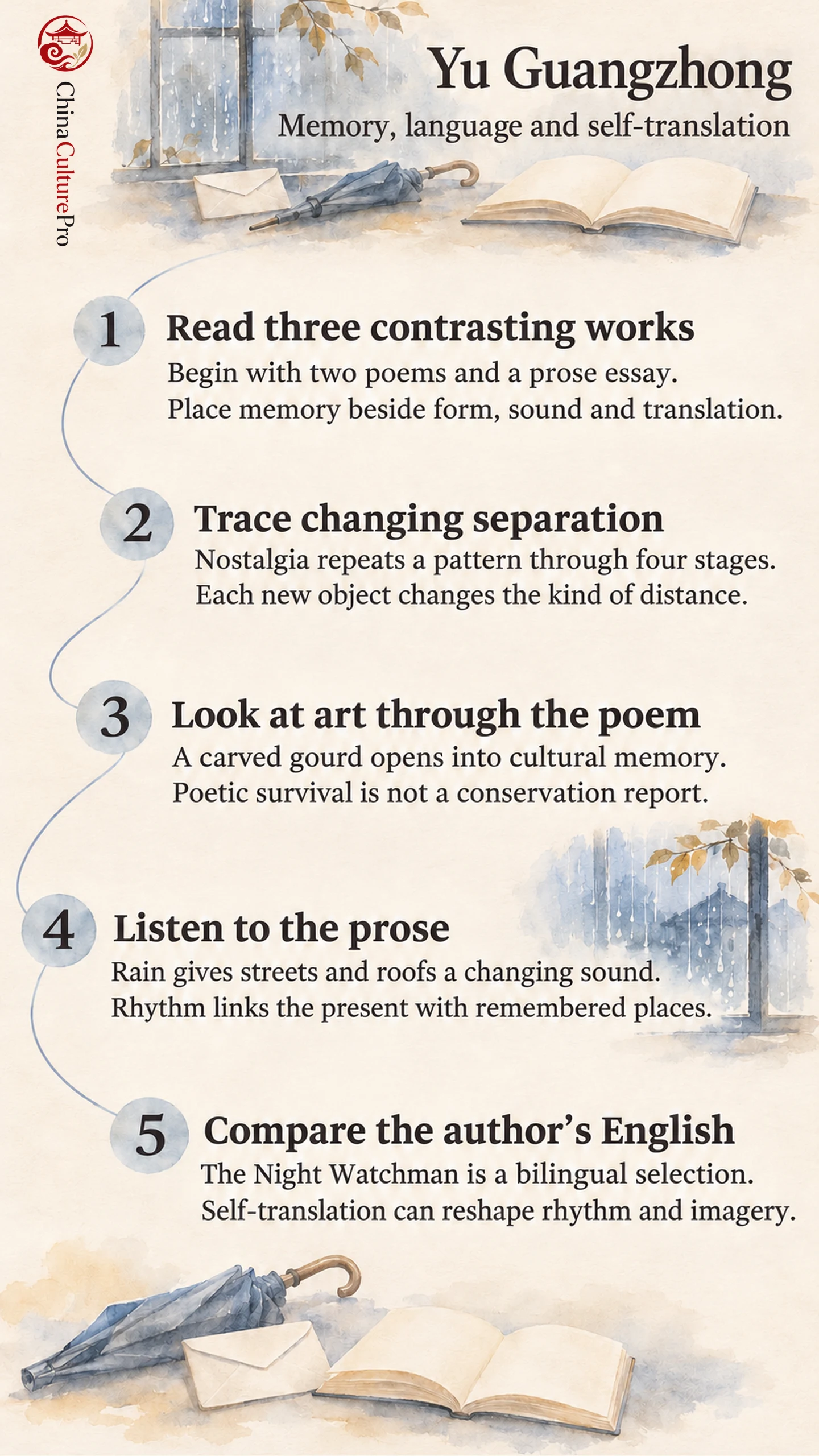
A small everyday object can organize a life’s separation; a carving can prompt a meditation on cultural survival; rain can carry the sound of vanished roofs. In Yu’s writing, memory takes shape through particular objects, rhythms and forms of attention.
Meet the Poet, Essayist and Translator
Born in Nanjing in 1928, Yu went to Taiwan in 1950, studied foreign languages and later earned an MFA at the University of Iowa. He taught at the Chinese University of Hong Kong from 1974 to 1985 before returning to Taiwan. [1] His life ended in 2017; his published work spans poetry, prose, literary criticism and translation. [7]
These three pieces introduce distinct ways of making memory present. The English labels describe the works; anthology wording may differ.
| Work | Form | What to notice |
|---|---|---|
| Nostalgia (乡愁, Xiāng Chóu) | Short modern poem | Repetition connects different forms of separation. [2] |
| White Jade Bitter Gourd (白玉苦瓜, Bái Yù Kǔ Guā) | Poem inspired by a museum object | Art links material beauty, history and imagined continuity. [3] |
| Listen to That Cold Rain (听听那冷雨, Tīng Tīng Nà Lěng Yǔ) | Prose essay | Sound and sensory detail carry remembered places. [4] |
For wider context, the modern Chinese literature guide helps place these choices alongside other writers and forms. Begin with one complete work before using a broad thematic label to explain it.
Read Nostalgia as Changing Forms of Separation
Written in 1972, Nostalgia moves through four stages of life. A stamp, a travel ticket, a grave and a strait embody separations involving mother, bride, death and the mainland. The repeated spatial arrangement changes most sharply at the grave, where distance becomes the boundary between outside and inside. [2]
The poem’s compactness depends on what changes within the repeated pattern. A means of communication, a means of travel and an irreversible loss are not equivalent obstacles. The final image widens the poem’s scale from family relations to the speaker’s divided sense of homeland across a strait. [2]
Read the recurrence aloud, then ask what each new object allows or prevents. This makes the poem’s organization audible without turning it into a simple list of symbols. The Chinese poetry guide provides comparisons with other ways of arranging repetition and changing perspective.
Approach White Jade Bitter Gourd as a Poem about Art
The museum poem gives the carved gourd an imagined ripeness and freshness. Its tendrils, leaves and rounded forms prompt associations with nourishment, mother and homeland. Historical violence enters the poem, while the artwork seems to persist beyond ordinary decay. [3]
Notice the changing scale: a contained object opens into a much larger cultural imagination, then returns to the carved object before the viewer. The tension between vulnerable organic life and durable art gives this work a different structure from the brief stages of Nostalgia. [3]
Its imagery is an interpretation of the object, rather than a museum conservation report or proof that an artefact literally escaped every historical injury. Keep those kinds of claims distinct. The same Chinese title also names a poetry collection, so check whether an edition or discussion refers to the individual poem or the book. [3]
Hear the Language and Lost Roofs of Listen to That Cold Rain
The prose essay moves from wet Taipei streets into remembered landscapes, the visual form of Chinese writing and the varied sounds of rain. Roof tiles become especially important: their resonance gives way to the different experience of a city rebuilt with concrete apartments. Urban change alters what memory can still hear. [4]
Read for rhythm as well as description. Repeated syllables, accumulating sensory phrases and musical comparisons give the prose its movement. Classical references connect an individual’s listening with earlier literary experiences, while remembered intimacy interrupts the larger cultural meditation. [4]
The ending brings rain back to an ordinary return home. That keeps the essay’s remembered world connected to a present observer, rather than leaving it as an abstract declaration about cultural loss. [4]
The Chinese literary allusions guide offers help with inherited references. Its reflections on written forms also make the Chinese characters guide a useful companion, while leaving the essay’s judgments about language as the writer’s aesthetic perspective.
Use Self-Translation to Open a Wider Reading Path
The Night Watchman (守夜人, Shǒu Yè Rén) is a bilingual selection of poems written and translated by Yu himself. The 2017 edition includes Nostalgia and White Jade Bitter Gourd alongside other work. It is a poetry selection, rather than a complete collection of his writing in every genre. [5]
Self-translation creates a particular reading opportunity. Research on this book identifies choices that prioritize musicality and reshape imagery or allusions. The author’s English can therefore be studied as a crafted version, rather than assumed to provide a word-by-word key to the Chinese. [6]
Compare what a passage does in each language: where its rhythm slows, what image receives emphasis and whether a repeated phrase stays repeated. An apparent difference is a reason to investigate the choice, not immediately to pronounce either version wrong.
Use the Chinese classic books guide when comparing selections and annotations. Keep poem, prose essay, Chinese collection and bilingual selection separate in your notes; that small distinction prevents a famous title from standing in for the whole career.
FAQs About Yu Guangzhong
Are Yu Guangzhong and Yu Kwang-chung the same writer?
Yes. They are different romanizations of the same Chinese name. Search both when checking English catalogues and translations.
Is Listen to That Cold Rain a poem?
It is a prose essay. Its rhythm, imagery and sound patterns are highly literary, but it should not be confused with a verse poem.
Does The Night Watchman contain his complete works?
No. It is a bilingual poetry selection, with English versions by the author. His prose, criticism and other translations require separate reading.
Sources
[1] Chinese University of Hong Kong, University Gallery. Professor Yu Kwang-chung
[2] Yu Guangzhong, National Sun Yat-sen University Digital Archives. Nostalgia
[3] Yu Guangzhong, National Sun Yat-sen University Digital Archives. White Jade Bitter Gourd: In the National Palace Museum Collection
[4] Yu Guangzhong, via Tzu Chi University of Science and Technology. Listen to That Cold Rain
[5] Chiuko Publishing, via Soochow University HyRead Catalogue. The Night Watchman: A Bilingual Selection of Poems
[6] Anita Wai-fun Siu, University of Hong Kong. Yu Kwang-chung as a self-translator: a case study of The Night Watchman
[7] Chiuko Publishing. Yu Guangzhong: Author Profile