
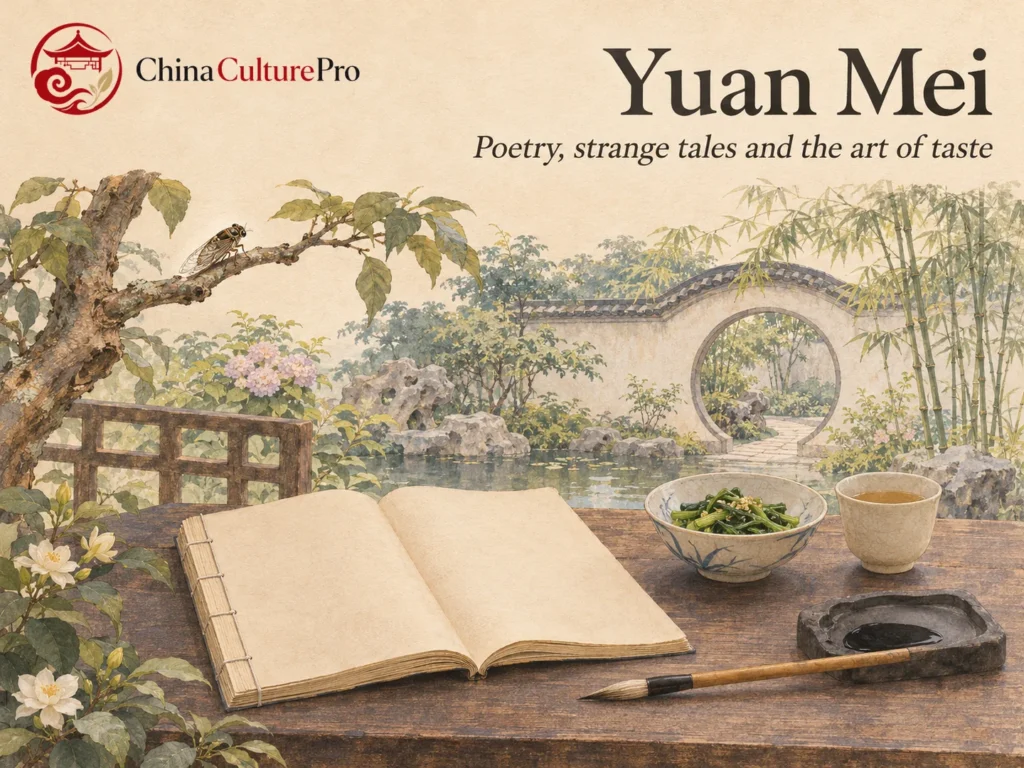

Quick Answer: Where Should You Start with Yuan Mei?
Yuan Mei (袁枚, Yuán Méi) was a Qing poet, essayist and literary teacher whose interests included poetry criticism, strange tales and food. Begin with one short poem, then choose a longer work according to whether you enjoy literary judgment, uncanny stories or the culture of eating.
- For poetry: Watch how an ordinary scene changes through a small action.
- For criticism: Compare personal feeling with the skill needed to express it.
- For prose: Notice the storyteller’s stance and the food writer’s discriminating voice.
His range is part of the attraction. A label such as gourmet, individualist or ghost-story collector offers only one entrance into his writing.

A singing child suddenly falls silent; a critic questions inherited rules; a diner asks how another household achieved a particular flavour. Yuan Mei’s attention moves across these situations, bringing precise judgment to subjects that can seem ordinary or marginal.
Meet Yuan Mei through Four Kinds of Writing
From the Hangzhou region, Yuan passed the highest-level civil service examination and served in government before resigning in 1748 to write and teach. His literary interests also included encouraging women’s poetry. [1] The Qing dynasty guide gives the larger historical frame, but the works themselves offer the clearest starting point.
| Entry work | Form | What it opens up |
|---|---|---|
| What I Saw (所见, Suǒ Jiàn) | Short poem | Observation, sound and a child’s changing attention. [2] |
| Suiyuan Shihua (随园诗话, Suí Yuán Shī Huà) | Poetry talks | Judgments about verse, feeling and literary reputation. [3] |
| Zi Bu Yu (子不语, Zǐ Bù Yǔ) | Strange-tale collection | The pleasure and uncertainties of extraordinary narration. [4] |
| Suiyuan Shidan (随园食单, Suí Yuán Shí Dān) | Gastronomic writing | Taste, cooking knowledge and remembered hospitality. [6] |
The titles name different reading experiences. Start with a poem if you want to hear the language at work immediately; choose a prose collection if short, self-contained entries suit your reading time.
Notice the Turn from Song to Silence in What I Saw
The four-line poem first presents a herding child riding a yellow ox, with singing that fills the wooded space. Then the wish to catch a calling cicada changes the scene: the mouth closes and the child becomes still. The poem ends before any successful capture. [2]
Its pleasure comes from that shift. Sound initially belongs to the child; attention then moves to the insect. The reader can understand why silence becomes useful without an explanatory moral or an account of what happens next. [2]
Read it once for the visible scene and again for the changing sound. Do not add a flute, a leap from the ox or a captured cicada: each would make the ending more definite than the text. The Chinese nature poetry guide provides useful comparisons for how small observations organize a poem.
Read Suiyuan Shihua for Feeling and Craft
Xingling (性灵, Xìng Líng), often discussed through personal feeling and individual sensibility, is central to Yuan’s poetics. It does not mean that technique is irrelevant: his interest joins personal expression with literary skill. [1]
In the second entry of the first volume, he argues that form should not be treated as an empty framework outside feeling. He points to differences among older poetic forms to question the idea of one permanently fixed model. In the next entry, he criticizes literary factions and urges attention to a writer’s strengths as well as shortcomings. [3]
This makes the book more useful as a sequence of judgments to test than as a formula that automatically decides whether a poem is good. Put a quoted example beside his comment and ask whether you hear what he praises. The Chinese poetry guide can supply a wider vocabulary for those comparisons.
Approach Zi Bu Yu as a Collection of Strange Tales
The title alludes to matters the Master did not discuss. In his preface, Yuan defends extraordinary narrative through literary precedents and the pleasure of collecting unusual stories; he does not simply claim that every report is true. He also records changing the title to Xin Qixie (新齐谐, Xīn Qí Xié) after discovering an earlier work with the first name. [4]
In the opening tale about Deputy Prefect Li, a loyal servant volunteers to exchange his life for his dead master’s. The supposed religious helper is exposed as a deceiver pursuing wealth and sexual access through a supernatural intervention. Devotion and exploitation coexist in the plot, so the presence of a miracle does not make every claimant to sacred power trustworthy. [5]
Read for who tells the story, who benefits from a claim and how the ending changes your judgment. For comparison, Strange Tales from a Chinese Studio belongs to another author and collection; shared supernatural material does not make the two books interchangeable.
Read Suiyuan Shidan as Taste, Judgment and Social Memory
The food book’s preface describes sending his household cook to learn from other kitchens and recording whose household supplied a memorable dish. It acknowledges that written rules cannot contain every skilled cook’s practice, or force all readers to share one taste. Its entries also distinguish ingredient quality, seasoning and different ways of balancing a dish. [6]
Read it as an opinionated historical voice with technical interests, rather than assuming that every judgment defines all Chinese food. The remembered source of a dish matters alongside its ingredients: culinary knowledge moves through people and households.
For English reading, match the edition to the genre:
- Poetry: I Don’t Bow to Buddhas, translated by J. P. Seaton, is a selection. [1]
- Strange tales: Censored by Confucius, edited and translated by Kam Louie and Louise Edwards, offers an English route into the stories. [1]
- Food writing: Sean J. S. Chen’s Recipes from the Garden of Contentment includes Chinese text and annotations; The Way of Eating is the compact English-only version. [7]
The Chinese classic books guide helps compare translations and commentary. Choose one genre first, then return to the others to hear how Yuan’s judgments change with his subject.
FAQs About Yuan Mei
Does Xingling mean writing without technique?
No. Personal feeling matters, but so does finding a fitting literary form. The idea should not be reduced to writing whatever comes to mind without craft.
Did Confucius actually censor Zi Bu Yu?
No. Confucius lived long before Yuan Mei. The title makes a classical allusion; the English title Censored by Confucius should not be read as a historical censorship event.
Is Suiyuan Shidan only a list of recipes?
It also discusses taste, ingredients, culinary judgment and learning from other households. Those passages make it useful for reading food culture as well as cooking history.
Sources
[1] Chinese University of Hong Kong, Research Centre for Translation. Yuan Mei
[2] Yuan Mei, via Wikisource. What I Saw
[3] Yuan Mei, via Wikisource. Suiyuan Shihua, Volume One, Entries Two and Three
[4] Yuan Mei, via Wikisource. Zi Bu Yu: Author Preface
[5] Yuan Mei, via Wikisource. Zi Bu Yu, Volume One: Deputy Prefect Li
[6] Yuan Mei, via Wikisource. Suiyuan Shidan: Preface and Essential Knowledge
[7] Berkshire Publishing. Recipes from the Garden of Contentment