


Quick Answer: What Should You Notice in Yang Wanli’s Poems?
Yang Wanli (杨万里, Yáng Wànlǐ) was a Southern Song poet known for lively observation and unexpected turns. Begin with short poems in which a small detail changes what the observer can see or hear, rather than treating the scene as a motionless picture.
- For close observation: Notice a dragonfly already resting on a newly emerging lotus leaf.
- For visual scale: Compare that detail with a lake’s expanse of leaves and flowers.
- For surprise: Follow a butterfly chase or a search for a nearby cicada’s sound.
The apparent ease of these poems should not obscure their arrangement. A final line can alter the reader’s understanding of everything before it.
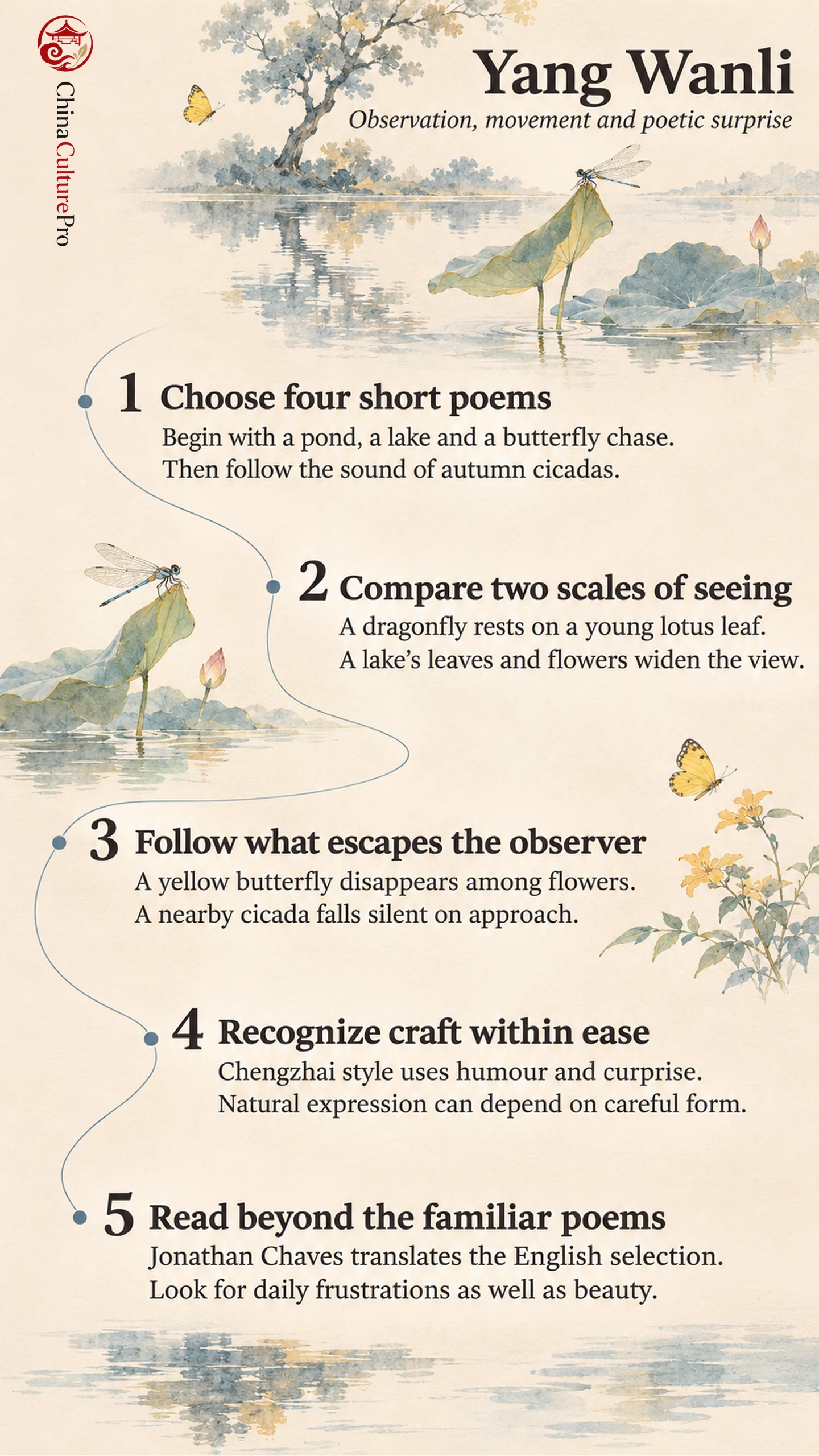
A yellow butterfly vanishes among yellow flowers. A cicada sounds close, then falls silent when the listener approaches. Such moments make an observer’s changing experience part of the poem, giving Yang Wanli’s familiar landscapes their energy.
Meet Yang Wanli and Select Four Short Poems
Yang Wanli lived from 1127 to 1206 and came from Jishui in present-day Jiangxi. He passed the civil examination in 1154 and held official posts. His collected poetry and prose are preserved in Chengzhai Ji (诚斋集, Chéng Zhāi Jí). [1] Place him in the literary world of the Song dynasty, while keeping each poem’s particular scene in view.
The English titles below are descriptive guides. For works preserved in groups, the opening image helps identify the selected poem more reliably than a sequence number alone.
| Work | Selected scene and reading focus |
|---|---|
| Small Pond (小池, Xiǎo Chí) | A spring, reflected shade and a dragonfly on a young lotus leaf. [2] |
| Leaving Jingci Temple at Dawn to See Lin Zifang Off (晓出净慈寺送林子方, Xiǎo Chū Jìng Cí Sì Sòng Lín Zǐfāng) | The familiar quatrain opening with West Lake’s sixth-month scenery. [3] |
| Staying at Mr Xu’s Inn in Xinshi (宿新市徐公店, Sù Xīn Shì Xú Gōng Diàn) | The poem opening with a sparse hedge and a deep path, followed by a butterfly chase. [4] |
| Walking in the Garden in Early Autumn (初秋行圃, Chū Qiū Xíng Pǔ) | The fourth quatrain, in which searching changes the experience of cicada song. [5] |
Compare a Small Pond with a Lake of Lotuses
Small Pond gives the spring and tree shade something like human care: the spring seems reluctant to release its slender flow, while the shade appears to cherish the water in gentle clear weather. The ending then narrows attention to a pointed young lotus leaf, with a dragonfly already standing on it. [2]
The relation between “just emerging” and “already there” gives the still scene a small surprise. What appears newly available to the observer has already been found by another creature. The dragonfly’s position completes the poem’s movement toward a precise detail. [2]
The West Lake quatrain works at a different scale. After announcing the special character of the sixth lunar month, it sets green lotus leaves reaching toward the sky against red flowers lit by the sun. Its paired ending expands the view rather than narrowing it. [3]
This familiar poem is conventionally attributed to Yang; textual notes also record an alternative attribution to Su Shi. That is worth checking in an annotated edition, without losing sight of the visible contrast between leaves and flowers. [3] Read it alongside other Chinese nature poetry by asking how a poem directs the scale of attention.
Follow the Butterfly and the Vanishing Sound
At the inn, a sparse hedge and a path establish an open view. A child runs after a yellow butterfly, which flies into a field of flowering brassicas and becomes impossible to find. The ending makes colour work as both attraction and concealment: the butterfly is visible as an object of pursuit until it merges with the flowers. [4]
Keep the action unfinished. The poem does not say that the child catches the butterfly, nor does it require an elaborate lesson about failure. The disappearance is enough to make the scene move beyond a list of spring objects. [4]
The early-autumn quatrain begins with the paradox of a sunset that seems both unfeeling and deeply responsive, prompting cicadas to sound through the trees. The listener hears the sound nearby but cannot locate it; on reaching its vicinity, the sound stops. [5]
The search changes what can be perceived. You can compare the child’s pursuit and the listener’s approach without treating either poem as evidence establishing a rule of animal behaviour. Their endings matter because the observer cannot keep possession of the original scene.
Understand the Craft behind Chengzhai Style
Chengzhai style (诚斋体, Chéng Zhāi Tǐ) names the distinctive manner associated with Yang’s literary identity. Colloquial expression, humour and surprises that unsettle expectations are important features. The natural impression is compatible with training and careful choices; it does not mean that a poem merely transcribes whatever happened. [6]
Nor should his individuality be reduced to a total rejection of earlier poetry. His continuing admiration for earlier models complicates a simple story of abandoning tradition. [6] The useful distinction is between repeating a model and finding a fresh effect within inherited forms.
The Chinese regulated verse guide helps explain the compact structures used by many familiar short poems. For these readings, notice how the last line changes the scene: a dragonfly has arrived first, a butterfly is lost to view, or a sound disappears at close range.
Move from Familiar Quatrains to a Wider English Selection
For English reading, Heaven My Blanket, Earth My Pillow: Poems from Sung Dynasty China is translated by Jonathan Chaves and published by White Pine Press. Its presentation places natural beauty alongside everyday bodily experience, including overwork and discomfort. [7] It offers a way beyond the familiar short poems often encountered first.
That broader range helps prevent an overly smooth image of Yang as a poet of effortless serenity. Ordinary frustrations and physical experience can belong in the same reading journey as leaves, water and birds. [7]
When choosing Chinese classic books, check the contents and notes rather than assuming any one selection contains every familiar poem. Use the Chinese poetry guide for wider comparisons, then return to one complete poem and trace the changes in what its observer can perceive.
FAQs About Yang Wanli
Which Yang Wanli poem is easiest to begin with?
Small Pond is a compact starting point. Its four lines move from water and shade to a single dragonfly, making the shift in attention easy to follow.
Does Small Pond describe a lotus flower bud?
The pointed emerging form is a young lotus leaf. Distinguish it from the red lotus flowers in the familiar West Lake quatrain.
Who translated Heaven My Blanket, Earth My Pillow?
Jonathan Chaves translated the English collection published by White Pine Press. Check that translator credit when locating it.
Sources
[1] Chinese University of Hong Kong, Renditions. Yang Wanli
[2] Yang Wanli, via Wikisource. Small Pond
[3] Hong Kong Education Bureau materials, via Classical Chinese Literature. Leaving Jingci Temple at Dawn to See Lin Zifang Off
[4] Yang Wanli, via Wikisource. Staying at Mr Xu’s Inn in Xinshi: Two Poems
[5] Yang Wanli, via Wikisource. Walking in the Garden in Early Autumn: Four Poems
[6] Chen Zhang, Harvard University doctoral dissertation. Learning to Write Naturally: The Problem of Southern Song Poetry in the Late Twelfth Century (2017)
[7] White Pine Press. Heaven My Blanket, Earth My Pillow: Poems from Sung Dynasty China