
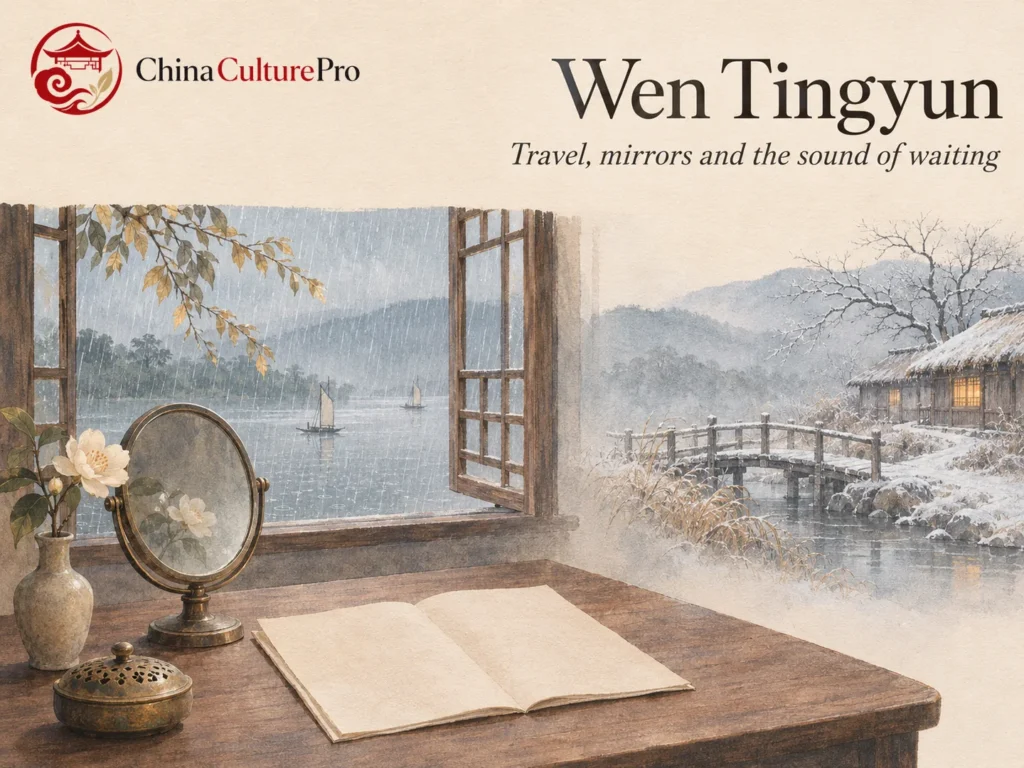

Quick Answer: What Makes Wen Tingyun Worth Reading?
Wen Tingyun (温庭筠, Wēn Tíng Yún) was a late-Tang poet important to the early literary development of song lyrics called ci (词, cí). Read him for concentrated images: a frosty journey, a woman’s mirrors, rain continuing through the night and boats passing an expectant watcher.
- For homesickness: Start with the departure poem set on Mount Shang.
- For rich visual detail: Read the lyric featuring a woman’s mirrors.
- For waiting: Compare the nighttime rain lyric with the watcher beside a river.
These scenes offer different reading experiences. Keep the poem’s stated situation separate from guesses about the author’s private life.

A poem can name sorrow directly and still make its objects carry much of the feeling. Wen Tingyun’s work rewards attention to what an image sits beside, and to the point at which the scene changes.
Place Wen Tingyun Between Shi and Ci
Wen was known for literary and musical talent, but failed the civil-service examination and obtained minor posts through connections. His career belongs to the late Tang, before the later flourishing of Song-dynasty ci. [1]
His writing includes shi (诗, shī), poetry exemplified here by a poem in regular five-character lines, and song lyrics associated with musical patterns and varying line lengths. The later anthology Among the Flowers (花间集, Huā Jiān Jí) helped make his lyrics influential for subsequent writers. He was a major early practitioner; calling him the sole inventor oversimplifies the genre’s development. [2]
Use these four works as contrasting entry points:
| Work | Identify the particular text | Reading focus |
|---|---|---|
| Early Departure on Mount Shang (商山早行, Shāng Shān Zǎo Xíng) | An early traveler hears departure bells. | Homesickness and sharply paired images. [3] |
| Pusaman (菩萨蛮, Pú Sà Mán) | The lyric beginning 小山重叠金明灭. | Dressing, mirrors and embroidered birds. [4] |
| Genglouzi (更漏子, Gēng Lòu Zǐ) | The lyric beginning 玉炉香. | A cold room and rain heard until dawn. [5] |
| Dreaming of the South (梦江南, Mèng Jiāng Nán) | The lyric beginning 梳洗罢. | A watcher and the boats that fail to bring the expected person. [6] |
The lyric names identify patterns shared by multiple compositions, so keep the opening words when finding a translation. For a broader formal comparison, see shi, ci and qu. [2]
Read Homesickness in the Travel Poem
Early Departure on Mount Shang announces the traveler’s sadness for home near its beginning. It then places a rooster’s call, an inn and the moon beside footprints, a wooden bridge and frost. Sound, light and footprints make the early departure tangible. [3]
Little explanatory language joins the objects. Readers connect the early hour, signs of travelers and visible cold: a whole moment is concentrated into two lines. [3]
At the close, the traveler thinks of a dream of Duling, where waterbirds fill a winding pond. That remembered place contrasts with the frosty road, completing the movement from declared homesickness through the journey toward home. [3]
When reading an English version, compare how it connects the paired images. Added verbs can make their relationship clearer while changing the compactness of the Chinese. The Tang poetry guide provides context for reading such short, carefully organized scenes.
Look Through the Mirrors in Pusaman
In the selected Pusaman lyric, a woman rises slowly, draws her brows and takes time over washing and dressing. Mirrors show flowers and face reflecting one another. The final image is a garment embroidered with golden partridges in pairs. [4]
Follow the movement of attention from the person to her reflections and then to the birds on cloth. The objects do more than establish expensive surroundings: they determine what the reader sees, and in what sequence. The paired birds can sharpen a sense of companionship missing from the scene, although the poem does not identify a departed husband or tell his story. [4]
What do the pairs suggest after one figure’s solitary dressing? This is an interpretive question the imagery supports, rather than evidence for a particular event in Wen’s life. [4]
Hear the Night and Watch the River
Genglouzi begins with incense, red candle wax, a painted hall and a cold bed. Its later lines move to a paulownia tree and nighttime rain. Repeated references to each leaf and each sound stretch the listening toward dawn; the poem also explicitly names the pain of separation. [5]
The change from room to rain gives waiting an audible duration. Instead of treating each object as a fixed symbol, notice how the sequence makes the night feel longer. The ending stays with rain on empty steps until dawn, leaving the separation unresolved. [5]
Dreaming of the South follows a different rhythm. After washing and combing, a solitary figure leans at a riverside pavilion. Sails pass, but none brings the expected person. Slanting sunlight and the continuing river carry the watching into disappointment. [6]
The phrase about a thousand sails conveys the succession of passing boats; it does not require a literal traffic count. Their repeated passing lets expectation renew itself and fail again. Compare that outward gaze with the rain lyric’s listening: both make separation unfold through the scene, without supplying a complete history of the relationship. [6]
For English-language study, Paul F. Rouzer’s Writing Another’s Dream: The Poetry of Wen Tingyun, published by Stanford University Press in 1993, offers a scholarly route beyond these entry points. [1] When choosing editions, the Chinese classic books guide explains useful questions about translation, notes and textual scope.
FAQs About Wen Tingyun
Which Wen Tingyun poem should I read first?
Begin with Early Departure on Mount Shang. Its eight five-character lines provide a compact journey from declared homesickness through travel details to a remembered home landscape.
Did Wen Tingyun invent ci poetry?
He was an important early literary practitioner, but the genre’s development cannot be reduced to a single inventor. His preservation and influence also matter to that reputation.
Are the women in his lyrics descriptions of his own life?
A lyric’s scene does not by itself establish autobiography. Read its voice, objects and implied relationships before connecting them to claims about the author’s experiences.
Sources
[1] Chinese University of Hong Kong, Renditions. Wen Tingyun
[2] Thomas J. Mazanec, Routledge Handbook of Traditional Chinese Literature. Wen Tingyun
[3] Wen Tingyun, via Wikisource. Early Departure on Mount Shang
[4] Wen Tingyun, via Wikisource. Pusaman: Xiaoshan Chongdie Jin Mingmie
[5] Wen Tingyun, via Wikisource. Genglouzi: Yu Lu Xiang
[6] Wen Tingyun, via Wikisource. Dreaming of the South: Shu Xi Ba