

Quick Answer: Where Should You Start with Wen Yiduo?
Wen Yiduo (闻一多, Wén Yì Duō; 1899–1946) was a modern Chinese poet, literary scholar and public intellectual. His work combines strong feeling with deliberate attention to poetic form. Start with the candle and stagnant-water poems, then compare a collective appeal with an intimate elegy.
- For an ideal of service: Read the poem addressing a burning candle.
- For irony: Follow the beautiful colours given to polluted water.
- For emotional range: Compare voices calling for return with a father’s grief.
His public commitments matter to his writing. Reading the words, sounds and shapes of individual poems reveals more than a biographical label alone.
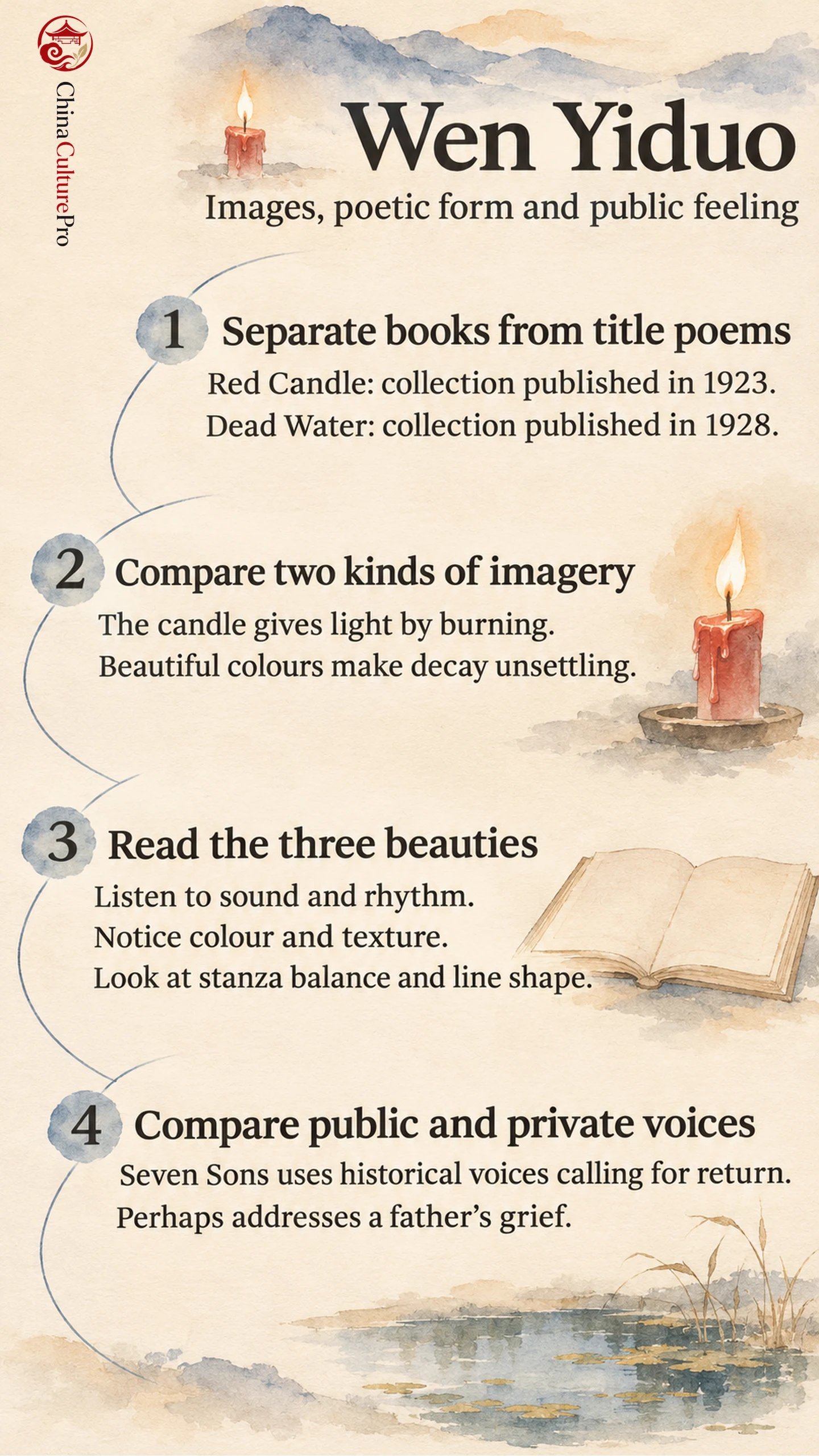
Wen’s images can appear immediately legible: a candle gives light; foul water signifies stagnation. Yet the poems develop through questions, changes of attitude and patterns that reward a slower reading.
Separate the Collections from the Poems
Wen studied art in the United States from 1922 and returned to China in 1925, later teaching at several universities. His two poetry collections appeared in 1923 and 1928. He also pursued classical scholarship and political activity; Nationalist secret police assassinated him in 1946. [1]
Keep the books distinct from individual poems bearing the same titles:
| Poem or sequence | Where to begin |
|---|---|
| Red Candle (红烛, Hóng Zhú) | Read the opening poem of the 1923 collection of the same name. [4] |
| Dead Water (死水, Sǐ Shuǐ) | Read the title poem; the collection appeared in 1928. [1] |
| Songs of the Seven Sons (七子之歌, Qī Zǐ Zhī Gē) | Compare its seven personified voices and repeated appeal to a mother. [6] |
| Perhaps (也许——葬歌, Yě Xǔ — Zàng Gē) | Listen to the repeated uncertainty in an elegy for a young daughter. [7] |
His visual-art training is also relevant: he made drawings, illustrations, book designs and seals. [3] His scholarly work extended to the Book of Songs, the Songs of Chu, Tang poetry and mythology. [2] This places his new verse within an active engagement with older literature; the modern Chinese literature guide supplies the broader literary setting.
Compare the Candle with the Stagnant Water
Red Candle addresses the candle repeatedly, asking why its body must burn before it gives light. The speaker first sees contradiction, then revises that judgment: burning is how the candle fulfills its purpose. Melting wax becomes tears, and the poem turns toward what this expenditure can give to others. [4]
Track those changes rather than assigning one meaning to the object at the start. Questions, corrections and renewed appeals make the poem an argument about devotion and creation. Its uneven lines and repeated address also give the reading a speaking voice. [4]
Dead Water creates a more troubling surface. Copper turns jade-green, rust resembles peach blossoms, grease becomes patterned silk and mould produces cloudlike colour. The luxurious vocabulary dresses decay in attractive forms. [5]
That apparent beautification is undercut by the ending’s refusal to call this a place of beauty. Read the attractive descriptions against their foul materials: the tension makes the irony work. The attractive details become unsettling because their materials remain refuse, grease and mould. [5]
The contrast offers a useful first comparison. One poem questions how an object can give light through being consumed; the other tests what happens when beautiful language is applied to corruption.
Use Sound, Colour and Shape to Read
In his 1926 essay The Form of Poetry (诗的格律, Shī De Gé Lǜ), Wen developed the approach commonly called the three beauties (三美, sān měi). These offer three complementary ways to attend to a poem. [2]
| Concept | Reading question |
|---|---|
| Musical beauty (音乐美, yīn yuè měi) | Attend to the pattern of sound and rhythm. |
| Pictorial beauty (绘画美, huì huà měi) | Notice the colours and textures created by words. |
| Architectural beauty (建筑美, jiàn zhù měi) | Look at the balance of stanzas and the arrangement of lines. |
These principles supported deliberate forms for new poetry, with patterns shaped to the work’s content. They did not require every new poem to copy a single classical template. [2]
Dead Water makes the questions concrete. Its twenty lines form five four-line stanzas, with nine Chinese characters per line. The regular outline contains the unstable, decaying scene described inside it. Look at the shape, then reread the colours and listen to the recurring sounds. [5]
Compare this experiment with classical regulated verse, while keeping their different conventions in view. Counting characters is one part of reading this particular poem, not a rule for all Wen’s writing.
Move Between Public Address and Private Grief
Songs of the Seven Sons gives voices to places addressed as children separated from their mother. Its 1925 setting matters: the sequence’s Macau, Hong Kong, Taiwan, Weihaiwei, Guangzhou Bay, Kowloon and joint Lüshun–Dalian section belong to its historical, anti-imperialist appeal. The recurring call for return connects the distinct voices. [6]
Read that personification as the sequence’s organizing device. A territory becomes able to speak of injury, memory and attachment through a family relationship. These are the poem’s historical voices, rather than a description of present-day administrative geography. [6]
Perhaps turns toward the death of Wen’s young daughter Liying. Repeated possibilities and requests for quiet address a child who cannot be awakened. The poem makes grief intimate through a voice trying to protect sleep, while the burial at its close makes the loss unmistakable. [7]
Comparing these works widens the emotional range: collective longing and private bereavement ask different things of a speaker. In each, repetition gives feeling a sustained shape.
For an English starting point, Red Candle: Selected Poems, translated by Tao Tao Sanders and published by Cape in 1972, is a selection from Wen’s poetry. Keep this translated selection distinct from the original 1923 collection when checking a poem’s source. [1] When comparing versions, use the guide to Chinese classic books and translations to consider notes and textual scope alongside the translated poem.
FAQs About Wen Yiduo
Are Red Candle and Dead Water books or individual poems?
Both are titles of poetry collections and of individual poems. Check whether a reference is discussing a whole book or its title poem.
Did Wen Yiduo write classical or modern poetry?
His major poetry collections belong to modern Chinese verse. His close study of classical literature informed his experiments with new poetic forms.
Which English translation can help me begin?
Tao Tao Sanders’s Red Candle: Selected Poems offers an English selection. Compare a translated poem’s wording and rhythm with the Chinese text when an edition provides it.
Sources
[1] Chinese University of Hong Kong, Renditions. Wen Yiduo
[2] Jiang Xiquan, Nanjing University Research Center for Modern Chinese Literature. Wen Yiduo’s Art of Poetry
[3] Tsinghua University. Ode to the Red Candle
[4] Wen Yiduo, via Wikisource. Red Candle
[5] Wen Yiduo, via Wikisource. Dead Water
[6] Wen Yiduo, via Wikisource. Songs of the Seven Sons
[7] Arthur Sze, Cipher Journal. On Wen Yiduo