
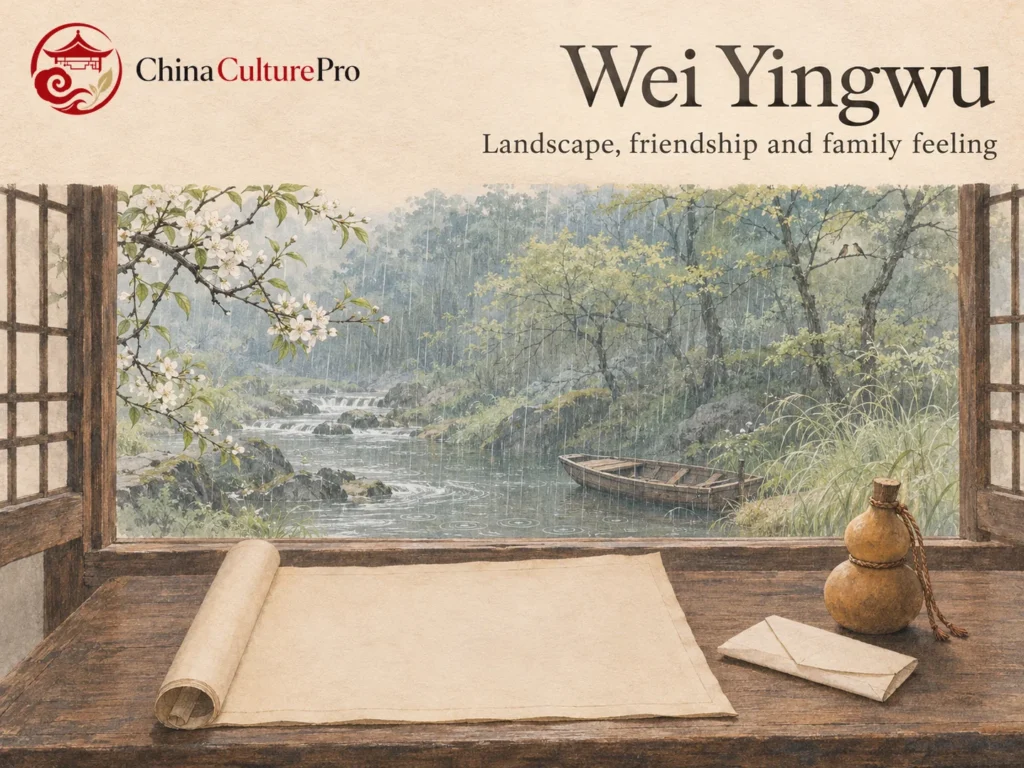

Quick Answer: Where Should You Start with Wei Yingwu?
Wei Yingwu (韦应物, Wéi Yìng Wù) was an eighth-century Tang poet associated with direct, dignified language and scenes of natural life. His poems also address friends, family and public responsibilities. Begin with a short landscape poem, then read what changes when a particular person is being addressed.
- For a first landscape: Try the four-line poem about Chuzhou’s western stream.
- For friendship: Compare an autumn-night message with the thought of visiting a mountain friend.
- For family feeling: Read the father’s farewell to a daughter leaving to marry.
Quiet feeling takes several forms here. Notice both what is moving in a scene and who is present, absent or imagined.
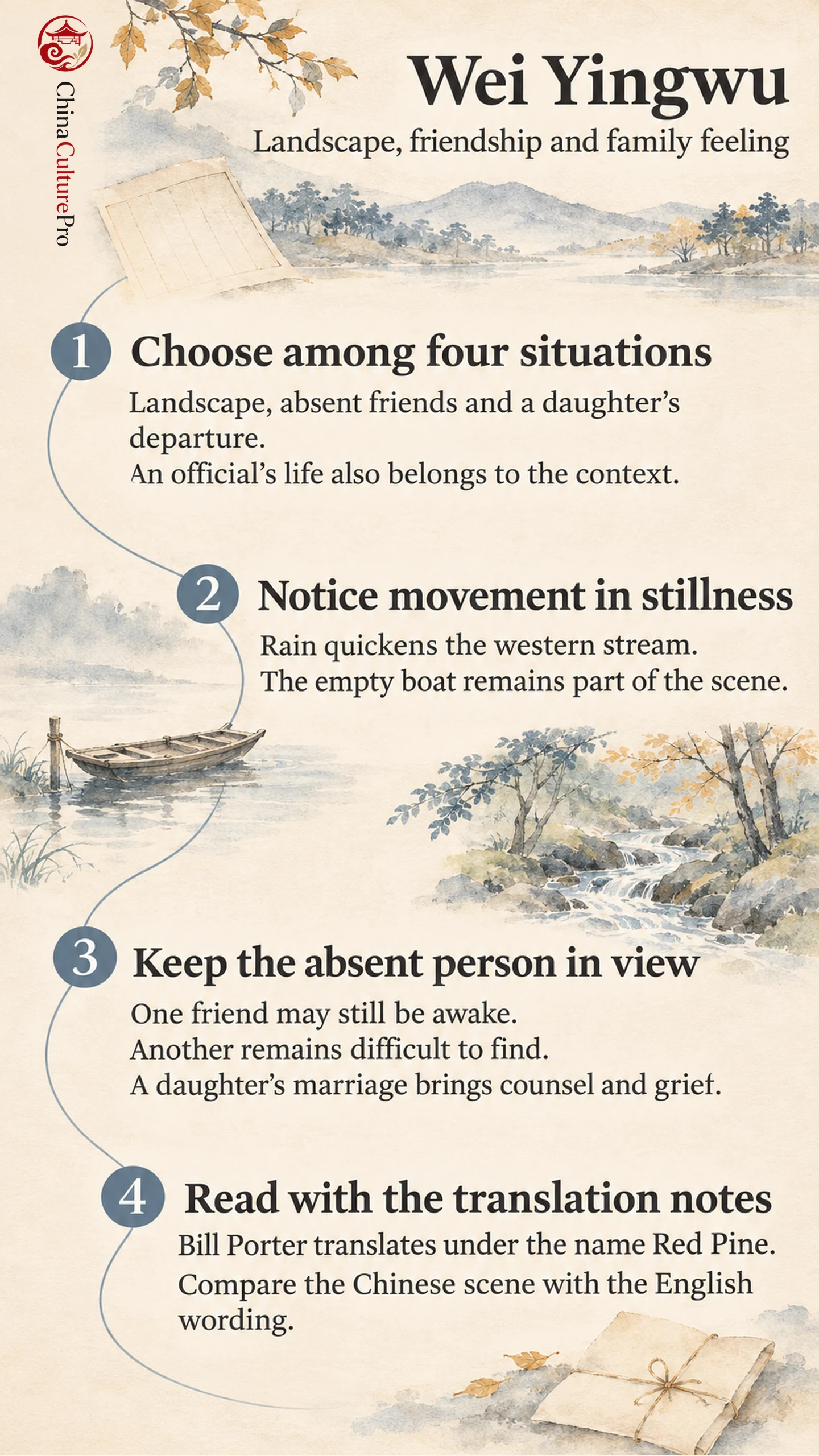
A boat at a deserted crossing can be memorable enough to become an author’s calling card. Wei Yingwu’s poetry, however, also contains an absent friend imagined awake, a visit that remains uncertain and a father returning to a changed household.
Locate the Poet and Choose Four Works
A native of Chang’an, Wei served as an imperial guard in his youth and later held official posts. The Chinese University of Hong Kong’s author profile connects his natural scenes with earlier poets, including Tao Yuanming, while also noting poetry concerned with social disruption after the An Lushan rebellion. [1]
That range matters: the quiet observer and the public official belong to one literary career. Read him within Tang poetry through several situations: service, friendship, household relationships and observation.
| Work | A useful reading focus |
|---|---|
| West Stream at Chuzhou (滁州西涧, Chú Zhōu Xī Jiàn) | Grass, birds and a rain-swollen current lead to a boat at a deserted crossing. [3] |
| An Autumn Night Message to Qiu (秋夜寄丘员外, Qiū Yè Jì Qiū Yuán Wài) | A nighttime walk turns toward a friend imagined elsewhere. [4] |
| To a Daoist in the Mountains of Quanjiao (寄全椒山中道士, Jì Quán Jiāo Shān Zhōng Dào Shì) | Concern for a mountain friend develops into the wish to bring wine. [5] |
| Sending My Daughter to the Yang Family (送杨氏女, Sòng Yáng Shì Nǚ) | A father’s counsel and grief accompany a marriage departure. [6] |
The first two are short quatrains; the others give the feeling more room to unfold. Choose one, identify its situation, and follow the way its ending redirects attention.
Notice Movement in the Western Stream
West Stream at Chuzhou begins with the speaker’s affection for grasses beside a ravine, then brings in birdsong from deep among trees. The second half changes the pace: evening rain swells the current, and the poem closes on a boat lying crosswise at a deserted crossing. [3]
Read the stillness alongside the motion. Grass and birds establish an intimate scale; water moving more urgently changes the surrounding energy. The boat’s position becomes striking against that current. [3]
The Chinese closing line does not explicitly introduce a person operating the boat. Let that absence remain part of your first reading before deciding on a symbolic interpretation. The scene’s effect can be explored through its visible actions and omissions. [3]
For comparison, the guide to Chinese nature poetry offers other ways that landscape, season and human attention work together. Here, avoid treating “quiet” as a synonym for motionless: the current is part of the poem’s force.
Keep People in the Quiet Scenes
An Autumn Night Message to Qiu opens with the speaker thinking of his friend during an autumn night. Walking and recitation give way to an imagined mountain scene, where pine seeds fall and the friend may still be awake. The closing thought crosses a distance the speaker has not physically traveled. [4]
Read the last line as a supposition about another person. It creates a sense of companionship through the possibility of shared wakefulness. The silence of the imagined setting can therefore hold a relationship, rather than simply a wish to escape people. [4]
To a Daoist in the Mountains of Quanjiao begins in a cold official residence. The speaker thinks of the mountain dweller and wishes to carry wine to comfort him on a stormy evening. Yet fallen leaves fill the mountains, and the ending asks where his traces can be found. The poem ends with the wish to find him, rather than an account of their meeting. [5]
Follow the difference between an intention and its fulfillment. A warm impulse toward friendship meets uncertainty about how to reach the person. Set that ending beside the autumn-night poem: both direct attention toward someone absent, but each gives the connection a different shape. [5]
Sending My Daughter to the Yang Family moves into a household. The father recalls the loss of the children’s mother, the elder daughter’s care for the younger and the pain of their separation. Advice about marriage duties belongs to the poem’s historical social world; the ending returns him to the younger daughter and tears. [6]
Read the counsel together with the grief. Concern for the daughter’s future does not settle the father’s feeling of loss. The history of Chinese marriage offers broader context for family expectations, while the poem remains a particular father’s address. [6]
These are three forms of attachment: imagining a friend awake, wishing to visit and trying to let a daughter go. The friendship and farewell poetry guide provides further comparisons of address and absence.
Read Wei Yingwu in a Bilingual Selection
In Such Hard Times: The Poetry of Wei Ying-wu, translated by Bill Porter under the name Red Pine, offers an English route into the poet’s work. Copper Canyon Press identifies the translator and publishes the selection. [2] The Academy of American Poets notes its facing Chinese texts and explanatory notes. [7]
Use the notes to separate a poem’s stated scene from biographical context and later interpretation. Compare how an English version handles a subject left unstated in Chinese, or the uncertainty of a friend’s being awake.
Wei Yingwu and Wei Ying-wu are spellings of the same author’s name. Keep the Chinese poem title alongside a translation’s English heading when tracking a particular work. The guide to Chinese classic books and translations gives further questions for comparing editions.
FAQs About Wei Yingwu
Which Wei Yingwu poem should I read first?
Begin with West Stream at Chuzhou. Its four lines offer a compact example of landscape organized through attention, sound and movement.
Was Wei Yingwu only a poet of seclusion?
No. He held official posts and wrote about social conditions, friends and family as well as natural scenes and solitude.
Is there a bilingual English selection of Wei Yingwu?
Yes. In Such Hard Times, translated by Bill Porter, also known as Red Pine, presents poems with Chinese texts and explanatory notes.
Sources
[1] Chinese University of Hong Kong, Renditions. Wei Yingwu
[2] Copper Canyon Press. In Such Hard Times: The Poetry of Wei Ying-wu
[3] Wei Yingwu, via Wikisource. West Stream at Chuzhou
[4] Wei Yingwu, via Wikisource. An Autumn Night Message to Qiu
[5] Wei Yingwu, via Wikisource. To a Daoist in the Mountains of Quanjiao
[6] Wei Yingwu, via Wikisource. Sending My Daughter to the Yang Family
[7] Academy of American Poets. In Such Hard Times: The Poetry of Wei Ying-wu