

Quick Answer: What Should You Read by Wang Zhihuan?
Wang Zhihuan (王之涣, Wáng Zhī Huàn) was a Tang poet known for compact poems that open onto expansive landscapes. Start with his tower poem and frontier song, then compare the more intimate gestures of his farewell writing.
- For changing perspective: Begin with the tower poem’s movement from a view to an ascent.
- For frontier feeling: Listen for the flute within the broad landscape.
- For parting: Follow willow branches or the contrast between today and tomorrow.
Read the scenes before extracting a general lesson. The force of an ending depends on the images and actions that precede it.
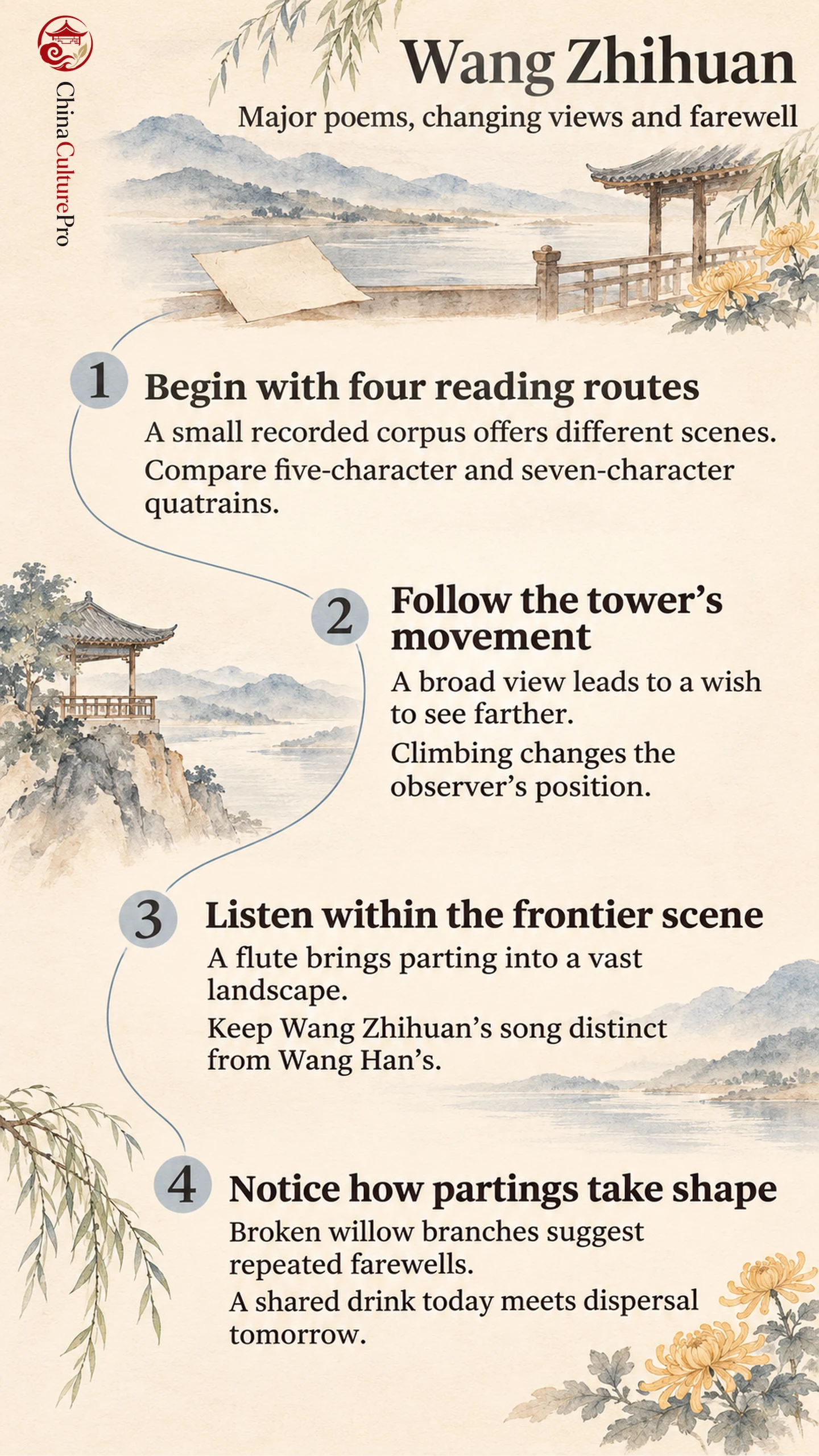
A river can lead the eye outward, a melody can recall someone far away, and a damaged branch can suggest repeated departures. Follow the movement from scene to thought in each poem.
Begin with a Small Surviving Corpus
The Complete Tang Poems places six poems under Wang Zhihuan’s name. The following four entry points include the two best-known works alongside two farewell poems. Each is a quatrain, though their line lengths differ. [1]
| Poem | Form | A useful focus |
|---|---|---|
| Climbing Stork Tower (登鹳雀楼, Dēng Guàn Què Lóu) | Four five-character lines | A broad view leads to a wish to see farther. |
| Song of Liangzhou (凉州词, Liáng Zhōu Cí), I | Four seven-character lines | Frontier scenery becomes a setting for sound and longing. |
| Seeing a Friend Off (送别, Sòng Bié) | Four five-character lines | Willow branches carry traces of repeated partings. |
| Seeing a Friend Off on the Ninth Day (九日送别, Jiǔ Rì Sòng Bié) | Four seven-character lines | A shared drink is set against tomorrow’s dispersal. |
All four appear in the anthology’s Wang Zhihuan section. Its other entries are a second Liangzhou poem and a banquet poem, so this selection provides an introduction rather than the whole recorded corpus. [1]
The Tang-poetry guide supplies a wider context, while the guide to Chinese regulated verse explains the surrounding formal terms. For a first reading, notice what each short ending changes.
Read the Tower Poem through Sight and Movement
Climbing Stork Tower begins with the sun disappearing beside mountains and the Yellow River flowing toward the sea. The final couplet, “欲穷千里目,更上一层楼,” turns the scene toward a desire and an action. My English rendering is: “To take in a thousand li with your eyes, climb one storey higher.” [2]
The movement matters. First comes a view; then comes the wish to extend it. The last line makes the observer’s position something that can change. A broader metaphor about effort and perspective grows from that physical relation between seeing and climbing. [2]
Read the four lines as two connected pairs, then return from the final action to the opening view. This keeps the landscape involved in the poem’s thought, rather than leaving only an isolated exhortation.
The poem is commonly attributed to Wang Zhihuan, but the anthology records an alternative attribution to Zhu Bin. Treat the familiar authorship as a received attribution with a textual complication, rather than an undisputed biographical episode. [1]
Hear the Frontier Song’s Willow Melody
Song of Liangzhou opens with the Yellow River extending toward white clouds, then places a lonely fortified city among immense mountains. A Qiang flute (羌笛, Qiāng Dí) enters this expansive setting. The willow reference can evoke the melody Breaking Willow Branches (折杨柳, Zhé Yáng Liǔ), associated with parting, as well as the tree itself. [3]
Listen to the turn from seeing to hearing. The final image of spring wind failing to cross the pass gives the scene its sense of remoteness and hardship. The Education Bureau’s reading emphasizes sympathy for soldiers far from home. [3]
The distant scenery and the nearby sound work together: landscape establishes scale, while the melody gives that scale an emotional relation to home. Read the closer guide to Wang Zhihuan’s Liangzhou poem for more on its images.
Keep the author with the title. Wang Han wrote a different Liangzhou poem opening with grape wine and a luminous cup. A shared song title does not make the two texts identical.
Compare Two Ways of Writing a Parting
Seeing a Friend Off begins with green willows along a canal. The branches have suffered repeated breaking; the speaker reasons that there must have been many farewells. The branches make repeated departures visible before any departing friend is described. [4]
Follow the order of perception and inference. The poem shows the branches before suggesting the human actions behind them. It lets the reader move from a small physical detail toward a larger pattern of separation. That is a different use of willow imagery from hearing a parting melody. [4]
Seeing a Friend Off on the Ninth Day brings the reader to a sparse gathering of friends. The poem speaks of climbing and briefly sharing chrysanthemum wine, then imagines the next morning’s separation through the image of a wind-driven plant. Today’s companionship is already being measured against tomorrow. [5]
Read the time words beside the final image. The shared occasion gives the parting its weight, while the movement of the plant makes dispersal feel difficult to control. For the cultural setting around the day’s climbing and chrysanthemum imagery, see Double Ninth Festival traditions. [5]
Compare the two poems after a first reading. One discovers past partings through the condition of branches; the other anticipates a departure while friends are still together. The friendship and farewell poetry guide offers further comparisons of scene, address and separation.
FAQs About Wang Zhihuan
Which Wang Zhihuan poem should I read first?
Start with Climbing Stork Tower for a clear movement from landscape to action. Follow it with Song of Liangzhou to compare a change from sight to sound.
Did Wang Zhihuan and Wang Han write the same Liangzhou poem?
No. Their poems share a title. Wang Zhihuan’s familiar version opens with the Yellow River; Wang Han’s opens with grape wine and a luminous cup.
How many poems does the Complete Tang Poems record for Wang Zhihuan?
It places six poems under his name, including two Liangzhou poems, the tower poem and three further quatrains.
Sources
[1] Qing imperial anthology editors, via Wikisource. Complete Tang Poems, Volume 253: Wang Zhihuan
[2] Wang Zhihuan, via Wikisource. Climbing Stork Tower
[3] Hong Kong Education Bureau. Song of Liangzhou: Text and Reading Notes
[4] Wang Zhihuan, via Wikisource. Seeing a Friend Off
[5] Wang Zhihuan, via Wikisource. Seeing a Friend Off on the Ninth Day