

Quick Answer: What Does Wang Zhihuan’s Liangzhou Song Express?
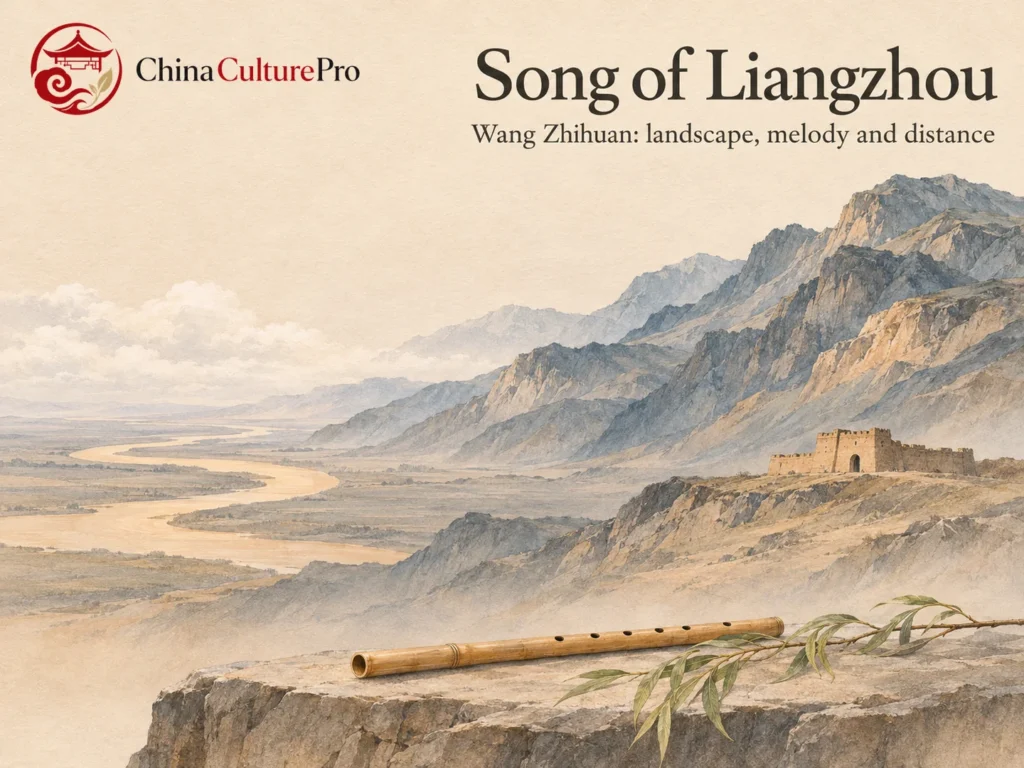
Song of Liangzhou (凉州词, Liáng Zhōu Cí) by Wang Zhihuan (王之涣, Wáng Zhī Huàn) places a lonely frontier fortress within an immense landscape. A flute’s willow melody then brings the feeling of separation into that vast scene.
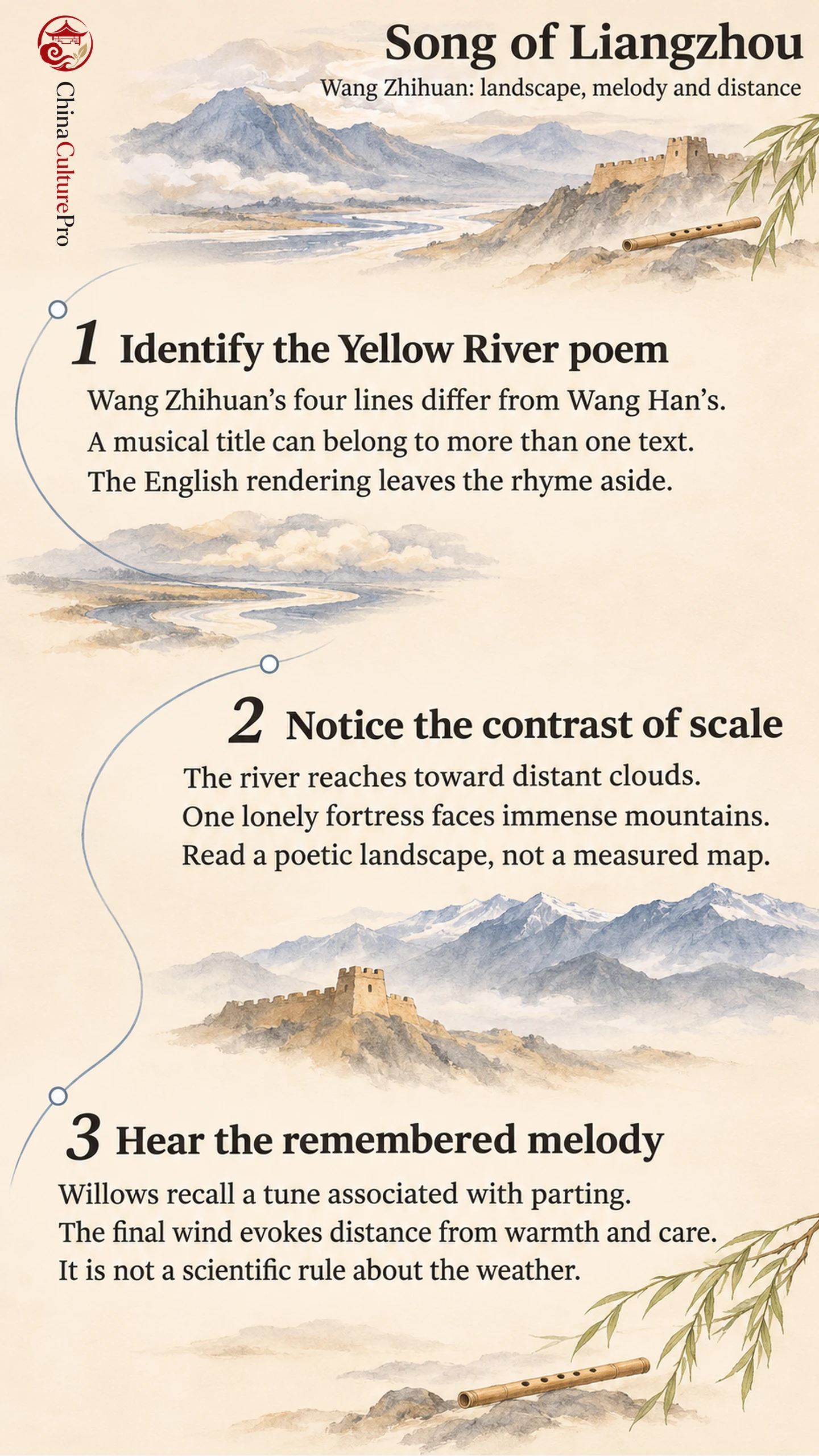
- Identify it: This is the poem beginning with the Yellow River and white clouds.
- Notice scale: One isolated fortress stands against towering mountains.
- Hear the allusion: Willows recall a parting melody, not just a tree beside the player.
The final spring wind belongs to the poem’s emotional landscape. Do not treat the line as a scientific claim that no wind crosses a particular pass.
The poem changes from an expansive view to a sound that suggests absence. The scale stays large, but the flute suggests the feelings of those stationed there: the listener can imagine a place and people far from the frontier.
Identify the Yellow River Poem and Read Its Four Lines
The Qiang flute (羌笛, Qiāng Dí) sounds in the third line. Yumen Pass (玉门关, Yù Mén Guān), also translated as Jade Gate Pass, supplies the final boundary; the historic pass lies west of Dunhuang in Gansu. [2]
The table follows the Yellow River reading of the opening, with an original, unrhymed English rendering. [1]
| Chinese line | Plain English rendering |
|---|---|
| 黄河远上白云间, | Far away, the Yellow River reaches up among white clouds. [1] |
| 一片孤城万仞山。 | One lonely fortress, amid mountains soaring high. [1] |
| 羌笛何须怨杨柳, | Why must the Qiang flute lament the willows? [1] |
| 春风不度玉门关。 | The spring wind does not cross Jade Gate Pass. [1] |
Wang Han (王翰, Wáng Hàn) wrote a different poem under this musical title. His wine-and-cup Liangzhou poem makes a useful comparison. For this poet’s other works, see the Wang Zhihuan reading guide.
Notice the Scale of the River, Fortress and Mountains
The opening makes the river appear to reach the distant clouds. It follows the eye looking far along the landscape; it does not require water to flow uphill. The next line places a single, lonely fortress against enormous mountains. The contrast makes the human settlement seem exposed. [2]
Read the second line aloud with a pause after the fortress. Its smallness matters in relation to what surrounds it. Replacing the scene with the general word desolation would lose that contrast of scale.
Nor does the poem supply a measured map joining every named feature into one verified viewpoint. Treat the river, fortress, mountains and pass as the arrangement of a poetic landscape before attempting a literal reconstruction.
The Tang poetry guide provides the wider literary context. The regulated verse guide explains how this four-line form can accommodate such an expansive scene. For contrast, the Song lyric guide explains a later form.
Hear the Willow Melody before Reading the Spring Wind
The willows point to Breaking Willow Branches (折杨柳, Zhé Yáng Liǔ), a traditional melody associated with parting. Willow branches also recall farewell gestures. The flute therefore introduces the associations of separation, rather than an ordinary complaint about nearby vegetation. [2]
For the convention, see willow symbolism in Chinese culture and friendship and farewell poetry. The Chinese musical instruments guide offers broader instrumental context without requiring an exact modern reconstruction of the flute.
The final line presents the frontier as beyond spring’s warmth. A political interpretation hears another distance in that image: the court’s care fails to reach the soldiers. That is an interpretive layer, rather than a named accusation or a documented account of one official decision. [3]
Try reading the question and answer together. Does asking why the flute must lament remove the sadness, or make its cause more apparent? The large landscape and restrained question allow sympathy to emerge without a full narrative of an individual soldier’s life.
FAQs About Wang Zhihuan’s Song of Liangzhou
Is this Wang Han’s wine-and-cup poem?
No. Wang Zhihuan’s familiar poem opens with the Yellow River; Wang Han’s opens with grape wine. The shared musical title can make them easy to confuse.
Is this a Song-dynasty song lyric?
No. It is a Tang quatrain associated with a musical title. That title does not turn it into the later Song lyric form.
Does the last line describe a literal limit of the wind?
Read it as the poem’s image of a remote, cold frontier. It is not a weather rule or a claim about all winds throughout the year.
Sources
[1] Qing Imperial Anthology Editors, via Wikisource. Complete Tang Poems, Volume 253: Two Liangzhou Songs
[2] Hong Kong Education Bureau. Song of Liangzhou: Text and Reading Notes
[3] Qiu Zhenjing and Qiu Yiwen, via Chinese Classical Literature Close Reading. Song of Liangzhou: Notes and Commentary