
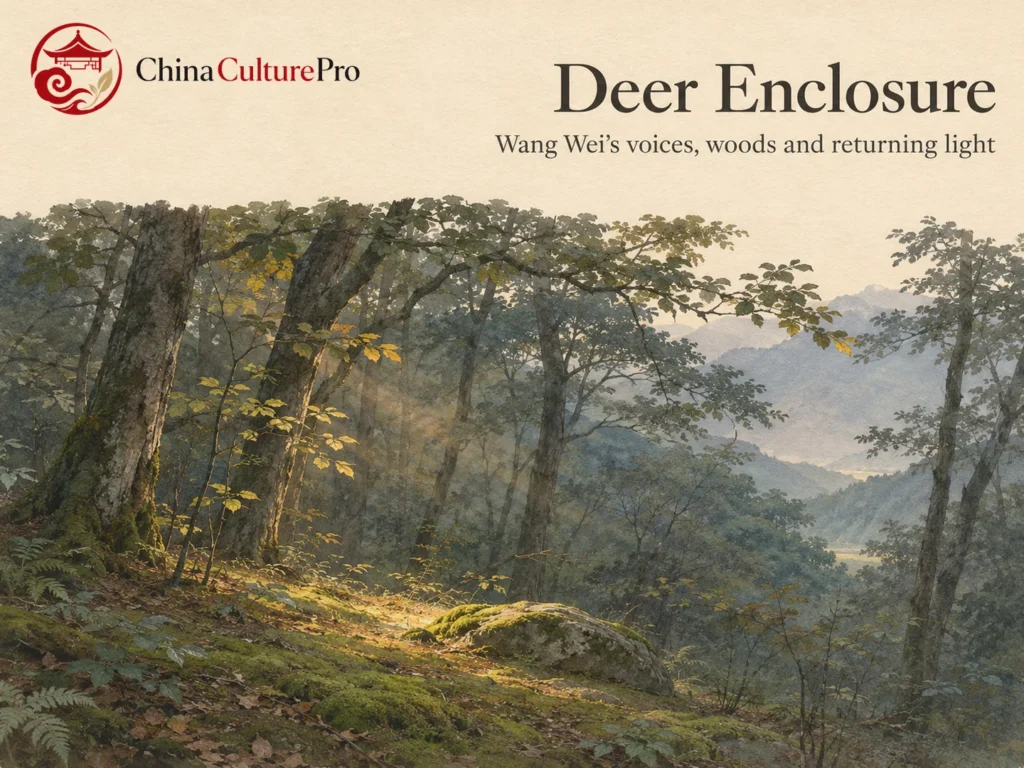

Quick Answer: What Is Deer Enclosure About?
Deer Enclosure (鹿柴, Lù Zhài) by Wang Wei (王维, Wáng Wéi) makes a secluded landscape perceptible through sound and light. No person is seen, human voices are heard, and sunlight enters the deep woods to illuminate green moss.
- Read four short lines: The complete poem contains twenty Chinese characters.
- Keep the human voices: An empty-looking mountain is not necessarily uninhabited.
- Notice the final surface: The poem ends with light on moss, not with an explanation of its meaning.
The title names a place. It does not require a visible deer or a scene of captive animals in the poem.

The first line seems to remove people from the view. The second changes what that absence means. This small adjustment prepares the reader for another change of attention, from the depths of the woods to a patch of illuminated moss.
Read the Complete Poem and Understand the Title
The poem belongs to the Wangchuan (辋川, Wǎng Chuān) collection. Its preface describes a series of places at the poet’s country estate and a poetic exchange with Pei Di (裴迪, Péi Dí). Seclusion within one poem therefore need not mean the entire literary setting was without company. [1]
The title is pronounced Lu Zhai, with the second character read zhài, not the usual firewood reading chái. Its sense is an enclosure or fence. [2]
The expression returning light (返景, Fǎn Yǐng) concerns reflected sunlight. “Returning sunlight” below keeps the movement of the Chinese without turning it into a technical account of the sun’s angle. [3]
| Chinese text | Original English rendering |
|---|---|
| 空山不见人, | On the empty mountain, no person is seen. [1] |
| 但闻人语响。 | Only human voices resound. [1] |
| 返景入深林, | Returning sunlight enters the deep woods. [1] |
| 复照青苔上。 | Again it shines upon the green moss. [1] |
The English leaves the observer unstated. The Chinese does not need an explicit “I” to organize these acts of seeing and hearing. It also does not say “I think” or cast doubt on whether the voices are real.
See the Wang Wei guide for the broader range of his writing.
Hear Human Presence without Seeing a Person
“Empty” describes the mountain as experienced in the scene. The following line immediately prevents a simple equation between an empty view and the absence of human beings. People can be heard without entering the visible field. [1]
The voices are not given names, words or an origin story. The poem does not identify a companion, announce a visitor’s arrival or explain who is speaking. Adding such details would change its balance of presence and uncertainty.
Sound also helps the surroundings feel spacious. The human presence reaches the observer indirectly, while the people remain out of sight. Quiet here can contain a sound that draws attention to the space around it.
This is different from requiring absolute silence. It is also different from making the voices supernatural merely because their speakers cannot be seen. The human sound is enough to complicate the opening view.
Compare Birdsong Stream, where intermittent sound similarly matters to the experience of a quiet landscape.
Watch the Light Reach the Green Moss
The second pair returns to sight, but it does not reveal the speakers. Instead, light enters the woods and reaches moss. The poem ends by attending more closely to the landscape rather than resolving the human presence. [1]
“Deep woods” gives the illumination a setting in which it can stand out. The final green surface is small beside the opening mountain. That change in scale directs attention without needing a dramatic event.
The word “again” makes the light feel renewed or returning. It does not provide an exact schedule. Nothing in the four lines requires a reader to calculate a date, clock time or measured duration for the illuminated patch.
A meditative reading can grow from this attention. It need not replace the voices with symbols or assign the moss one compulsory philosophical meaning. Staying with what is seen and heard preserves the poem’s openness.
For another compact scene from the estate collection, read Bamboo Lodge. The Chinese nature poetry guide offers further ways to compare landscape and human perception.
FAQs About Deer Enclosure
Is the second character in the title read chai?
In this title it is read zhài, giving Lu Zhai. The enclosure or fence sense is relevant here.
Are there deer in Wang Wei’s four lines?
No deer appears in the verse. The place name supplies the title, while the lines describe an unseen human presence, woods, light and moss.
Does an empty mountain mean that no humans are nearby?
Not here. The next line says human voices are heard, even though no person is visible.
Sources
[1] Wang Wei, via Wikisource. Wang Youcheng’s Collected Works, Volume 13: Deer Enclosure and Wangchuan Preface
[2] Taiwan Ministry of Education. Revised Mandarin Chinese Dictionary: Lu Zhai
[3] Taiwan Ministry of Education. Revised Mandarin Chinese Dictionary: Fan Ying